
Four-banded longhorn beetle
Leptura quadrifasciata
Description
How to identify
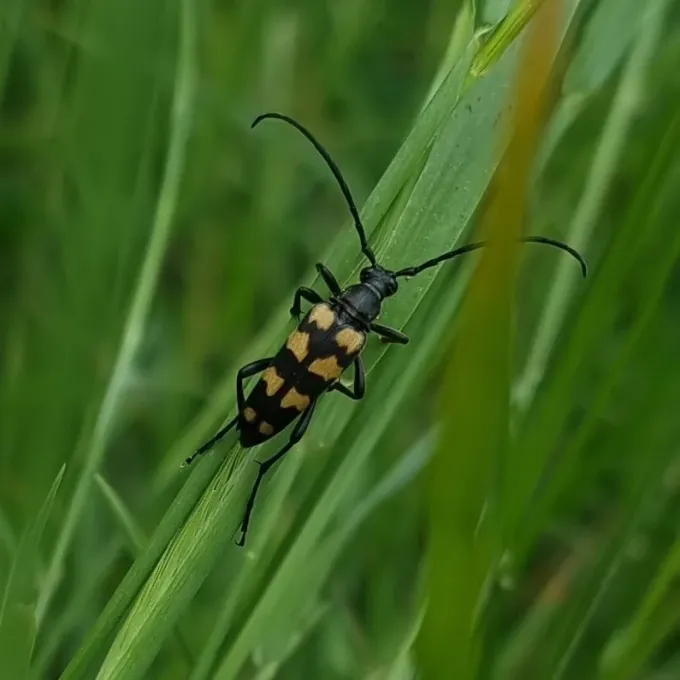
The Four-banded longhorn beetle (Leptura quadrifasciata) is a member of the Cerambycidae family, commonly found in deciduous forests across Europe and Asia.
Adult beetles are easily recognized by their slender body, which typically measures between 11 and 20 millimeters in length.
The elytra, or wing covers, display a distinct pattern consisting of four dark transverse bands against a vibrant yellow background.
The head, pronotum, and antennae are dark black, providing a sharp contrast to the patterned elytra, while the entire body is covered in fine pubescence.
The larvae are typically wood-boring, legless, and white with robust mandibles capable of chewing through solid wood tissue.
What it damages
This beetle primarily affects broad-leaved trees such as birch, alder, linden, willow, and occasionally orchard trees that are already in a state of decay.
As a secondary pest, it targets trees that are stressed, injured, or weakened by environmental factors, drought, or prior fungal infections.
Larvae create extensive, winding galleries within the timber, which compromises the structural integrity of the tree trunk.
These galleries often facilitate the entry of wood-decay fungi, accelerating the decomposition process and the formation of rot.
In cases of heavy infestation, the tree's health declines rapidly, significantly increasing the risk of windthrow and wood failure.
When it appears
The adult flight period typically occurs during the warmer summer months, spanning from June through August.
During this period, adults are frequently spotted on flowers, particularly those of the Apiaceae family, where they feed on pollen and nectar.
After mating, females lay eggs in bark crevices or wounds of suitable host trees, ensuring larvae have immediate access to nutrients.
Development from the egg stage to the adult beetle usually takes between one and two years, depending on the environmental temperature and wood moisture.
Pupation takes place within the tree, often inside a prepared chamber, before the mature beetle chews its way to the exterior.
Signs of infestation
The most visible sign of infestation is the presence of perfectly round or oval exit holes on the surface of the bark, created when the adult beetle emerges.
Frass, which consists of fine wood particles and waste, is often observed at the base of the tree or tucked into bark furrows.
Canopy thinning, yellowing foliage, and the dieback of upper branches are common indicators that the internal structure of the tree has been damaged.
If the bark is carefully peeled away from a suspected area, the characteristic larval tunnels packed with wood debris become evident.
Monitoring the flight activity of adults on nearby flora during the summer helps determine the presence and population density of this pest.
Control measures
The most effective management strategy involves rigorous sanitation, including the removal and destruction of fallen, dead, or highly stressed trees.
Promptly disposing of wood debris prevents the spread of the beetle to healthy surrounding trees and minimizes the success of egg-laying females.
Maintaining high forest and orchard health through adequate water, nutrient supply, and site management is essential to prevent successful colonization.
In managed forestry settings, trap trees can be utilized to attract adults; these are then removed and destroyed before the new brood emerges.
- Conduct regular sanitary thinning of infected stands.
- Ensure rapid disposal of logging residues.
- Foster tree vigor through proper horticultural practices.
Taxonomy
- Latin name
- Leptura quadrifasciata
- Order
- Coleoptera (beetles)
- Family
- Cerambycidae
- EPPO code
- LPTUQU
Discussion
No discussions yet — be the first.