
Redear sunfish
Lepomis microlophus
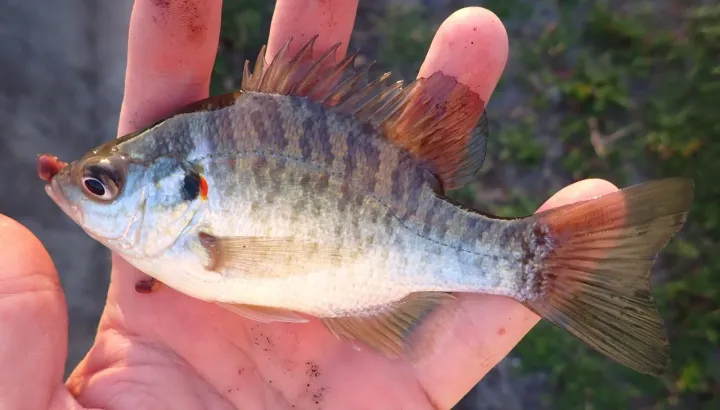
Description
How to identify
The Redear sunfish (Lepomis microlophus) is an invasive freshwater fish species belonging to the Centrarchidae family. It is recognized by its deep, laterally compressed body and a distinct red or orange margin on the opercular flap, commonly referred to as the ear.
Adult specimens typically reach lengths of 20 to 30 centimeters. They possess thick, heavy scales that offer resilience against environmental stressors, allowing them to thrive in various types of still or slow-moving water bodies.
The species displays high behavioral adaptability. Males are generally more colorful than females, especially during the reproductive phase when they exhibit intense hues to attract mates and defend their nesting territories.
Reproduction involves nesting in shallow areas, where the male creates a depression in the substrate and guards the eggs. High fecundity allows for rapid colonization of new habitats, which is a major concern for ecological conservation.
As an invasive species, the Redear sunfish often outperforms native fish in resource competition. Its ability to colonize varied environments makes it a significant threat to local biodiversity and managed water systems.
What it damages
The primary damage caused by Redear sunfish in aquaculture is the severe competition for food resources. They feed extensively on snails, insect larvae, and zooplankton, essential components for the growth of high-value commercial fish species.
The species is known to prey on the eggs and fry of other fish, including game species. This predatory behavior leads to significant reductions in survival rates and yields within controlled pond environments.
By consuming resources without providing economic value, the Redear sunfish acts as a major drain on farm profitability. Farmers often see a decline in the average weight and health of the target stock when this invasive species is present.
Redear sunfish can introduce and spread parasites throughout a pond system. Due to their high density, they serve as reservoirs for diseases, which can compromise the overall health of the entire stock of farmed fish.
Furthermore, their constant grazing on aquatic vegetation damages the natural water filtration system of ponds. This leads to increased sedimentation and degraded water quality, requiring higher management costs to maintain healthy conditions.
When it appears
Redear sunfish exhibit peak activity during the warmer months, typically when water temperatures consistently stay above 15 degrees Celsius. In these conditions, their metabolism and feeding rates are at their maximum.
The spawning season, occurring from late spring through mid-summer, is when their territorial behavior is most pronounced. During this time, they gather in dense groups in shallow waters, making them more visible and accessible for management.
As autumn approaches and temperatures drop, their activity levels decrease. They move to deeper parts of the pond to conserve energy and wait out the colder winter months, though they remain active in milder climates.
The seasonality of their lifecycle allows managers to schedule removal operations during vulnerable periods. Targeting them during the nesting season is considered the most effective way to disrupt their population growth.
Consistent environmental monitoring throughout the seasons is essential for detecting early signs of an infestation. Quick action during the early reproductive phase is crucial to preventing a major population explosion.
Control measures
Biological control through the introduction of apex predators like Northern pike or largemouth bass is a common strategy. These predators effectively predate on the juvenile sunfish, keeping the population in check.
Mechanical removal using fine-mesh seine nets is a reliable method for reducing adult populations. This process should be repeated systematically to ensure that fish are removed before they reach sexual maturity.
Draining and drying ponds during winter is the most radical but effective approach to eradicating an established population. This eliminates the nesting sites and kills off any fish remaining in the basin.
Using selective trapping devices placed in known spawning areas can help target large numbers of adults. This method is relatively low-cost and allows for the targeted removal of the pest without damaging the main commercial stock.
- Implement regular water quality and biological surveys.
- Install filters or mesh screens on water intake pipes.
- Manage and reduce excessive aquatic vegetation in ponds.
- Enforce strict quarantine protocols for any new fish stock.
Taxonomy
- Latin name
- Lepomis microlophus
- Family
- Centrarchidae
- EPPO code
- LEPMMI
Discussion
No discussions yet — be the first.