
Deathstalker
Leiurus quinquestriatus
Description
How to identify
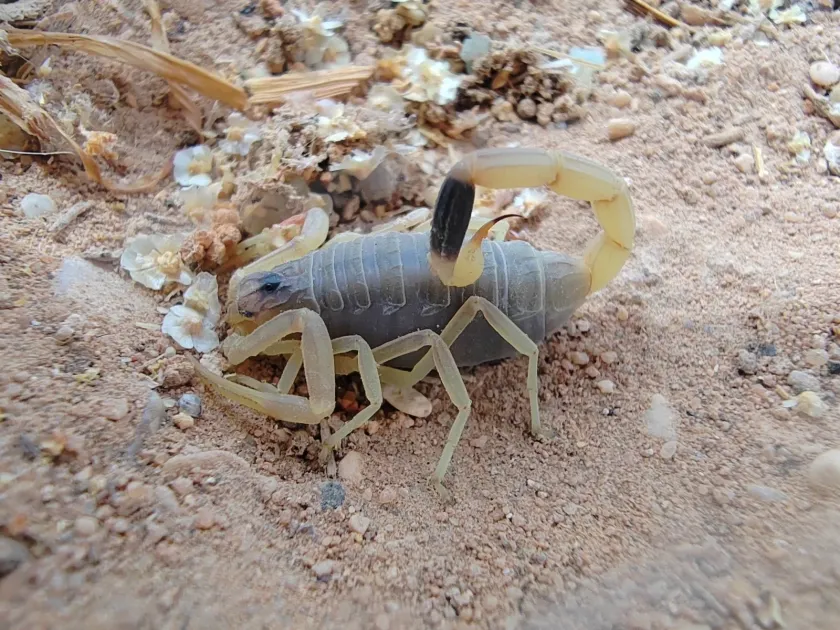
The Deathstalker (Leiurus quinquestriatus) is a species in the Buthidae family. Adults typically measure 8–10 cm and exhibit a distinct yellow to light tan coloration.
It is easily recognized by its slender chelae (pincers) and a thick metasoma containing a highly potent neurotoxic venom, making it one of the world's most dangerous scorpions.
These scorpions are nocturnal hunters, spending their daylight hours hiding in deep rock crevices or burrows in arid environments.
Proper identification is vital for agricultural personnel working in endemic regions to avoid high-risk interactions.
Their anatomy is finely tuned for survival in extreme heat, allowing them to remain active in challenging semi-desert climates.
What it damages
The Deathstalker does not feed on crops and does not cause physical damage to plants, meaning it is not a direct threat to agricultural yields.
The damage it causes is strictly related to human safety, as its presence poses a severe risk to farm workers during harvest and irrigation tasks.
Scorpions can be attracted to fields by the presence of insects, which are their primary food source, often bringing them into contact with laborers.
Work stoppages can occur if high densities of these scorpions are found in harvest areas, negatively impacting agricultural productivity.
The danger of envenomation forces operations to prioritize safety measures, increasing the complexity and cost of field management.
When it appears
Activity is most pronounced during the warm season when ambient temperatures support optimal biological functions for the species.
In arid climates, activity peaks during the summer months and is primarily concentrated during the twilight and nighttime hours.
Springtime can see an increase in surface activity, coinciding with the beginning of the agricultural season and soil cultivation.
During colder months, these scorpions retreat into deep underground burrows to survive, remaining dormant until temperatures rise again.
Monitoring for signs of activity is most successful during the early morning hours, just before the heat forces them into hiding.
Signs of infestation
Visual identification of burrows and small openings in the soil, particularly near rocky debris or irrigation infrastructure, is a primary indicator.
Shed skins (exuviae) found near field edges or equipment storage areas indicate a localized population.
Scorpion tracks on loose sand or dusty paths at the edge of cultivated plots provide clear evidence of movement.
The presence of large insect populations in the area often correlates with the presence of these predatory scorpions.
Actual sightings of the yellow-colored arachnids are the most definitive sign of infestation within a particular sector.
Control measures
Control efforts focus on habitat modification rather than chemical eradication, which is largely ineffective against this species.
The most effective strategy is to remove potential harborage sites, including piles of debris, stones, and excess vegetation around farm infrastructure.
- Implementing strict Personal Protective Equipment (PPE) standards, including heavy-duty boots and gloves.
- Maintaining well-lit work areas if operations must be conducted at night.
- Applying integrated pest management to reduce the population of insects that serve as the scorpion's food source.
Staff should be regularly trained on venomous sting protocols and the location of the nearest medical facility equipped with appropriate antivenom.
Exclusion techniques, such as sealing gaps in storage facilities, can effectively reduce the risk of accidental exposure to personnel.
Taxonomy
- Latin name
- Leiurus quinquestriatus
- Family
- Buthidae
- EPPO code
- LEIUQU
Discussion
No discussions yet — be the first.