
Lawana imitata
Lawana imitata
Description
How to identify
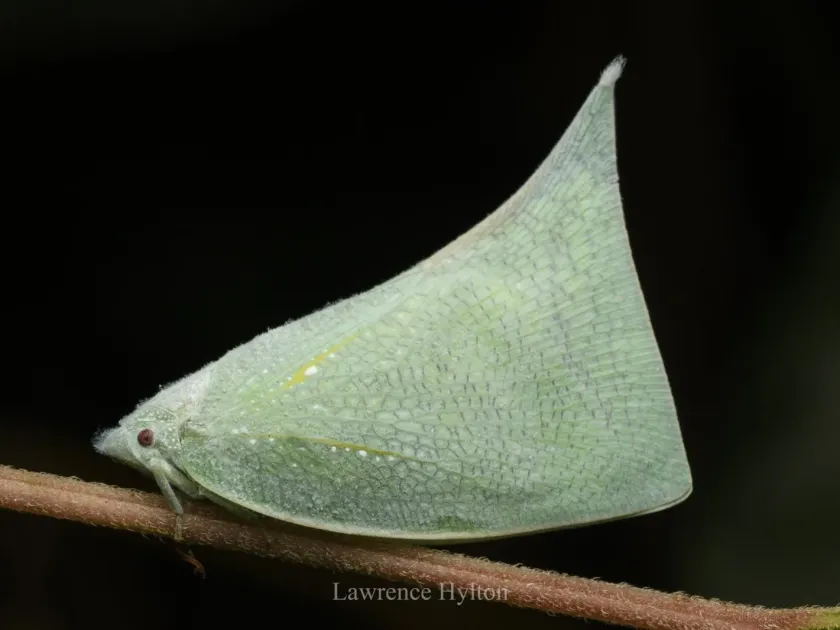
Lawana imitata is a member of the order Hemiptera, belonging to the family Flatidae. Adults appear as small, moth-like insects with broad, flattened wings that fold tent-like over their bodies when resting.
Their coloration is generally pale, ranging from white to grayish, which serves as effective camouflage on leaves and stems. Their bodies are often covered in a protective waxy secretion, characteristic of this insect family.
Nymphs are distinct from adults, often covered in long, white, filamentous waxy threads that make them look like small, fluffy clumps. This camouflage helps protect them from predators during their early development stages.
The insect undergoes a process of incomplete metamorphosis. Nymphs pass through several developmental stages, growing progressively larger while maintaining the same body structure and feeding behavior as the adults.
A key identifying feature of both nymphs and adults is their agility. They are highly responsive to movement and can leap or fly away quickly when approached, making them difficult to catch or observe closely.
What it damages
The pest attacks a wide range of ornamental, fruit-bearing, and agricultural crops. It shows a preference for plants with succulent young shoots and tender foliage, which are easier for the insect to pierce and suck sap from.
Significant damage has been observed on tropical and subtropical fruit trees, citrus plants, various ornamental shrubs, and occasionally on vegetable crops. Infestations can spread rapidly within a single plantation.
The primary damage is caused by the direct extraction of nutrients from the plant's phloem. This saps the plant's energy, resulting in stunted growth, leaf deformation, and a weakened overall physiological condition.
While feeding, these insects excrete large quantities of honeydew. This sticky substance covers the plant surfaces and provides an ideal substrate for the growth of sooty mold, a type of fungus that turns plant parts black.
The accumulation of sooty mold prevents sunlight from reaching the leaves, significantly reducing photosynthetic efficiency and leading to premature leaf drop and a severe loss in the plant's market value.
When it appears
The biological cycle of this pest is closely tied to climatic conditions. In warmer, tropical or subtropical regions, the insect can complete multiple generations in a single growing season, leading to persistent infestations.
Eggs overwinter in sheltered areas, such as bark crevices or inside plant stems. As temperatures rise in spring, nymphs emerge and immediately begin feeding on fresh vegetative growth.
The peak activity of adults usually occurs during the warm summer months. During this time, they are highly mobile, moving across crops and spreading the infestation to new, previously unaffected areas.
Population levels often peak in late summer when environmental conditions are optimal for reproduction. This is the period when agronomic impact is most severe and crop protection is critical.
As autumn approaches, activity gradually declines. Adults lay their eggs in protected environments, preparing for the next generation to restart the cycle when the conditions become favorable again.
Signs of infestation
The first sign of an infestation is the presence of white, fluffy nymphs clustered on the undersides of leaves or along tender stems. Their unique appearance makes them fairly easy to spot upon inspection.
The presence of sticky honeydew on the foliage is a major red flag. If left untreated, these sticky patches will soon become covered with black sooty mold, indicating that the insect has been present for some time.
Leaf curling, yellowing, and the deformation of growing tips are common physiological responses to the stress caused by the pest. The plants may appear wilted even when soil moisture levels are adequate.
If a plant is shaken or approached, the sudden flight of numerous insects is a clear indication of a significant population density that requires immediate intervention to prevent further damage.
Long-term infestation signs include the drying out of individual branches and overall lack of plant vigor. If a plant starts dropping leaves prematurely without obvious water stress, checking for these pests is essential.
Control measures
Effective management of this pest requires a multifaceted approach, emphasizing early detection and consistent monitoring throughout the growing season to catch infestations before they escalate.
- Mechanical removal of infested plant parts and destruction of egg-laying sites during winter pruning.
- Application of biological control agents, such as entomopathogenic fungi, which can reduce nymph populations.
- Promoting good air circulation within the canopy through proper pruning and spacing.
- Using reflective mulches or barriers to deter insects from settling on susceptible crops.
Chemical control should rely on systemic insecticides, which are particularly effective against sap-sucking insects. Neonicotinoids and pyrethroids are commonly used for managing heavy outbreaks.
It is crucial to rotate insecticide classes to minimize the risk of the pest population developing chemical resistance, ensuring the long-term effectiveness of the chosen treatment program.
Implementing cultural practices, such as removing weeds from the perimeter of the field, helps eliminate secondary host plants, thereby reducing the risk of pests migrating into your primary crop area.
Taxonomy
- Latin name
- Lawana imitata
- Order
- Hemiptera (bugs, aphids, leafhoppers)
- Family
- Flatidae
- EPPO code
- LAWAIM
Discussion
No discussions yet — be the first.