
White flatid planthopper
Lawana candida
Description
How to identify
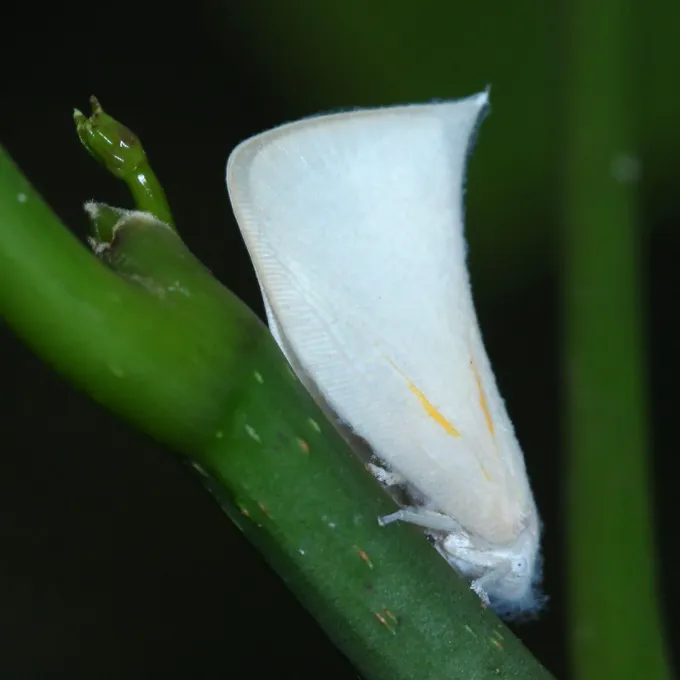
Lawana candida, commonly known as the white flatid planthopper, belongs to the family Flatidae within the order Hemiptera. These insects are easily recognized by their distinctively broad, white wings that are held roof-like over their bodies.
The adult insect typically measures between 15 and 20 mm in length. Its body and wings are covered in a fine, powdery wax secretion, which gives the insect a porcelain-white or snowy appearance.
Nymphs of Lawana candida are characterized by their soft bodies adorned with long, white, waxy filaments. These filaments often create a fluffy, cotton-like appearance that protects the young nymphs from predators.
The life cycle involves an egg stage, several nymphal instars, and the adult stage. Unlike many other insects, the nymphs grow gradually, maintaining their waxy protective coating throughout the developmental stages.
They are primarily found in tropical and subtropical regions. However, they can thrive in greenhouses and indoor plant collections where temperatures are consistently warm.
What it damages
The white flatid planthopper is a polyphagous pest, meaning it attacks a wide variety of plant species, including coffee, cacao, citrus trees, and various ornamental plants.
Damage is primarily caused by both nymphs and adults feeding on the phloem sap of young shoots and leaves. This removes essential nutrients from the plant, causing stunted growth and general weakening.
Infested plants often exhibit leaf curling, yellowing, and chlorosis. In severe cases, the depletion of nutrients can cause premature leaf drop and a significant reduction in fruit or flower production.
The excretion of honeydew is a major indirect consequence of the infestation. This sugary substance accumulates on the foliage and serves as a substrate for sooty mold fungi to grow.
The resulting sooty mold covers the leaves in a black layer, which physically blocks sunlight and severely inhibits the plant's ability to perform photosynthesis.
When it appears
In tropical environments, Lawana candida can complete multiple generations annually, with populations peaking during the rainy season or periods of active vegetative plant growth.
Females insert their eggs into slits cut into the stems or leaf stalks. These egg clutches are difficult to detect and provide the offspring with protection during the embryonic development stage.
The duration of the life cycle is highly temperature-dependent, typically ranging from one to two months. Warm, humid conditions are ideal for rapid population expansion and high survival rates.
Dispersal primarily occurs through the flight of adults, which are capable of moving between plants, and through the accidental transport of infested nursery stock across larger distances.
During cooler seasons or in temperate regions, activity significantly decreases, and the species often struggles to survive outdoors, retreating to protected microclimates.
Signs of infestation
The most prominent sign of an infestation is the presence of white, fluffy waxy filaments on the undersides of leaves and along stems. These often look like small tufts of cotton or spider web residue.
Sticky honeydew on leaf surfaces, followed by the appearance of dark sooty mold, is a classic indication that a planthopper colony has established itself on the plant.
If you disturb the branches of an infested plant, the adults will jump or fly away in large numbers, often described as a white cloud rising from the canopy.
The presence of physical scarring or small punctures on the green stems indicates where adult females have laid their eggs, which can cause localized tissue necrosis.
Stunted, deformed, or wilting new growth on previously healthy plants is a clear indicator that the sap-sucking activity is affecting the plant's vascular system.
Control measures
Managing Lawana candida requires a combination of monitoring, cultural practices, and, when necessary, targeted chemical interventions using systemic insecticides.
Manual control, including pruning and destroying infested plant parts, is effective for small-scale infestations in gardens or greenhouses, provided it is done early.
Biological control, utilizing natural predators like parasitic wasps or ladybird beetles, can help regulate population numbers in more balanced ecosystems.
Monitoring using yellow sticky traps is a highly effective way to detect the early arrival of adult planthoppers and to estimate the need for further intervention.
- Apply systemic insecticides to disrupt the feeding cycle.
- Prune and dispose of infested branches to remove egg deposits.
- Wash leaves with insecticidal soap to remove honeydew and sooty mold.
- Maintain proper plant spacing to improve airflow and reduce humidity.
Taxonomy
- Latin name
- Lawana candida
- Order
- Hemiptera (bugs, aphids, leafhoppers)
- Family
- Flatidae
- EPPO code
- LAWACA
Discussion
No discussions yet — be the first.