
Laurel sucker
Lauritrioza alacris
Description
How to identify
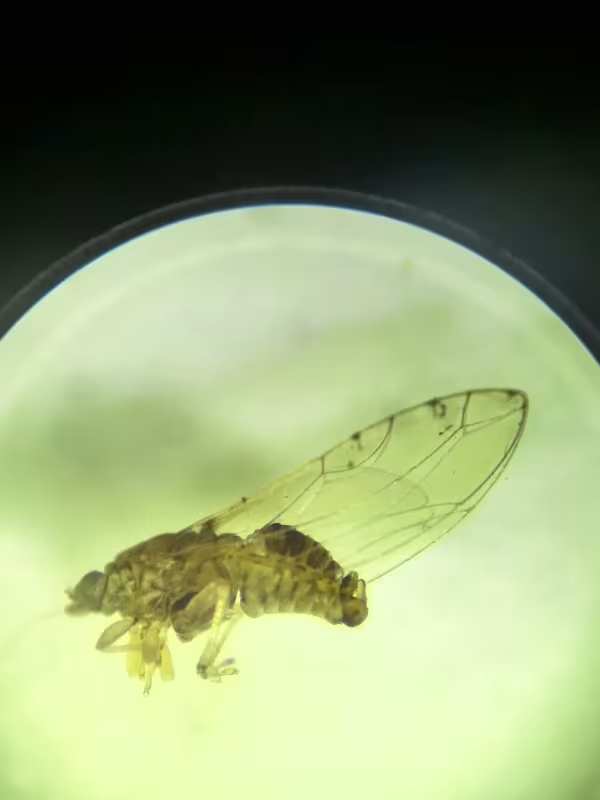
The laurel sucker (Lauritrioza alacris) is a small jumping plant louse belonging to the Triozidae family. These insects are highly specialized, feeding almost exclusively on plants within the Lauraceae family.
Adults are approximately 2–3 mm long and possess clear wings, allowing them to jump or fly quickly when disturbed. Their life cycle is synchronized with the flush of new growth on the host plant.
Female laurel suckers lay their eggs on the margins of young, succulent leaves. Once hatched, the nymphs begin feeding immediately, which is the start of the typical leaf deformation process.
There are multiple nymphal stages, during which the insects remain relatively stationary, often secreting wax-like substances that provide them with some protection from environmental factors.
The overwintering stage typically occurs as adults, which shelter in bark crevices or among debris under the canopy of the host tree until the return of warmer spring temperatures.
What it damages
The primary host of this pest is the bay laurel (Laurus nobilis). The damage is caused by the nymphs feeding on the plant sap, specifically on the underside of developing leaves.
As the insects feed, they introduce substances that cause the leaf margins to curl upwards and inwards, creating protective structures known as galls where the colony continues to thrive.
This feeding behavior severely impacts the tree's health, causing stunted growth, loss of vigor, and a significant reduction in the quantity and quality of the foliage.
Heavy infestations can cover the entire new flush of leaves, leading to large portions of the plant becoming unsightly and eventually causing the premature senescence of the curled leaves.
The presence of honeydew secreted by the nymphs often leads to the growth of sooty mold, which blocks light and impairs photosynthesis, further stressing the already weakened plant.
Signs of infestation
The most diagnostic sign of a laurel sucker infestation is the tight inward curling of leaf edges on new shoots, which protects the nymphs inside the folds.
If you unroll a curled leaf, you will find small, flat, often yellowish or greenish nymphs, along with cast skins and sticky honeydew residue on the leaf surface.
Affected leaves may initially appear pale or yellow-spotted, and as the infestation progresses, they eventually turn brown, dry out, and drop prematurely from the stems.
The overall appearance of the plant becomes distorted, with stunted, twisted terminal shoots that are easily recognizable compared to the healthy, flat leaves of uninfested bay trees.
Secondary symptoms may include the presence of black sooty mold covering the leaves or stems, which is a clear indicator that sucking insects have been present for some time.
Control measures
Effective management begins with vigilance. Inspecting the tips of laurel bushes in early spring is crucial for detecting the first signs of leaf curling before the colony expands.
Small-scale infestations can be managed by manually removing and destroying the infested leaves as soon as they are spotted to prevent the nymphs from reaching maturity.
For more severe cases, systemic insecticides are the most effective solution because they are absorbed into the plant's tissues and kill the nymphs as they feed within the curled leaves.
- Application of systemic insecticides (e.g., those containing acetamiprid or imidacloprid).
- Encouraging natural predators such as ladybirds, lacewings, and hoverfly larvae.
- Avoiding excessive nitrogen fertilization, which encourages an abundance of soft, attractive growth.
Ensuring the plant is well-watered and healthy helps it withstand the stress caused by the pest, and regular monitoring remains the most sustainable way to keep populations low.
Taxonomy
- Latin name
- Lauritrioza alacris
- Order
- Hemiptera (bugs, aphids, leafhoppers)
- Family
- Triozidae
- EPPO code
- TRIZAL
Discussion
No discussions yet — be the first.