
Laurel psyllid
Lauritrioza
Description
How to identify
The laurel psyllid, scientifically classified as Lauritrioza alacris, belongs to the family Triozidae. It is a small sap-sucking insect primarily known for infesting bay laurel (Laurus nobilis) plants.
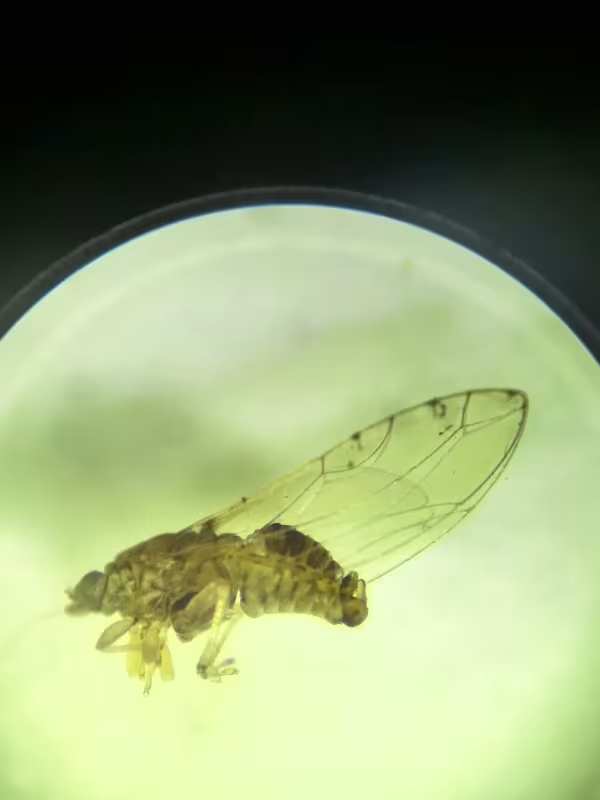
Adult psyllids are typically about 3 mm long and possess transparent wings. They have strong hind legs that allow them to jump quickly when disturbed, which is a distinctive behavioral trait of this species.
The immature stages, or nymphs, are flattened and often stationary. They are frequently covered in waxy secretions that act as a natural defense against environmental factors and chemical applications.
The insect thrives in temperate environments where bay laurel is cultivated. Depending on the local climate and greenhouse conditions, multiple generations can occur annually, leading to persistent infestations.
The life cycle is closely synchronized with the growth of the host plant, as the insects rely on the availability of tender, newly emerged leaves for successful egg-laying and larval development.
What it damages
The primary damage is caused by both adults and nymphs feeding on the plant's sap. By inserting their stylets into the leaves, they extract nutrients, which weakens the plant's overall metabolic structure.
Nymphal feeding induces a physiological response in the leaf tissue, causing the leaves to curl, thicken, and deform. This prevents the leaf from fully expanding and interferes with the plant's photosynthesis.
The curled leaves provide a protective shelter for the developing nymphs, making them harder to reach with conventional spray treatments. This creates a challenging cycle that necessitates specific control timing.
The honeydew excreted by the insects promotes the growth of sooty mold, a dark fungal layer that covers the foliage, further inhibiting gas exchange and reducing the aesthetic value of the plant.
Severe infestations can cause premature leaf senescence and drop, which reduces the vigor of the tree and can lead to significant branch dieback in young or stressed specimens.
Signs of infestation
The most prominent sign is the conspicuous curling or rolling of the leaf margins. This deformation is often accompanied by yellowing or chlorosis of the tissue where the insects have been feeding.
On the undersides of the curled leaves, you can often find colonies of nymphs embedded within the folds. These are frequently accompanied by sticky honeydew and white, cottony wax filaments.
The presence of sooty mold is a secondary but reliable indicator of an established psyllid population. If the plant looks dirty or sticky, a thorough inspection of the new growth is essential.
During spring and summer, a sudden swarm of tiny, winged insects taking flight when a branch is brushed is a clear sign that the psyllid population is currently active and reproducing.
Stunted growth of new shoots is another indicator. If the terminal buds look deformed and fail to develop into healthy, glossy leaves, the laurel psyllid is likely the primary cause.
Control measures
Systemic insecticides are generally the most effective control method. These products are absorbed by the plant and kill the psyllids as they feed on the sap, offering better coverage than contact sprays.
Timing is critical when applying treatments. Applications should be timed to coincide with the emergence of new growth, before the leaves have fully curled and protected the nymphs inside.
For smaller plants or minor infestations, pruning and destroying the affected curled leaves can significantly reduce the pest population and prevent the spread to healthy parts of the plant.
Integrated pest management strategies often include fostering natural predators, such as lady beetles or lacewing larvae, which can help keep psyllid populations at manageable levels in gardens.
- Monitor young growth regularly for signs of curling.
- Apply systemic insecticides during early spring.
- Prune out heavily infested shoots and discard them.
- Maintain plant health with balanced irrigation and nutrients.
- Quarantine new plants before introducing them to the garden.
Taxonomy
- Latin name
- Lauritrioza
- Order
- Hemiptera (bugs, aphids, leafhoppers)
- Family
- Triozidae
- EPPO code
- LTRISP
Discussion
No discussions yet — be the first.