
Furrow spider
Larinioides cornutus
Description
How to identify
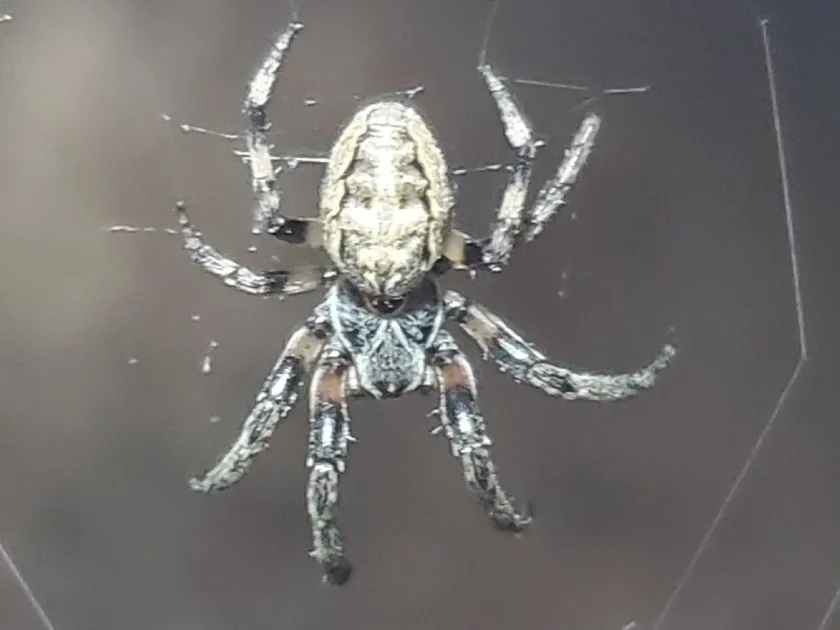
The furrow spider (Larinioides cornutus) is a common orb-weaver spider belonging to the family Araneidae. It is easily recognized by its flattened abdomen with a distinct spruce-tree pattern and a dark-colored patch on the anterior side.
Adult females typically range from 10 to 14 mm in size, while males are slightly smaller. The body is covered in fine hairs, and the coloration ranges from pale brown to dark brown, providing excellent camouflage on stems and bark.
The name "horned" (cornutus) refers to the small protuberances located on the carapace, which are a key identification feature for this species when examined closely.
They are primarily nocturnal animals, building large, symmetrical orb webs. During the day, they prefer to hide in folded leaves or crevices, attached to their webs by a signal thread.
This species is found in various habitats, particularly in moist areas, near bodies of water, and frequently within agricultural landscapes where prey availability is high.
What it damages
In strictly agronomic terms, the furrow spider is not a primary pest of crops, as it does not feed on plant tissues or sap. It is a predatory insect that consumes various small flying pests.
The "damage" caused is mostly mechanical; heavy spider webs can occasionally deform tender young leaves or shoots if the silk is anchored too tightly to the growing plant parts.
In greenhouses or nursery settings, excessive web accumulation can hinder routine management tasks, such as monitoring, pruning, or the harvesting of delicate ornamental plants.
However, from an integrated pest management (IPM) perspective, these spiders provide significant ecosystem services by predating on aphids, flies, and other small pest insects.
Therefore, their presence is usually considered beneficial or benign, and they rarely require any form of population control in field or garden environments.
When it appears
The life cycle of the furrow spider is heavily dictated by seasonal temperature changes, with the active phase beginning in late spring when temperatures stabilize above 10 degrees Celsius.
Population density typically reaches its maximum during mid-summer, coinciding with the peak abundance of insect prey, which facilitates rapid growth and development of the spiders.
As autumn approaches, the spiders prepare for winter. Females lay eggs in thick, protective silk cocoons that are placed in sheltered areas, such as bark crevices or dry plant stems.
Nymphs hatch the following spring and undergo several molting stages, gradually reaching reproductive maturity over the course of the growing season.
Environmental factors, specifically humidity levels, play a crucial role in the survival rate of the overwintering generation and the subsequent spring population levels.
Signs of infestation
The most prominent sign of a furrow spider's presence is the characteristic circular, symmetrical orb web suspended between plants, stakes, or trellis wires.
If you inspect the plant near the web, you will almost always find a retreat consisting of a rolled leaf, which the spider uses as a shelter from direct sunlight and predators.
Slight leaf tissue necrosis or minor twisting can occur at the anchor points where the spider silk is attached, especially on very young, succulent vegetation.
Presence of small, dried insect carcases wrapped in silk and left in the web periphery confirms that the spider is actively using the site for hunting.
Small, white fecal spots on leaves underneath the retreat site serve as a reliable sign of a long-term habitation by the spider.
Control measures
Chemical control is generally discouraged because furrow spiders serve as natural biocontrol agents. Broad-spectrum insecticides will eliminate these beneficial predators and potentially cause pest outbreaks.
If web accumulation is excessive for aesthetic or operational reasons, simple cultural methods such as pruning overgrown foliage and improving ventilation in greenhouses are very effective.
Manual removal of webs using a brush or a light water spray is the safest way to maintain cleanliness without harming the spider or other beneficial insects.
Managing weed growth around crop rows reduces the habitat density, which naturally limits the number of spiders in specific areas without the use of toxic chemicals.
By maintaining a balanced environment and avoiding unnecessary chemical applications, you allow the ecosystem to regulate spider populations naturally.
Taxonomy
- Latin name
- Larinioides cornutus
- Family
- Araneidae
- EPPO code
- ARAUCO
Discussion
No discussions yet — be the first.