
Northern winter moth
Larentia autumnata
Description
How to identify
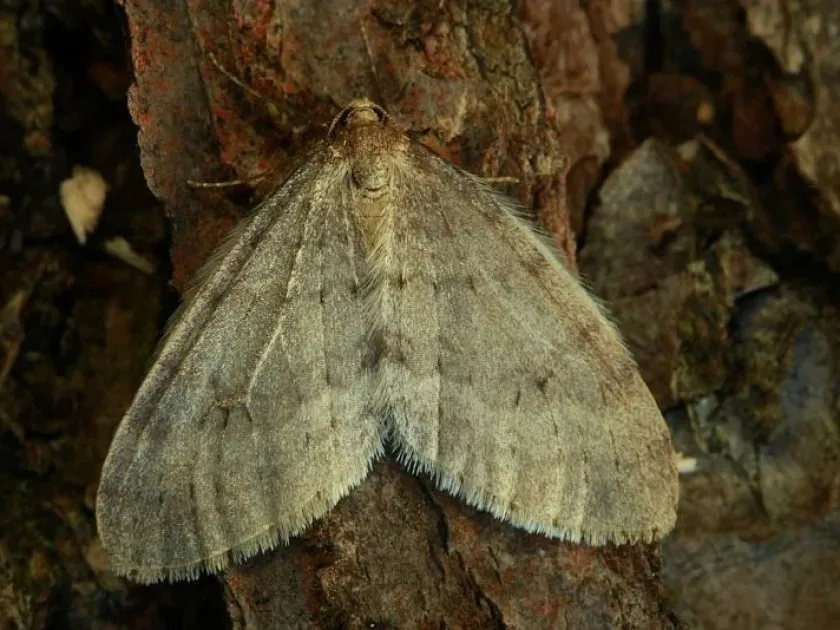
The Northern winter moth (Epirrita autumnata) is a member of the Geometridae family within the order Lepidoptera. Adult moths typically feature a wingspan of 30–40 mm with grayish or brownish wings marked by undulating lines.
The larvae, known as "loopers" or "inchworms," possess a distinct gait due to the absence of middle abdominal prolegs. Their bodies are predominantly green with thin pale stripes, providing excellent camouflage against foliage.
Pupae are dark brown and are found in the soil beneath host trees. Adult moths are primarily nocturnal and are frequently attracted to light sources, which aids in monitoring local population levels.
Sexual dimorphism is evident; while males are active flyers, females have reduced wings and are often flightless, relying on crawling up tree trunks to reach egg-laying sites.
Specialized entomological identification focuses on the larval head capsule and the arrangement of setae, which distinguishes Epirrita autumnata from other closely related species like Operophtera brumata.
What it damages
This pest is a significant polyphagous defoliator affecting various deciduous tree species. Common hosts include fruit trees such as apple and pear, alongside forest species like birch, alder, and willow.
Larval feeding can lead to severe defoliation, where entire tree canopies are skeletonized. This massive loss of leaf area critically impacts the photosynthetic capacity of the host plant.
Early-season feeding on buds and blossoms causes direct fruit loss, significantly reducing crop yields. Repeated defoliation weakens the tree's immune system, making it susceptible to secondary infections.
Young nursery stock is particularly vulnerable, as multiple years of defoliation can lead to stunted growth or mortality. The tree's inability to store sufficient reserves for winter poses a long-term risk.
In forest ecosystems, outbreaks can cover vast areas, altering the light regime of the forest floor and impacting the entire biological community that relies on the canopy cover.
When it appears
The life cycle of the Northern winter moth is finely tuned to autumn and spring phenology. Adult moths emerge late in the season, typically from September to November, for mating and oviposition.
Eggs overwinter on the bark of host trees and are highly tolerant of freezing temperatures. Hatching coincides with the budburst of host plants, ensuring immediate access to high-quality food.
The larval stage occurs during the spring months, mainly May and June. This is the period of intense growth, where larvae consume significant amounts of foliage to prepare for pupation.
In mid-summer, fully grown larvae drop to the ground and burrow into the soil to pupate. They remain in this stage until the environmental cues of autumn signal the emergence of adults.
Monitoring the timing of budburst and the onset of adult flights is essential for pest management. Precise timing of chemical or biological applications is the key to preventing extensive damage.
Signs of infestation
Initial signs of infestation appear as small, irregular holes in the opening buds. As larvae mature, these develop into larger, ragged edges on leaves, often leaving only the primary veins intact.
Silk webbing between leaves is a classic indicator of larval presence, as the caterpillars use silk to secure leaves into protective shelters against predation and wind.
Accumulation of larval frass on leaves or lower branches is a clear visual cue of an active infestation. In high-density populations, the sound of active chewing may be audible.
Observing larvae suspended on silk threads when branches are tapped is a reliable field diagnostic method. This allows orchard managers to assess the need for intervention.
In late autumn, the presence of small, flightless moths crawling on the trunks of trees is a strong warning that a high number of eggs have been laid for the following season.
Control measures
Chemical control involving insecticides should be timed to match the early larval stages. Broad-spectrum products or specific growth regulators are used when monitoring thresholds are exceeded.
Mechanical control is highly effective for Northern winter moth due to the wingless female. Sticky bands (tree guards) applied to trunks in early autumn prevent females from reaching the canopy to lay eggs.
Soil cultivation under the tree canopy in late autumn or early spring disrupts the pupal stage, significantly reducing the survival rate of the pest population within the orchard.
Biological control using Bacillus thuringiensis sprays is effective against larvae while minimizing impacts on beneficial insects and predators. This is a preferred method for integrated pest management.
Encouraging insectivorous birds, such as tits and flycatchers, by providing nesting sites can offer long-term suppression of caterpillar numbers in orchard and forest settings.
Taxonomy
- Latin name
- Larentia autumnata
- Order
- Lepidoptera (butterflies)
- Family
- Geometridae
- EPPO code
- LAREAU
Discussion
No discussions yet — be the first.