
Long-tailed blue
Lampides boeticus
Description
How to identify
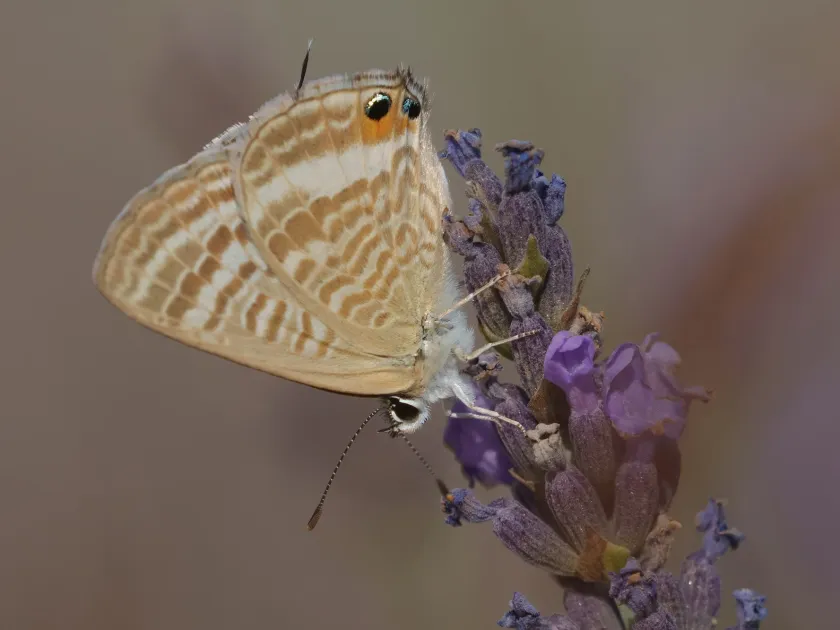
The Long-tailed blue (Lampides boeticus) is a butterfly species of the Lycaenidae family, characterized by a wingspan of 30 to 40 mm.
Males feature a vibrant violet-blue upper surface of the wings, while females have a more subdued brown coloration with blue dusting near the wing bases.
A distinctive feature is the thin, thread-like tail on each hindwing, accompanied by two prominent black eyespots rimmed with orange.
The larvae, or caterpillars, reach lengths of 12–15 mm and are typically green with a darker dorsal stripe and light diagonal lateral marks.
The pupae are brown and matte, often found concealed within plant debris or near the soil surface where they overwinter or undergo transformation.
What it damages
This species is a significant pest of various leguminous crops, frequently causing severe economic losses in warmer agricultural zones.
It prefers crops such as peas, broad beans, lentils, soybeans, lupins, and lucerne, focusing its attack on the reproductive parts of the plants.
The larvae bore into the pods, consuming the developing seeds inside, which severely degrades the quality and quantity of the harvest.
Visible damage includes hollowed-out seeds and pod deformation, often accompanied by internal accumulations of larval frass.
- Peas
- Broad beans
- Soybeans
- Lupins
- Lentils
When it appears
The life cycle of Lampides boeticus is highly temperature-dependent, as the species is a migratory butterfly known for colonizing new areas.
Adults emerge in spring or early summer to lay individual eggs on the flower buds and young developing pods of their host plants.
Embryonic development is rapid, typically lasting about a week before the larvae hatch and immediately seek entry into the host fruit.
Under optimal climate conditions, the insect can produce several overlapping generations per season, increasing the risk of sustained damage.
As a highly mobile species, its presence can be unpredictable, requiring vigilant monitoring during the flowering stages of legume crops.
Signs of infestation
The primary sign of infestation is the presence of small, clean-cut entry holes on the surface of the bean pods.
Excrement near the entry points is a clear indicator that a larva is actively feeding inside the pod and compromising the seed development.
Premature yellowing and abscission of young pods are common symptoms, as the plant reacts to the damage caused by the internal feeding larvae.
Internal examination of suspected pods will reveal partially or completely destroyed seeds, along with the presence of the larva itself.
Frequent observations of adult butterflies hovering around fields during the blossom period are indicative of an impending infestation threat.
Control measures
Effective control starts with robust cultural practices, including crop rotation and ensuring sufficient distance from other legume patches.
Deep autumn plowing of fields is an essential step to disrupt the life cycle by destroying pupae that dwell in the soil or crop residues.
Chemical intervention should be timed precisely to coincide with the period of egg hatching, before the larvae successfully enter the protection of the pods.
Integrated Pest Management (IPM) strategies emphasize monitoring populations to apply insecticides only when necessary, minimizing impact on beneficial insects.
Biological control agents, such as formulations containing Bacillus thuringiensis, offer a safer, targeted alternative for managing larval populations.
Taxonomy
- Latin name
- Lampides boeticus
- Order
- Lepidoptera (butterflies)
- Family
- Lycaenidae
- EPPO code
- LAMDBO
Discussion
No discussions yet — be the first.