
Long-tailed blue
Lampides
Description
How to identify
The long-tailed blue (Lampides boeticus) is a butterfly of the Lycaenidae family, widely recognized for its migratory behavior and impact on agriculture.
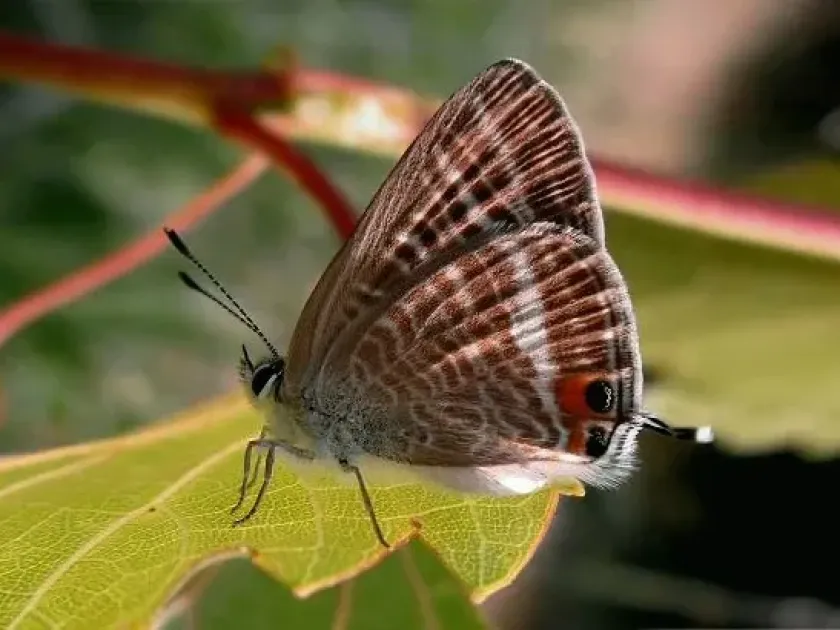
Adult butterflies have a wingspan of 30–40 mm. Males are typically violet-blue with thin white edges, while females are darker brown with blue scaling at the base of the wings.
A distinctive feature of the species is the presence of two black eyespots on the underside of the hindwings, accompanied by a small "tail," which serves as a biological defense against predators.
The larvae, or caterpillars, are pale green with a characteristic dorsal stripe and a velvety texture, perfectly camouflaged against the stems of legume plants.
The species undergoes complete metamorphosis: egg, larva, pupa, and adult, with the larval stage being the most destructive to agricultural production.
What it damages
The pest primarily targets leguminous crops, including peas (Pisum sativum), beans (Phaseolus), lentils, and soybeans (Glycine max).
Larvae feed internally on flowers, buds, and pods, causing significant damage by consuming the developing seeds within the shells.
Infestation often leads to the premature shedding of blossoms and the destruction of the fruit, directly resulting in reduced harvest yields.
Damaged pods become prone to secondary infections from fungi and bacteria due to the presence of larval frass, which compromises seed quality.
In high-density outbreaks, the larvae can destroy a large percentage of the crop, making the produce unsuitable for either human consumption or market distribution.
When it appears
The long-tailed blue is a thermophilic species that thrives in warm, sunny climates and is highly active during the summer months.
Its life cycle is temperature-dependent, usually lasting between one month and six weeks, which allows for multiple generations per season in warmer regions.
As a highly migratory butterfly, it can rapidly colonize new areas, arriving in large numbers during the peak flowering season of leguminous host plants.
The most intense damage occurs when the pest population peaks simultaneously with the reproductive phase of the crop (flowering and pod-filling).
Overwintering occurs primarily in the pupal stage, hidden within plant debris or near the soil surface, awaiting favorable temperatures in the spring.
Signs of infestation
The most visible sign of an infestation is the presence of small, circular holes in the pod walls, which are entry points for the larvae.
Wilted or fallen flower buds are early warning signs that larvae have bored into the reproductive structures of the plant.
Small mounds of larval excrement (frass) may be found clinging to the surface of the pods or on the leaves directly beneath the affected area.
Upon opening a damaged pod, one can observe the partially eaten seeds and the caterpillar itself, which is often found tucked inside the shell.
- Distorted and misshapen pods.
- Premature yellowing of the pods.
- Silk webbing present on flower clusters.
Control measures
Cultural practices, such as crop rotation and the destruction of leguminous weeds in and around the field, are critical to reducing pest pressure.
Deep plowing after harvest helps destroy pupae and overwintering larvae, limiting the initial population density for the next growing season.
Chemical control must be timed precisely during the adult flight period or egg-laying phase, as larvae become protected once they burrow inside the pods.
Monitoring using pheromone traps is highly recommended to detect the arrival of the pest and to time insecticide applications efficiently.
Integrated Pest Management (IPM) strategies, including the use of selective insecticides that do not harm beneficial pollinators, are preferred for sustainable control.
Taxonomy
- Latin name
- Lampides
- Order
- Lepidoptera (butterflies)
- Family
- Lycaenidae
- EPPO code
- LAMDSP
Discussion
No discussions yet — be the first.