
Kob
Kobus kob
Description
How to identify
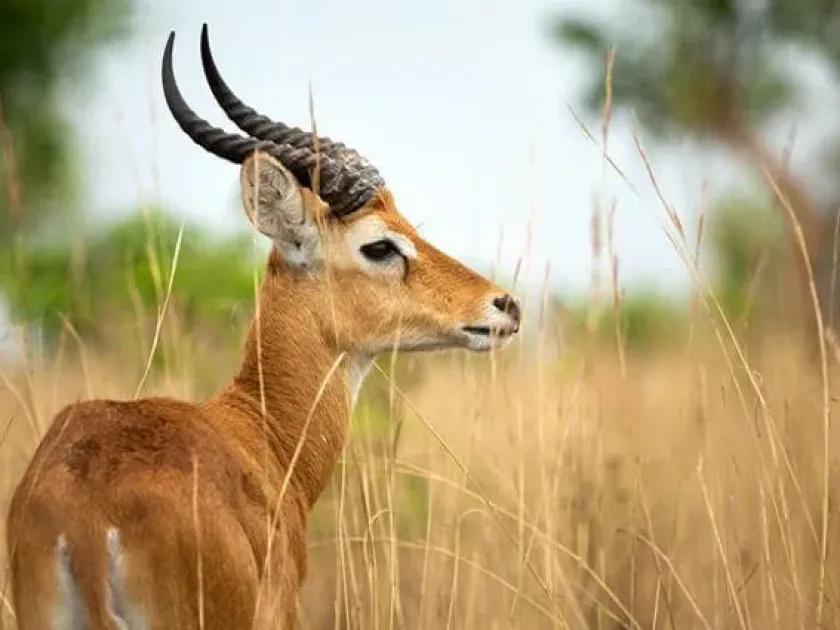
The Kob (Kobus kob) is a medium-sized antelope belonging to the Bovidae family and the Artiodactyla order. These animals are native to sub-Saharan Africa.
Physically, they possess a golden-brown coat, white eye rings, and a distinct throat patch. Males are characterized by their ringed, lyre-shaped horns and more robust muscular structure.
Kobs live in social groups known as herds. Their biology is strictly tied to permanent water sources, which often brings them into proximity with agricultural landscapes.
They are highly adaptive grazers, preferring open grasslands. When these grasslands are converted into farm fields, Kobs often treat them as prime feeding grounds.
A mature male can weigh up to 90 kg. Their social nature means that when they enter a field, they do so in groups, which amplifies the potential for rapid crop destruction.
What it damages
Kobs primarily feed on grasses and young shoots. In agricultural settings, they target cereal crops, including maize, millet, and rice, especially during the early growth stages.
The feeding activity involves stripping leaves and biting off the tender growing points of plants, which significantly retards development and reduces the final yield.
Physical trampling is a major secondary damage factor. As herds move through fields, they break stems and crush root systems, leading to localized plant death.
Their browsing behavior is most damaging during the dry season when vegetation in the wild becomes scarce, driving the animals into irrigated or fertilized farmlands.
- Maize (Corn) plantations.
- Rice paddies in early vegetative stages.
- Young millet and sorghum crops.
Signs of infestation
The most reliable sign of Kob presence is the discovery of hoof prints in the soil, which are distinct from those of domestic cattle due to their shape and size.
Look for ragged, torn leaf edges on crops. Unlike insect damage, these marks indicate biting by a large herbivore with a specific dental structure.
Large patches of flattened or crushed vegetation within the field indicate pathways used by the herd while moving through the crop canopy.
The presence of animal droppings in and around the field perimeter is a definitive indicator of regular visits by a herd.
Increased stress behavior in local wildlife or livestock, as well as distinct vocalizations heard at dawn or dusk, often signal the presence of a Kob group nearby.
Control measures
Physical fencing is the primary method of crop protection. High-tensile wire or mesh fences are effective at keeping Kobs out of high-value plantation areas.
Electric fencing systems, commonly known as electric shepherds, are highly effective in deterring antelopes without causing lethal harm to the animals.
Acoustic and visual deterrents, including flashlights and noise-making devices, can be used to disrupt the grazing patterns of the herd at night.
Strategic planting, such as creating buffer strips of unpalatable plants, can help minimize the attractiveness of the field perimeter to foraging herds.
Engagement with local wildlife authorities is recommended for long-term solutions, as they can provide guidance on humane deterrents and population management.
Taxonomy
- Latin name
- Kobus kob
- Family
- Bovidae
- EPPO code
- KOBUKO
Discussion
No discussions yet — be the first.