
Waterbuck
Kobus ellipsiprymnus
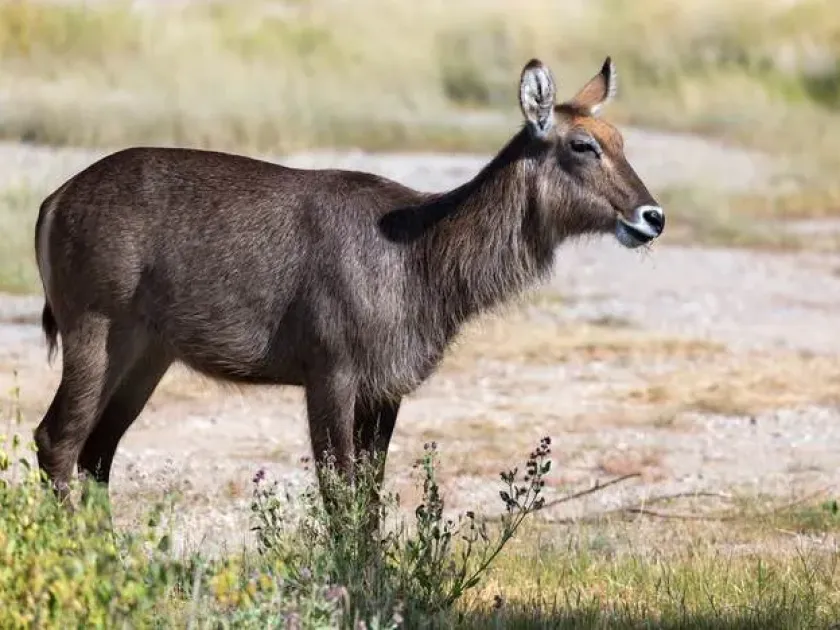
Description
How to identify
The Waterbuck (Kobus ellipsiprymnus) is a large, sturdy antelope found widely in sub-Saharan Africa, often staying close to water sources.
Physically, they are distinguished by a coarse, greyish-brown coat and a white ring around the rump, which serves as a recognizable visual marker.
Adult males carry impressive, spirally ringed, lyre-shaped horns that are used for dominance displays within the herd structure.
They belong to the order Artiodactyla, family Bovidae. These animals are highly dependent on high-quality grazing and proximity to fresh water.
Their biological adaptation allows them to thrive in grassy areas, but their size and constant need for water make them a significant threat to agriculture.
What it damages
Waterbucks cause extensive damage to agricultural crops, particularly sugar cane, maize, and rice plantations located near riverbanks.
They consume large quantities of green biomass, frequently stripping entire sections of a field overnight if the perimeter is not secured.
Beyond ingestion, the trampling effect of the herd significantly reduces yield, as heavy hooves crush young plants and compact the soil structure.
The animals can destroy irrigation infrastructure, including piping and sprinkler systems, when moving through agricultural estates in groups.
Their presence leads to degradation of cultivated land, forcing farmers to implement costly defensive measures to secure their harvest.
When it appears
While they are present year-round, their pest activity spikes during the dry season when natural forage in the savanna is depleted.
During these lean periods, waterbucks are forced to raid irrigated farmlands, which remain lush and attractive compared to the surrounding drought-stricken vegetation.
They are primarily nocturnal or crepuscular feeders, meaning most crop damage occurs under the cover of darkness, complicating manual surveillance.
Seasonal migratory patterns can lead to sudden influxes of herds into agricultural zones, posing a rapid and unpredictable threat to growing crops.
The planting season is particularly critical, as fresh, tender shoots are highly palatable to these animals, leading to higher damage rates.
Signs of infestation
Clear tracks and hoof prints found in muddy or soft ground are primary indicators that a waterbuck herd has recently occupied a field.
Droppings are deposited in large, distinct piles, which are easily identified by experienced farm workers and serve as a marker of activity.
Ragged, chewed edges on crop stems such as corn or cane indicate the involvement of large ruminants rather than smaller pest species.
Physical disturbances to field borders, such as broken fences or matted grass, provide evidence of entry paths used by the herd.
Visual spotting during the early morning or late evening hours is the most direct way to identify the presence of these animals near crops.
Control measures
The most reliable control method is the installation of robust, high-tensile wire fencing that prevents physical access to the agricultural plot.
Electric fencing, when maintained properly, is highly effective at keeping waterbucks away from sensitive crops like rice or maize.
Integrating sensory-based deterrents, such as motion-activated lights and sirens, can discourage herds from settling in cultivated areas.
Buffer zones cleared of dense vegetation around the perimeter make the approach less secure for the animals, reducing the likelihood of raiding.
- Installing high-voltage electric barriers.
- Regular perimeter inspection and maintenance.
- Deploying ultrasonic or auditory alarms.
- Using chemical repellents on field edges.
Taxonomy
- Latin name
- Kobus ellipsiprymnus
- Family
- Bovidae
- EPPO code
- KOBUEL
Discussion
No discussions yet — be the first.