
Birch catkin bug
Kleidocerys resedae
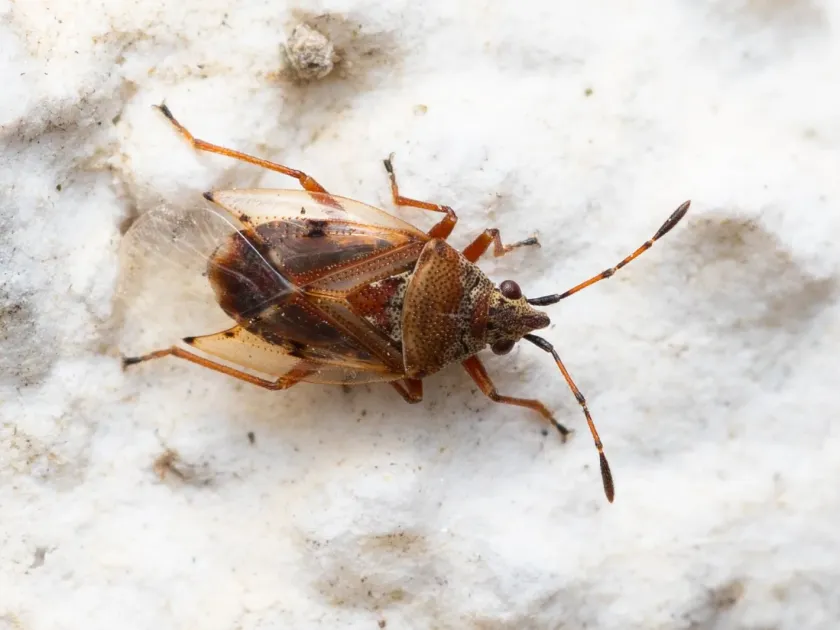
Description
How to identify
The birch catkin bug (Kleidocerys resedae) is a member of the Lygaeidae family within the order Hemiptera. Adult insects typically measure between 4 and 6 millimeters and possess a distinctive reddish-brown to brown body with dark markings on their forewings.
They are characterized by four-segmented antennae and a specific pattern on the pronotum, which makes them distinguishable from other related species. The bug’s body shape is slightly flattened, facilitating movement in tight bark crevices.
Nymphs are similar in appearance to adults but lack developed wings and are generally smaller. They often exhibit a more vibrant reddish coloration, which provides effective camouflage among the young leaves and catkins of their host trees.
This species is widely distributed and commonly found in temperate forest ecosystems, parks, and gardens. While they are often associated with birch trees, they are known to feed on various woody plants including alder and shrubs.
Like many members of the Lygaeidae family, these bugs utilize scent glands to release defensive chemicals when threatened. This behavior is a key evolutionary trait that aids their survival in diverse environmental settings.
What it damages
Both adults and nymphs cause damage by feeding on plant sap. They use their piercing-sucking mouthparts to penetrate the tissues of tender shoots, developing buds, and, most importantly, the catkins of trees.
The primary host plants include birch, alder, and several species of the Rosaceae family. The extraction of cell contents during feeding disrupts the normal physiological processes of the host plant, often resulting in localized necrosis.
Damage to catkins is particularly significant as it can lead to reduced seed production and premature drop of reproductive structures. In nursery settings, this can directly impact the quality and yield of seedlings.
The punctures left by the insects become entry points for secondary pathogens, including various fungi and bacteria. This exacerbates the damage, leading to withered shoots and weakened overall tree health.
While mass outbreaks are relatively rare compared to other agricultural pests, high densities in localized areas can lead to significant aesthetic and biological damage to valuable trees, necessitating timely intervention.
When it appears
The life cycle of the birch catkin bug is adapted to the seasonal changes of temperate zones. Adults typically overwinter in sheltered locations, such as leaf litter, cracks in tree bark, or in protected cavities.
Activity resumes in early spring when temperatures rise consistently, triggering the adults to emerge from diapause. They immediately seek out food sources, focusing on budding leaves and the early catkins of birch trees.
Mating and oviposition occur throughout the late spring and early summer months. Females lay their eggs in protected spots near food sources to ensure that emerging nymphs have immediate access to nutrients.
Nymphal development takes place throughout the summer, with several instars occurring before the final moult into adulthood. This growth period is essential for accumulating the energy reserves needed for overwintering.
As autumn approaches and temperatures drop, the new generation of adults seeks overwintering sites. The transition into dormancy is a critical survival phase, during which the bugs become inactive until the next growing season.
Signs of infestation
The presence of these bugs is often first noticed through direct observation on the branches and catkins of trees. They are particularly active during the day, making them easier to spot during sunny weather.
Evidence of feeding is characterized by the appearance of tiny pale spots on leaves and catkins. These are the immediate results of the bug's mouthparts piercing the plant epidermis to access nutrient-rich fluids.
Over time, these spots darken and may merge into larger necrotic patches. This indicates significant tissue damage and can lead to the deformation or curling of leaves that were attacked at an early developmental stage.
- Withered or blackened catkins dropping prematurely.
- Distorted or stunted young shoot growth.
- Black fecal spots visible on the underside of foliage.
- Presence of a distinct odor when shaking branches of infested trees.
In the fall, finding large numbers of adults clustering on the bark of trees is a clear sign that the tree is being used as a staging area for migration to overwintering sites.
Control measures
Effective management strategies begin with sanitation, which is the most reliable way to reduce overwintering populations. Collecting and disposing of leaf litter and debris from under host trees significantly limits the availability of winter refuges.
In gardens or managed landscapes, manual removal of concentrated clusters of bugs is feasible if the infestation is localized. This is best done in the morning when the insects are less mobile due to cooler temperatures.
When biological controls or manual methods are insufficient, chemical insecticides may be employed. Use products labeled for ornamental tree protection, targeting nymphs before they reach maturity to disrupt the breeding cycle.
Encouraging natural predators such as lady beetles, lacewing larvae, and small insectivorous birds can provide significant natural suppression of bug populations. Minimizing broad-spectrum pesticide use helps maintain these ecological balances.
Maintaining tree vigor through proper fertilization and watering is an essential defensive measure. A healthy, stress-free tree is generally more resilient to insect damage and can recover more rapidly from minor infestations.
Taxonomy
- Latin name
- Kleidocerys resedae
- Order
- Hemiptera (bugs, aphids, leafhoppers)
- Family
- Lygaeidae
- EPPO code
- KLEIRE
Discussion
No discussions yet — be the first.