
Currant spanworm
Itame ribearia
Description
How to identify
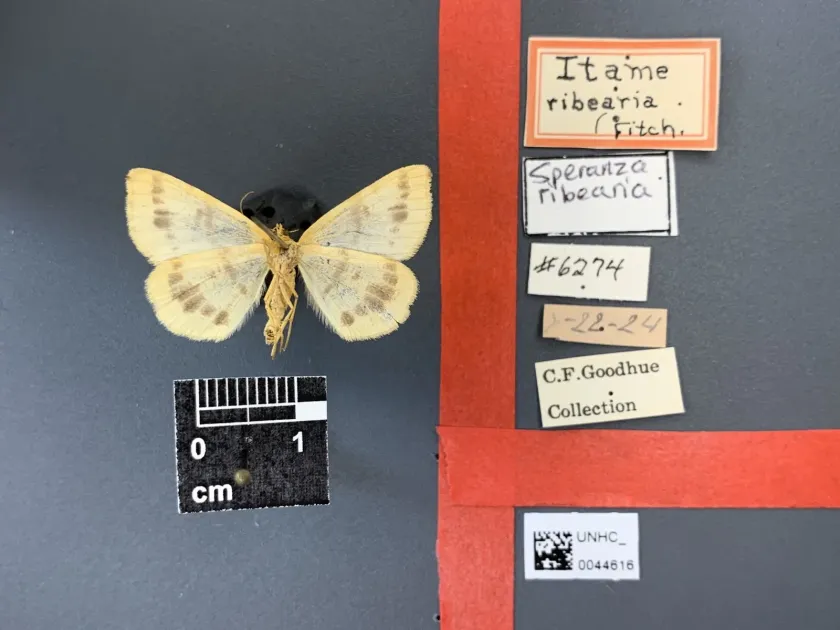
The Currant spanworm (Itame ribearia) is a moth species belonging to the family Geometridae. Adult moths have a wingspan of approximately 30-35 mm and display yellowish-brown wings with distinctive dark bands and spots.
The larvae, known as loopers or spanworms, have a yellow body with black spots and stripes. Their movement, achieved by arching their bodies, is the characteristic trait of this moth family.
The life cycle consists of four stages: egg, larva, pupa, and adult. The insect typically overwinters in the egg stage on the bark of host plant branches.
In spring, larvae emerge and begin feeding on young foliage. This larval stage usually lasts for several weeks before the pupation process begins in the soil.
Adult moths emerge in mid-summer, mate, and lay eggs on the branches, completing the cycle for the next season.
What it damages
The Currant spanworm primary feeds on plants in the Grossulariaceae family, specifically targeting gooseberries, red currants, and black currants.
The caterpillars are foliage feeders that can completely defoliate an entire shrub within a short period, leaving only the veins of the leaves behind.
This extensive damage inhibits the plant's ability to photosynthesize, which directly results in reduced vigor and poor yield for the following year.
Severe infestations weaken the host plant, making it more susceptible to environmental stress, winter damage, and various secondary diseases.
Without proper management, populations can reach levels where they destroy the majority of the foliage on infested bushes, leading to significant crop failure.
Signs of infestation
The first sign of an infestation in early spring is the appearance of small irregular holes in the developing leaves as young larvae begin to feed.
As the caterpillars grow, they consume larger portions of the leaf tissue, leaving only the skeletonized remains of the leaf structure.
Observing the presence of caterpillars, especially those hanging from silk threads after the bush is shaken, is a clear indicator of a pest problem.
- Holes in young leaves
- Skeletonized leaf veins
- Visible caterpillars on foliage
- Defoliation of branches
- Frass (droppings) below the bush
Inspecting the underside of the leaves during the early vegetative stage is the most effective way to detect the pests before extensive damage occurs.
Control measures
Cultural control involves tilling the soil beneath the bushes in late autumn to disrupt the pupation sites and reduce the overwintering population.
Mechanical control, such as manual picking of caterpillars or shaking them off onto a tarp for disposal, is effective for home gardens and small plantings.
Chemical control can be achieved by using approved insecticides. Applications should be timed to coincide with the period of peak larval activity.
Always follow label instructions regarding safety and pre-harvest intervals to ensure the berries are safe for consumption after treatment.
Maintaining strong, healthy bushes through proper pruning and watering can help plants better tolerate and recover from light infestations.
Taxonomy
- Latin name
- Itame ribearia
- Order
- Lepidoptera (butterflies)
- Family
- Geometridae
- EPPO code
- ITAMRI
Discussion
No discussions yet — be the first.