
Issus coleoptratus
Issus coleoptratus
Description
How to identify
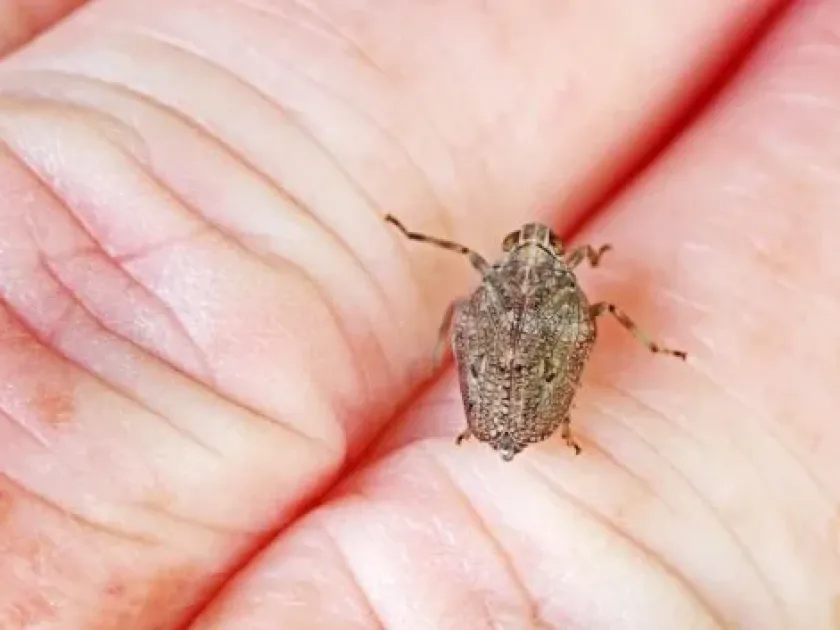
Issus coleoptratus belongs to the order Hemiptera, family Issidae. It is a small insect, with a body length of about 5–7 mm.
Externally, the adult insect resembles a small planthopper with a characteristic shell-like structure of the forewings, which press tightly against the body, giving it a triangular shape.
The coloration ranges from brownish to almost black, allowing the pest to camouflage perfectly on the bark of trees and shrubs.
The head has a specific shape, and the forewings have a distinct reticulated venation, which is a key identifying feature of the species.
Nymphs are less conspicuous, often light-colored, and lead a hidden lifestyle, moving along the undersides of leaves or along shoots.
What it damages
This pest is a polyphage and is capable of damaging a wide range of woody and shrubby crops, preferring broad-leaved species.
Colonies of Issus coleoptratus are most frequently found on oak, hornbeam, hazel, linden, as well as on some fruit trees in orchards and park zones.
The main damage is caused by adults and nymphs, which use their piercing-sucking mouthparts to feed on plant tissue sap.
During mass outbreaks, the pest depletes the tree's vitality, leading to stunted shoot growth and a decrease in the plant's overall immune resistance.
Micro-wounds often occur at the sites of puncture, which can serve as entry points for pathogenic fungi and bacteria.
When it appears
Issus coleoptratus has a univoltine (one generation per year) life cycle, with the egg being the most common overwintering stage, laid in the bark or under bud scales.
Nymphs appear in the spring during the period of active sap flow and bud break, when plants are most vulnerable to moisture loss.
Active development of nymphs occurs during the first half of summer, as they pass through several instars, feeding intensively on host sap.
Adult insects (imagines) appear in the second half of summer, usually from July to September, when they are most active and visible in the canopy.
Mating and egg-laying for the winter occur in the autumn, after which the life cycle of the current generation concludes.
Signs of infestation
The first sign of the presence of Issus coleoptratus is the accumulation of honeydew secreted by them on the leaf surface, which eventually becomes covered with sooty mold.
Visually, the adults can be detected by shaking branches abruptly — the insects jump quickly and move to adjacent parts of the canopy.
A characteristic sign is the yellowing and deformation of young leaves, which begin to curl as a result of impaired tissue nutrition.
When inspecting the bark, one can notice egg-laying traces, which look like small punctures or characteristic thickenings in the epidermis of young twigs.
- Presence of sticky honeydew on leaves;
- Loss of turgor and wilting of young shoots;
- Development of sooty mold on the foliage;
- Presence of jumping adults when branches are disturbed.
Control measures
Preventive measures include maintaining high agrotechnical standards, as strong and healthy trees are better able to withstand pest attacks.
It is important to conduct timely sanitary pruning of damaged and dry branches, which may harbor overwintering stages of the pest.
In cases of high population density, effective control involves the use of systemic or contact insecticides registered for use in orchards.
Treatments are recommended during the periods of greatest nymphal vulnerability, allowing for a significant reduction in the pest population before the adult stage.
In private gardens, it is recommended to encourage natural predators, such as birds and beneficial insects, which help keep Issus coleoptratus populations in check.
Taxonomy
- Latin name
- Issus coleoptratus
- Order
- Hemiptera (bugs, aphids, leafhoppers)
- Family
- Issidae
- EPPO code
- ISSUCO
Discussion
No discussions yet — be the first.