
Agalmatium
Agalmatium
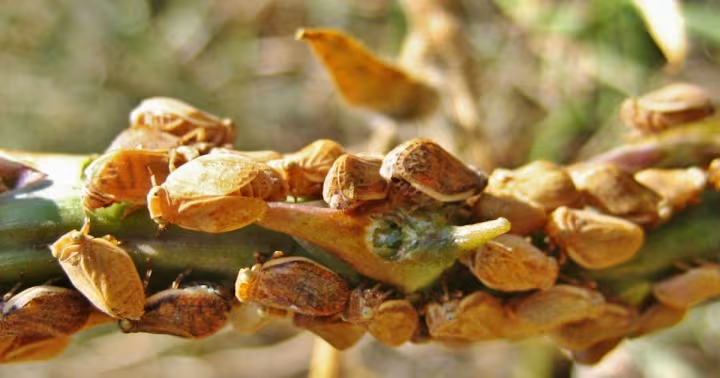
Description
How to identify
Agalmatium is a genus of planthoppers belonging to the family Issidae, within the order Hemiptera. Adult insects are characterized by a stout, short body and wings that are held roof-like over the abdomen when at rest.
The adults generally exhibit brownish or grayish coloration, often mottled, which provides excellent camouflage against tree bark or plant stems. Their head is short, and the specific structural morphology of the frons is key to distinguishing them from other Issidae genera.
Nymphs are typically sedentary and often covered in a waxy, white secretion that protects them from desiccation and predators. They undergo several developmental stages while residing on host plants or within leaf litter.
The biology of these insects is deeply tied to the availability of perennial woody and herbaceous vegetation. Adult insects are capable jumpers, which serves as their primary defensive mechanism when disturbed.
Identification can be challenging due to the presence of other similar planthopper species; therefore, accurate classification often requires examination of the male genitalia in a laboratory setting.
What it damages
Agalmatium is a polyphagous pest capable of feeding on a wide range of cultivated and wild plants. They are frequently found in vineyards, orchards, ornamental shrubs, and occasionally various field crops.
Both adults and nymphs cause damage by piercing plant tissues with their mouthparts and sucking cell sap. This disrupts the plant's metabolic processes and significantly hinders its overall growth and development.
Symptoms at feeding sites often include tissue discoloration, necrotic spotting, and the deformation of leaf blades. In cases of high infestation density, premature wilting of shoot tips is a common observation.
Beyond direct mechanical injury, these insects can act as vectors for phytoplasma and viral diseases. Furthermore, the injection of saliva during feeding can induce local toxicity, adding further stress to the plant.
In intensive cultivation systems such as vineyards, heavy infestations can reduce yields and weaken the host's immune system, making perennials more susceptible to winter damage.
When it appears
The life cycle of Agalmatium is typically univoltine, meaning there is only one generation per year. The overwintering stage consists of eggs deposited under bark, in woody crevices, or within plant debris.
Nymphs begin to emerge in the spring, coinciding with bud burst and the active growth of new shoots. This is a critical timeframe for monitoring population levels in agroecosystems.
The peak feeding period for nymphs occurs in late spring and early summer, during which they actively move across the plant in search of the most succulent young tissue.
Adult emergence is observed in mid-to-late summer. These adults continue feeding on plant sap while mating and laying eggs that will serve as the overwintering generation for the following year.
By autumn, the number of active individuals gradually declines as they enter diapause in preparation for winter, making the late season less favorable for field detection.
Signs of infestation
A distinct sign of Agalmatium presence is the accumulation of waxy secretions on shoots and the underside of leaves. This material is produced by nymphs for protective purposes.
Damaged leaves may exhibit curling, yellowing, or fine, punctate necrosis. Upon closer inspection of the stems, one may observe adult planthoppers quickly moving to the opposite side of the branch when approached.
Early signs of infestation often include stunted shoot growth and a general unthrifty appearance of the plant without an obvious cause. Severe infestations may lead to premature leaf drop.
In the lower canopy or near the base of the plant, the presence of sooty mold is often noted, which develops on the honeydew excreted by these sap-sucking insects.
The use of yellow sticky traps is a reliable method for monitoring adult population dynamics in gardens and orchards, helping to determine the necessity of intervention.
Control measures
Agricultural control methods include regular sanitary pruning of trees and shrubs, along with the removal of weeds and debris that serve as overwintering sites for eggs.
Systemic insecticides are effective when applied during the early nymphal stages. Selection of products must adhere to regional guidelines and specific crop regulations.
Biological control is an essential component, involving the preservation and augmentation of natural enemies such as parasitic wasps and entomophagous insects that regulate Agalmatium populations.
For home gardens, contact-acting insecticides may be utilized; however, it is strictly necessary to observe the pre-harvest interval (PHI) specified on the product labels to ensure consumer safety.
- Removal of loose bark to destroy overwintering egg sites.
- Weed management to eliminate alternative host plants.
- Use of sticky traps for population monitoring.
- Application of biopesticides during the early vegetative phase.
Taxonomy
- Latin name
- Agalmatium
- Order
- Hemiptera (bugs, aphids, leafhoppers)
- Family
- Issidae
- EPPO code
- AGLMSP
Discussion
No discussions yet — be the first.