
Isometrus
Isometrus
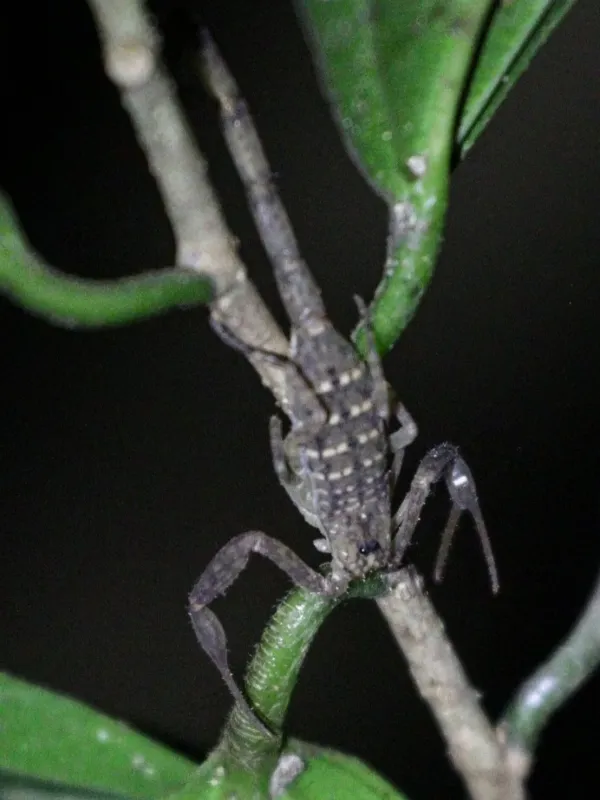
Description
How to identify
Isometrus belongs to the family Buthidae, order Scorpiones. As members of the class Arachnida, they are recognized in an agricultural context as arthropods that can pose safety risks to personnel working in greenhouses or tropical agricultural environments.
Physically, Isometrus is a medium-sized scorpion characterized by slender pedipalps (claws) and a segmented metasoma (tail) ending with a venomous telson, which is typical for the Buthidae family.
The body coloration is usually in shades of brown or yellowish-tan, providing excellent camouflage among leaf litter, mulch, or decaying plant materials commonly found in agricultural production systems.
They possess specialized sensory organs, including trichobothria (sensitive hairs) and pectines (comb-like structures), which allow them to detect vibrations in the soil or plants, aiding in navigation and prey detection.
Unlike phytophagous insects, they are predators, yet their presence in agroecosystems is frequently associated with high moisture levels and accumulated organic matter, creating hidden habitats within greenhouse structures.
What it damages
Isometrus does not feed directly on plant tissues and therefore does not inflict mechanical damage on crops through chewing or sap-sucking activities typical of traditional pests.
The primary concern regarding this species involves creating hazardous conditions for workers during routine agricultural operations and the potential disruption of local ecology upon introduction into protected environments.
Their presence in nurseries or produce storage facilities often necessitates reduced manual labor efficiency due to the risk of stings when handling containers or plants.
In certain instances, their activity within the soil substrate can disrupt the root development of seedlings as they dig burrows or establish hiding spots in the root zone.
Indirect damage occurs through the predation of beneficial fauna, including pollinators and natural enemies of crop pests, which can upset the biological balance within the agricultural setting.
When it appears
The activity of Isometrus is highly dependent on climatic factors, as they prefer warm and humid environments typical of tropical and subtropical regions.
In greenhouse conditions, seasonality is largely absent, as stable temperatures and constant humidity allow them to reproduce and remain active throughout the year.
Mass reproduction periods often coincide with wet seasons when populations of small invertebrates increase, providing a reliable food source for these arachnids.
Migration and foraging activity increase significantly at night, when the species leaves its shelter in search of prey, making daytime population monitoring difficult.
When faced with adverse conditions such as drought or sudden drops in temperature, they may enter a state of dormancy, hiding deep within the soil or deep inside dense plant substrates.
Signs of infestation
The most reliable sign of Isometrus presence is the direct observation of individuals during weeding, harvesting, or routine substrate maintenance in greenhouse environments.
The presence of specific entry holes in the soil, with diameters corresponding to the size of the scorpion's body and claws, indicates the establishment of temporary shelter burrows.
In drier areas, characteristic tracks on dusty soil surfaces or discarded exuviae (old skins) left behind after molting can indicate established dwelling sites.
Presence can be confirmed at night using ultraviolet (UV) flashlights, as the chitinous exoskeleton of the scorpion exhibits strong fluorescence under ultraviolet light.
A surge in scorpion numbers often signals a breakdown in the sanitary management of the facility and the accumulation of excessive moisture and rotting organic matter.
Control measures
The primary control strategy is the implementation of rigorous sanitation practices, including the removal of organic debris, litter, and regular cleaning of storage and greenhouse areas.
Managing greenhouse humidity levels, particularly by improving drainage systems, helps make the environment less attractive for scorpion colonization.
- Use of protective gear and gloves when performing tasks in potentially infested areas.
- Manual removal and nocturnal monitoring using UV flashlights to track population density.
- Installation of physical barriers, such as fine-mesh screens on ventilation intakes to prevent entry.
- Routine tilling or raking of the topsoil layer to disrupt established burrows and hiding spaces.
Chemical control against this species is generally ineffective and not recommended, as scorpions possess high resistance to standard insecticides used in crop production.
In cases of severe infestation, consulting professional pest control services is advised to conduct targeted treatments in habitat zones using approved contact-action substances.
Taxonomy
- Latin name
- Isometrus
- Family
- Buthidae
- EPPO code
- ISOMSP
Discussion
No discussions yet — be the first.