
Grass chinch bug
Ischnodemus sabuleti
Description
How to identify
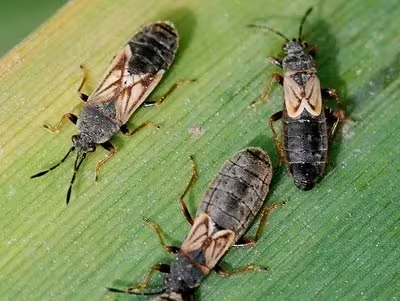
The grass chinch bug Ischnodemus sabuleti belongs to the family Lygaeidae. These insects are characterized by a slender body, usually measuring 4 to 5 mm in length, with a dark brown to black coloration.
Adult bugs possess a robust exoskeleton and may exhibit both macropterous (long-winged) and brachypterous (short-winged) forms, allowing them to adapt to various environmental conditions.
The head is relatively broad with prominent compound eyes, and the pronotum is typically rectangular. These features allow the insect to navigate effectively within the dense canopy of grass plants.
Nymphs undergo several molting stages, shifting from a bright red appearance in early instars to darker shades as they approach maturity. Their small size and cryptic habits make them difficult to spot during routine inspections.
They are highly social at certain stages, preferring to aggregate in large colonies at the base of stems, which is a key behavioral trait for identification in agricultural fields.
What it damages
The grass chinch bug primarily feeds on wild grasses, but it can cause severe damage to cereal crops such as wheat, barley, rye, and maize when populations reach high densities.
Using their piercing-sucking mouthparts, they extract sap from stems and leaf sheaths. This feeding behavior disrupts the vascular transport of nutrients throughout the plant.
Heavy infestations lead to stunted growth, yellowing, and eventual wilting of the plants. The overall vitality of the crop is significantly reduced, impacting the grain filling process.
In addition to direct physiological damage, the punctures provide entry points for secondary pathogens and fungi, which can further exacerbate the decline of the crop health.
In extreme cases, the structural integrity of the stems is compromised, causing the plants to lodge, which results in significant harvesting difficulties and yield losses.
When it appears
Adults overwinter in protected areas such as field margins, dry plant debris, or beneath the soil surface. They emerge when temperatures rise consistently in early spring.
Mating and egg-laying occur during the late spring months. Females typically lay eggs on the lower parts of stems, protected by the leaf sheaths of host grasses.
The development cycle of a generation takes about one month, depending on environmental conditions. In warmer climates, the insect may complete two generations within a single season.
The peak of activity is observed during hot and dry summer weather, which encourages the migration of these bugs from wild grasses toward cultivated cereal fields.
As autumn approaches and temperatures drop, the bugs gradually move away from their host plants to find suitable overwintering sites, remaining dormant through the winter.
Signs of infestation
The primary indication of an infestation is the presence of yellowing patches within the cereal field, often appearing in areas near the edges or overgrown spots.
Close inspection of the stem bases, especially under the leaf sheaths, will reveal clusters of small, dark, or reddish insects feeding in colonies.
Sticky residues or small black fecal droplets are frequently observed on the lower parts of the plant stems as a result of the insect's high feeding activity.
- Premature yellowing and drying of the lower leaves.
- Visible deformation or twisting of young shoots during the vegetative growth stage.
- A distinct, pungent odor released by the bugs when disturbed in large clusters.
Birds frequently foraging in specific parts of the field can sometimes serve as an indicator that a large population of bugs is present in the lower canopy.
Control measures
Effective management begins with strict sanitation, including the removal of grassy weeds in and around fields that serve as breeding reservoirs for the chinch bug.
Deep plowing in the autumn helps to bury plant residues, effectively destroying the overwintering sites and killing a large portion of the hibernating population.
Crop rotation remains a crucial strategy. Moving away from continuous cereal cropping to non-host plants can significantly break the life cycle of Ischnodemus sabuleti.
If population thresholds are exceeded, chemical control with registered insecticides is recommended. Applications should target the lower part of the plant stems where the insects congregate.
Integrated pest management also involves monitoring fields regularly during the spring and early summer to ensure timely interventions before the population reaches damaging levels.
Taxonomy
- Latin name
- Ischnodemus sabuleti
- Order
- Hemiptera (bugs, aphids, leafhoppers)
- Family
- Lygaeidae
- EPPO code
- ISCNSA
Discussion
No discussions yet — be the first.