
Ischnodemus
Ischnodemus
Description
How to identify
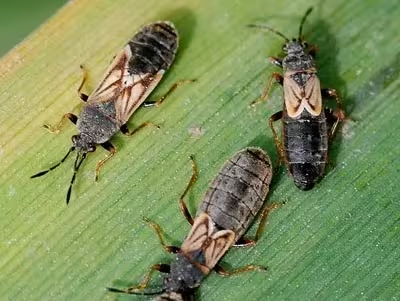
Ischnodemus is a genus of insects belonging to the Blissidae family, order Hemiptera. These are small bugs characterized by an elongated body shape and specific coloration, often ranging from dark brown to black.
Adult insects typically reach a length of 3 to 5 millimeters. They usually possess well-developed wings, although short-winged forms exist, which influences their migration capabilities across agricultural landscapes.
The head and pronotum are covered with fine hairs, serving as a key diagnostic feature for species identification. Their mouthparts are of the piercing-sucking type, adapted to extract plant sap from the tissues of various grasses.
Nymphs resemble the adults morphologically but are smaller in size and lack fully developed wings. Their coloration varies depending on the developmental stage, often displaying reddish or brownish tints as they grow.
These pests often maintain a secretive lifestyle, clustering within leaf axils or under the leaf sheaths of host plants. This behavior makes early detection of the infestation particularly challenging for field scouts.
What it damages
Ischnodemus species primarily target a wide range of monocotyledonous plants. The main economic damage occurs in cereal crops, including wheat, rye, oats, barley, and corn.
Beyond cultivated cereals, these bugs frequently colonize wild grasses, such as couch grass and other Poaceae species, which serve as crucial reservoirs for their reproduction and population growth.
The insects feed by sucking sap from stems, leaves, and glumes, which disrupts plant metabolism. This feeding activity significantly reduces photosynthetic efficiency and stunts the growth of the crop.
Under conditions of mass outbreaks, the pest can cause severe reductions in grain yield. Decreased quality and biomass loss are direct consequences of the intense feeding pressure exerted by these bugs.
Plant tissues damaged by piercing-sucking feeding become highly susceptible to secondary infections, including various fungal pathogens that exploit the wounds left by the insects on the epidermis.
When it appears
The life cycle of Ischnodemus is closely tied to climatic conditions and the availability of food sources. Adults overwinter in protected areas, including plant debris, tree bark, or soil crevices.
In spring, as temperatures rise, overwintering adults emerge to seek out young host plants. This is the period when they often migrate into new fields to establish early infestations.
Females deposit eggs on leaf surfaces or within leaf sheaths in late spring. Nymphal development proceeds through several instars, usually spanning about a month depending on regional temperatures.
Peak activity occurs during summer months, facilitating rapid population growth and field-wide dispersal. Depending on the climate, multiple generations can occur within a single growing season.
As temperatures drop in the autumn, the bugs gradually enter a state of diapause. They leave their host plants and search for suitable overwintering sites to survive the cold months.
Signs of infestation
The first visual sign of an Ischnodemus infestation is the appearance of yellowish spots on leaves, which gradually expand and coalesce, covering large areas of the leaf blade.
A characteristic symptom is leaf curling and subsequent wilting, particularly in the lower parts of the stem. Affected plants appear visibly stunted compared to their healthy neighbors.
Careful inspection of the leaf axils often reveals clusters of insects, which serves as a definitive confirmation of the pest's presence within the field.
Field scouting during early morning hours may reveal the presence of insect excrement, which appears as small black specks on the stems and leaf surfaces of the crop.
- Yellowing leaf tips
- Wilting of individual stems
- Presence of nymphs in leaf axils
- Deformed ears in case of early infestation
- Overall thinning of the crop stand
Control measures
Effective management of Ischnodemus requires a comprehensive approach, integrating agronomical, biological, and chemical strategies to keep populations below economic damage thresholds.
Crucial to management is the timely control of weeds, especially couch grass, as these plants often host the pest before it moves into the main cereal crops.
Implementing crop rotation and ensuring thorough soil cultivation after harvest can destroy overwintering sites, significantly reducing the number of surviving adults for the following season.
Chemical control via insecticides is recommended once economic damage thresholds are reached. Applications typically involve organophosphates or pyrethroids that act through contact and ingestion.
Ongoing monitoring using pheromone traps or regular field inspections allows for targeted pesticide application, minimizing chemical impact on the environment while ensuring effective protection of the crop.
Taxonomy
- Latin name
- Ischnodemus
- Order
- Hemiptera (bugs, aphids, leafhoppers)
- Family
- Lygaeidae
- EPPO code
- ISCNSP
Discussion
No discussions yet — be the first.