
Scarce Swallowtail
Iphiclides
Description
How to identify
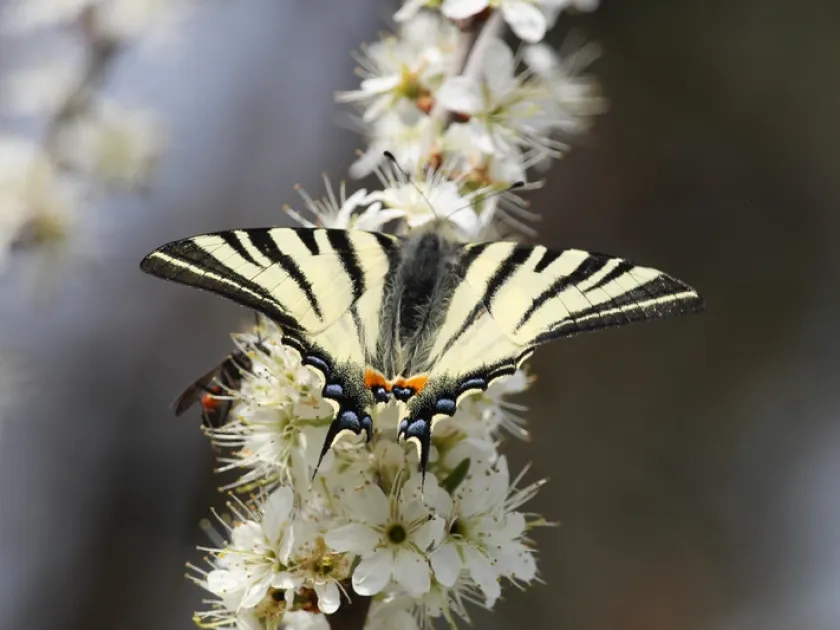
The Scarce Swallowtail (Iphiclides podalirius) is a large butterfly species belonging to the Papilionidae family. Adults are easily recognized by their pale yellow wings with black stripes and long, sword-like tails on the hindwings.
The larvae (caterpillars) are vivid green, often decorated with small yellow spots and darker lines, which provides camouflage among the foliage of their host trees during the day.
The species undergoes complete metamorphosis, including egg, larva, pupa, and adult stages. They typically overwinter as pupae attached to the bark or branches of the host plants.
Depending on the latitude, the butterfly can produce one or two generations per year. The first generation usually emerges in spring, coinciding with the flowering period of fruit trees.
While the butterfly itself is a beautiful sight, its larval stage can become a significant pest when populations reach high density, requiring careful orchard management.
What it damages
The larvae are specialized phytophages that feed on the leaves of plants from the Rosaceae family. This feeding behavior causes significant defoliation in various orchard crops.
Commonly damaged hosts include apple, pear, plum, cherry, apricot, and peach trees. Wild relatives like hawthorn and blackthorn also serve as primary food sources for the larvae.
Extensive feeding reduces the total leaf area available for photosynthesis, which negatively impacts the development of fruits and the formation of flower buds for the subsequent season.
Severe infestations weaken the trees, making them more susceptible to secondary pests and environmental stressors, which can lead to reduced overall health and productivity.
In orchards, high larval populations can cause sufficient damage to require intervention, especially in young saplings where leaf loss can significantly stunt growth.
Signs of infestation
The primary symptom of infestation is the presence of eaten leaves, often with irregular margins or completely stripped blades where only the veins remain visible.
Caterpillars can be found by inspecting the underside of leaves or along the stems, as they tend to remain stationary or move slowly while feeding during the daytime.
During the dormant season, pupae can be detected by examining the bark of trunks and lower branches, where they are attached in a camouflaged manner.
The arrival of adult butterflies in the orchard during the spring is a clear indicator that egg-laying is occurring and that monitoring for neonate larvae should begin.
Sparse foliage in mid-season, characterized by visible gaps in the canopy, often points to the recent activity of these larvae, even if the insects have since pupated.
Control measures
Manual removal of caterpillars is highly effective for small gardens and young orchards where minimal chemical impact is preferred to maintain ecosystem health.
Chemical control involving selective insecticides may be necessary in commercial orchards if the damage threshold is exceeded, provided that applications are timed to avoid harming bees.
Biological control using formulations based on Bacillus thuringiensis provides a selective way to manage caterpillar populations while remaining safe for the surrounding environment.
Orchard hygiene practices, including the removal of deadwood and proper canopy thinning, can reduce the success rate of overwintering pupae and improve overall tree health.
- Regular monitoring of host trees during the spring.
- Encouraging natural predators such as insectivorous birds.
- Applying selective biological pesticides only when necessary.
Taxonomy
- Latin name
- Iphiclides
- Order
- Lepidoptera (butterflies)
- Family
- Papilionidae
- EPPO code
- IPHISP
Discussion
No discussions yet — be the first.