
Strawberry miner moth
Incurvaria praelatella
Description
How to identify
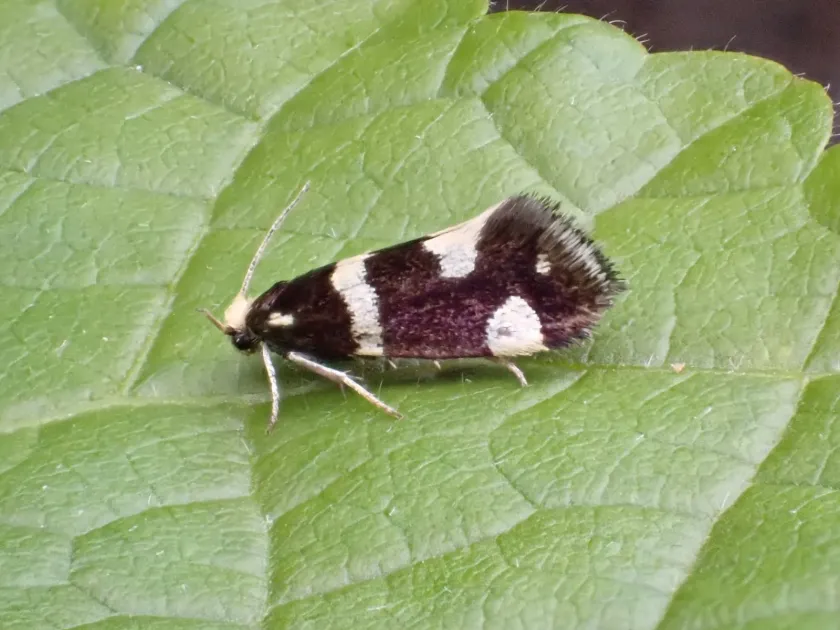
The strawberry miner moth (Incurvaria praelatella) belongs to the order Lepidoptera, family Incurvariidae. The adult moth is small, with a wingspan ranging from 12 to 15 mm.
The wings typically feature dark, bronze-brown coloration with distinctive pale or golden patches, providing excellent camouflage against vegetation. The body of the moth is covered with fine, hair-like scales.
Larvae pass through several growth stages, initially appearing pale before becoming darker as they approach maturity. They live mostly inside the leaf tissue, which makes them difficult to spot during initial infestation.
The lifecycle is closely aligned with the growth cycle of host plants. There is generally one generation per year, and the winter period is spent as larvae in the soil or under debris.
Pupation occurs in spring, followed by the emergence of adults. Moths lay eggs on the underside of leaves, ensuring the larvae have immediate access to food upon hatching.
What it damages
The primary host for this pest is the cultivated strawberry, though it may also infest wild strawberries, blackberries, and other members of the Rosaceae family.
Upon hatching, larvae create mines within the leaf tissue. As they grow, these mines expand into irregular blotches, causing the leaf tissue to lose its integrity and functionality.
Heavy infestations result in widespread leaf chlorosis, curling, and early drying. Since the leaf is the energy center of the plant, such damage significantly reduces berry yield.
Plants affected by the miner moth exhibit reduced vitality, making them more susceptible to drought, winter frost, and various secondary fungal pathogens.
In high-density populations, the loss of photosynthetic capacity is severe enough to stunt the growth of the entire plant, impacting harvest quantity and fruit quality.
Signs of infestation
The first indicator of an infestation is the appearance of small, winding galleries or blotch-like mines on the surface of the strawberry leaves.
If you look closely at the underside of a leaf, you will notice dark specks of excrement inside these galleries, which distinguishes mining from simple surface blemishes.
As the damage progresses, the affected leaf tissue turns brown and brittle, eventually creating necrotic holes that look like typical leaf spot diseases.
Adult moths are often visible hovering around the base of strawberry plants, especially during the twilight hours or on overcast, humid days.
A slight curling or crinkling of young foliage is another common sign that larvae are active within the leaf layers, feeding on the inner chlorophyll-rich tissues.
Control measures
Cultural control practices, including thorough cultivation of soil in between rows, help to destroy pupae and overwintering larvae residing in the upper soil layers.
Sanitation is key: removing and destroying dead foliage after harvest removes the overwintering sites for the moth, reducing the population for the next season.
Monitoring using pheromone traps or sticky traps helps identify the flight period of the moths, allowing for the precise application of protective treatments.
Biological control, particularly using Bacillus thuringiensis, is highly effective against young larvae while remaining safe for beneficial garden insects.
- Regular inspection of leaves starting from early spring.
- Avoidance of overcrowded planting zones to ensure better airflow.
- Targeted application of insecticides only when economic thresholds are met.
Taxonomy
- Latin name
- Incurvaria praelatella
- Order
- Lepidoptera (butterflies)
- Family
- Incurvariidae
- EPPO code
- INCUPR
Discussion
No discussions yet — be the first.