
Mission blue butterfly
Icaricia icarioides
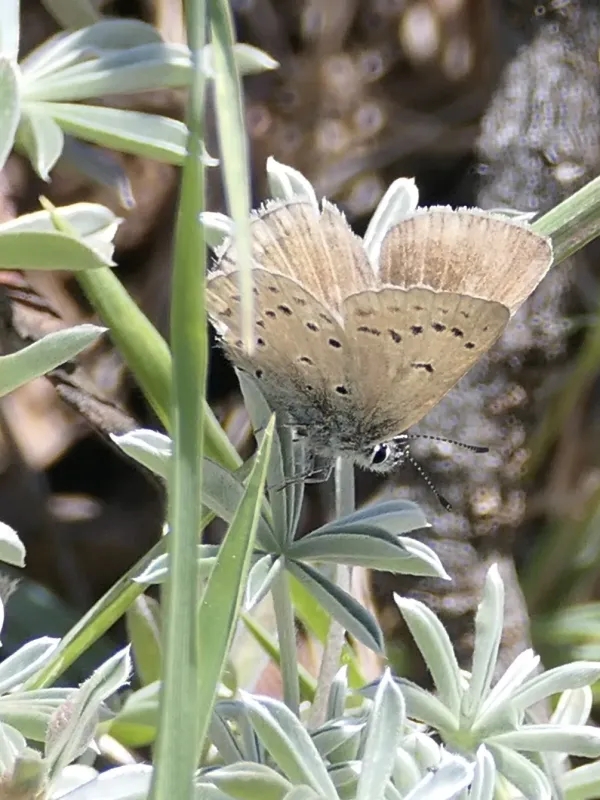
Description
How to identify
The Mission blue butterfly (Icaricia icarioides) is a member of the Lycaenidae family, known for its distinct beauty and specific host plant requirements.
Adult butterflies exhibit sexual dimorphism: males possess brilliant blue wings with narrow black borders, while females appear brownish with varying degrees of blue scales.
The larvae are dorsoventrally flattened and feature a specialized appearance that allows them to blend seamlessly with the leaves of their host plants.
The pupae are typically found in the litter layer or near the base of the host plant, where they remain protected during their transformation into adults.
This species is well-adapted to specific ecological niches, primarily focusing its life cycle around the availability of its preferred lupine species.
What it damages
The larvae of Icaricia icarioides primarily feed on members of the Fabaceae family, with a strong preference for wild and cultivated lupines.
By consuming foliage, the caterpillars reduce the overall photosynthetic capacity of the plants, leading to stunted growth and reduced vigor.
Feeding on floral parts, including buds and flowers, directly affects seed production, which is a major concern for seed-producing agricultural operations.
In cases of high infestation, the cumulative loss of leaf area can lead to the mortality of younger, more vulnerable plants within the stand.
The damage caused by these larvae can also open entry points for various secondary plant pathogens, complicating the overall health management of the crop.
When it appears
The life cycle is typically univoltine, meaning one generation per year, with adult flight occurring during the late spring and early summer months.
Larvae overwinter in a state of diapause, residing within the plant debris or the upper soil surface to survive colder temperatures.
As spring temperatures rise, larvae emerge to resume feeding, synchronizing their developmental stages with the peak growth phase of the host plants.
Pupation takes place as temperatures stabilize, leading to the emergence of adults who then proceed to mate and deposit eggs on suitable foliage.
Monitoring for adults during their flight period is essential for determining the timing of control measures in areas where the butterfly is considered a pest.
Signs of infestation
The most common sign of infestation is the presence of irregular, notched feeding holes along the leaf margins of host legumes.
Skeletonized leaves, where only the veins remain, are often visible in areas where larval density is particularly high on individual plants.
Visible frass (larval droppings) on the leaves or the soil surface underneath the plant is a reliable indicator of active caterpillar feeding.
A sudden drop in the number of developing flower buds on lupine stands can signal that larvae have moved to the reproductive parts of the plant.
In the early morning, observant farmers may spot the larvae resting on the underside of leaves, a behavior commonly used for thermoregulation and protection.
Control measures
Cultural management through the removal of non-crop host plants around field margins can significantly reduce the local population of the pest.
Biological control methods involve fostering populations of natural predators and parasitoids that naturally regulate caterpillar numbers in the wild.
When infestation exceeds economic thresholds, selective insecticides may be applied, ensuring that they do not harm essential pollinators in the vicinity.
Strategic timing of crop management practices, such as harvesting or mowing, can disrupt the larval cycle and force migration away from the production area.
- Use of certified, pest-free seed lots.
- Maintenance of perimeter vegetation buffers.
- Installation of pheromone-based monitoring traps.
- Application of microbial control agents such as Bt-based products.
Taxonomy
- Latin name
- Icaricia icarioides
- Order
- Lepidoptera (butterflies)
- Family
- Lycaenidae
- EPPO code
- ICARIM
Discussion
No discussions yet — be the first.