
Dusky Meadow Brown
Hyponephele lycaon
Description
How to identify
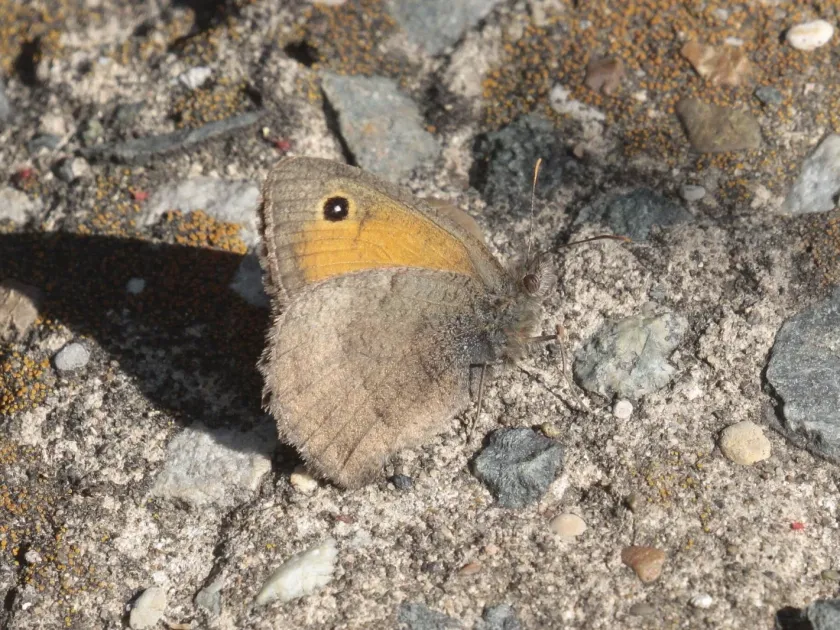
The Dusky Meadow Brown (Hyponephele lycaon) is a species of butterfly in the family Nymphalidae. It is a medium-sized butterfly with a dull brownish or greyish-brown wing pattern.
Males are easily identified by a distinct dark androconial patch on their forewings, which is visible even while the insect is in flight.
Females are generally paler in color and possess more prominent eyespots on their wings, which serve as a camouflage mechanism against dry grass and soil.
The larvae are covered with short, fine hairs and exhibit greenish or yellowish-grey tones, blending perfectly with the stems of their host grasses.
Pupae are typically found at the base of plants or near the soil surface, protected by vegetation debris during the developmental stage.
What it damages
Damage is primarily caused by the larvae, which feed on the vegetative parts of various grasses, including wild species and some cultivated cereals.
Crop fields adjacent to meadows or neglected land are at the highest risk, as the pest migrates from its natural habitat into cultivated areas.
In pastures and hayfields, the larvae can significantly reduce biomass production, leading to decreased forage quality and yield losses for livestock farmers.
Large populations may strip the leaves of grasses, causing the plants to lose vigor and eventually wither under heat or drought stress.
While the pest rarely causes total crop failure, it can create significant spot damage that affects the uniform development of the stand.
When it appears
The species generally completes one generation per year. Adult butterflies are typically seen from late June through August.
The larvae overwinter in various stages of development, sheltering in leaf litter or near the base of host plants to survive cold winter temperatures.
In the spring, as temperatures rise, the larvae resume feeding, actively consuming young grass shoots during the early stages of the growing season.
Pupation occurs in late spring or early summer, with the new generation of adults emerging shortly thereafter to begin the cycle again.
Monitoring for adult flight activity is essential for timely assessment of potential infestation levels in nearby fields.
Signs of infestation
Early signs of infestation include irregular or scalloped edges on grass blades, caused by larvae feeding along the margins.
The presence of adult butterflies near the borders of cereal crops serves as an indicator that larvae may be present in the surrounding vegetation.
Larval droppings, appearing as small granular particles in leaf axils or on the soil surface, are a key diagnostic sign of active feeding.
Affected plants often appear stunted and lose their vibrant color, showing signs of drought-like stress despite adequate soil moisture.
Close inspection of the lower leaf canopy, especially in the mornings, may reveal the presence of larvae hiding from the sun.
Control measures
Maintaining clean borders around fields by mowing high grass is a highly effective cultural method to reduce suitable habitats for the pest.
Deep autumn plowing of field edges and fallow lands can physically destroy overwintering larvae and pupae buried in the soil.
Biological control agents, such as microbial insecticides, can be applied early in the season to suppress larval populations effectively.
Chemical intervention should be considered only when economic thresholds are exceeded, with preference given to targeted applications.
- Frequent monitoring of field perimeters during the flight season.
- Implementing crop rotation to disrupt the pest's development cycle.
- Preserving habitats for natural predators like birds and parasitic wasps.
Taxonomy
- Latin name
- Hyponephele lycaon
- Order
- Lepidoptera (butterflies)
- Family
- Nymphalidae
- EPPO code
- HYNPLY
Discussion
No discussions yet — be the first.