
Pale Oak Beauty
Hypomecis punctinalis
Description
How to identify
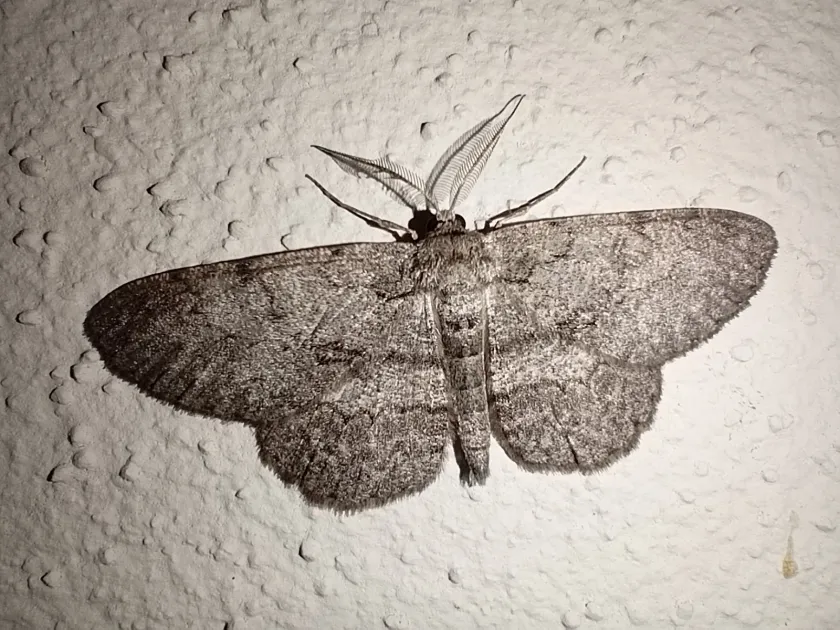
The Pale Oak Beauty (lat. Hypomecis punctinalis) is a moth of the order Lepidoptera and the family Geometridae. The adult moth has a wingspan of 40–50 mm, with wings typically colored in shades of grey to brownish-ash, featuring dark lines and a characteristic dotted pattern.
The larva of this moth is a typical "looper" or inchworm, characterized by a slender body with fewer prolegs, causing it to move by looping its middle section. Larvae exhibit color polymorphism, ranging from greyish-green to brown, allowing them to blend perfectly with tree bark and twigs.
The pupa is dark, shiny, and typically overwinters in the soil or leaf litter at a depth of a few centimeters. The insect undergoes a complete metamorphosis, passing through the stages of egg, larva, pupa, and imago.
Adult moths are nocturnal and are strongly attracted to artificial lights. During the day, they remain stationary on tree trunks, folding their wings flat, which provides effective camouflage against predators.
The species usually completes one generation per year. Moths emerge in late spring or early summer, following which females lay eggs on the bark or leaves of their host plants.
What it damages
This pest is a polyphage, primarily targeting various deciduous trees and shrubs. Common host plants include oak, birch, alder, lime, as well as fruit trees like apple and plum.
Larvae feed on leaves, either grazing the edges or skeletonizing the leaf blade. In cases of massive infestations, this can lead to significant defoliation, which severely stresses the plant.
Stressed trees are significantly more susceptible to secondary pests, such as wood-boring insects and pathogenic fungi, which can exacerbate the decline of the host plant.
Damage is most apparent during peak infestation years, when the loss of photosynthetic surface area exceeds the plant's threshold for maintaining normal physiological functions.
In orchards, heavy feeding by larvae can indirectly impact crop quality and development, as reduced energy production by leaves limits fruit growth.
When it appears
The flight period for the Pale Oak Beauty begins in May and can extend through July, depending on regional climate conditions. This is the period for mating and egg-laying.
Larvae appear in summer and feed actively throughout July, August, and September. This is the period when they cause the most noticeable damage to vegetation.
The overwintering stage is the pupa, which remains in the soil in a state of diapause from autumn until the arrival of spring.
The emergence of adults in spring is generally synchronized with the leaf-bud break of host trees, ensuring that newly hatched larvae have an immediate food source.
Monitoring population levels is typically conducted using light traps or pheromone traps during the evening flight, helping to predict the risk for the next season.
Signs of infestation
The primary visual sign of infestation is the presence of partially consumed leaves with uneven edges. In severe cases, larvae may consume almost the entire leaf, leaving only the primary veins.
Small, dark granular frass (excrement) found on the ground beneath the tree canopy is often the first indicator that larvae are present in the foliage above.
Upon closer inspection, one may find larvae that remain perfectly still when disturbed, stretching their bodies at an angle to resemble a small twig. This mimicry makes them difficult to spot.
Observing adult moths resting on tree trunks during the day confirms the presence of the species and warrants further inspection of the canopy.
- Irregularly eaten leaf blades
- Accumulation of frass on the ground
- Larvae mimicking twigs on branches
- Reduced growth of new shoots
- Premature yellowing of foliage
Control measures
Preventive measures include autumn cultivation or hoeing of the soil around the base of the trees to disturb and kill the pupae hibernating in the ground.
For larval control, biological insecticides based on Bacillus thuringiensis are highly effective, providing targeted protection while sparing beneficial insect species.
In cases of extremely high pest density, the application of registered contact or systemic insecticides may be necessary to prevent severe canopy defoliation.
Promoting a healthy environment for natural predators, such as birds and beneficial insects, is a key component of long-term sustainable pest management.
Regular monitoring and selective pruning of heavily infested branches can help keep the pest population below the economic threshold and prevent outbreaks.
Taxonomy
- Latin name
- Hypomecis punctinalis
- Order
- Lepidoptera (butterflies)
- Family
- Geometridae
- EPPO code
- BOARPU
Discussion
No discussions yet — be the first.