
Green shore fly
Hydrophorus oceanus
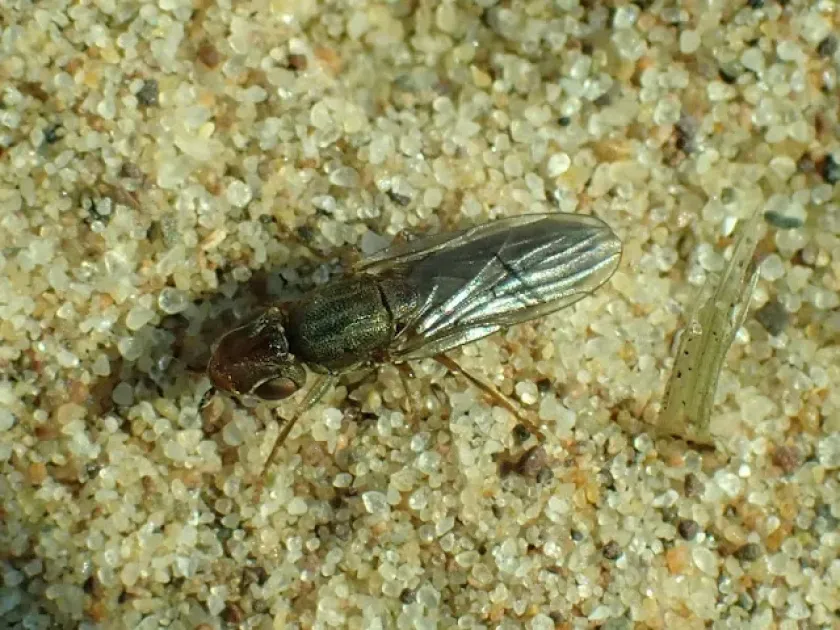
Description
How to identify
The green shore fly is a member of the Dolichopodidae family, order Diptera. These small flies are easily recognized by their metallic green or bronze-colored bodies, which shimmer in the light.
Adults possess long, slender legs that allow them to skate across water surfaces or navigate damp soil with great agility, searching for prey.
Larvae are typically cylindrical and whitish, adapted to living in high-moisture environments such as mud or organic-rich soil.
The lifecycle follows a complete metamorphosis: egg, larva, pupa, and adult, with each stage requiring specific humidity levels to survive and develop.
They are primarily known for their predatory nature as adults, feeding on smaller organisms along the shorelines of water bodies.
What it damages
While typically not a major agricultural pest, Hydrophorus oceanus can become a nuisance in intensive greenhouse vegetable production where irrigation is frequent.
The damage is mostly attributed to the larvae, which, in overwatered media, may feed on soft root tissues, causing stunted plant growth and overall vigor reduction.
Feeding lesions on roots facilitate the entry of secondary pathogens, leading to root rot and other physiological stressors in young seedlings.
Their presence is often a biological indicator of poor sanitation or improper substrate management, such as waterlogging or organic matter accumulation.
In high-density greenhouse environments, significant larvae populations can lead to uniform crop loss if the soil conditions remain consistently saturated.
When it appears
Adult activity peaks during the warmer months, typically from late spring through early autumn, when soil temperatures favor rapid development.
The flies thrive during periods of high humidity, which is a critical environmental factor for the successful completion of their life cycle.
In climate-controlled greenhouse facilities, the flies can complete multiple, overlapping generations, maintaining a constant pressure on young crops year-round.
Development rates are highly temperature-dependent, with warmer conditions significantly accelerating the transition from egg to adult.
Moisture availability in the substrate is the most influential factor regulating the seasonal presence and population density of the shore fly.
Signs of infestation
The most immediate sign of an infestation is the presence of small, metallic-green flies moving rapidly across the surface of the soil or seedling trays.
Disturbed soil surface, characterized by small entry holes or irregular textures, often points to the active foraging of larvae in the upper layers of the substrate.
Stunted growth or unexplained wilting of seedlings, especially after heavy watering, suggests potential root system impairment by larvae.
A foul, swampy smell or the presence of persistent algae on the surface of potting mixes often indicates conditions ideal for fly proliferation.
Microscopic examination of damaged root systems may reveal feeding scars or missing root hair tissue, which are telltale signs of larval feeding.
Control measures
The primary control strategy is the improvement of irrigation practices; ensuring proper drainage is crucial to prevent substrate saturation.
Using high-quality, sterile growing media prevents the accidental introduction of larvae or eggs that may exist in field soil or raw organic matter.
Yellow sticky traps placed near the substrate level are highly effective for capturing adult flies and monitoring the intensity of the infestation.
Biological soil treatments, specifically those containing entomopathogenic fungi, can be used to suppress larval populations without the use of harsh chemicals.
Enhancing airflow and reducing relative humidity through proper ventilation will help dry out the soil surface, making the environment less suitable for development.
Taxonomy
- Latin name
- Hydrophorus oceanus
- Order
- Diptera (flies)
- Family
- Dolichopodidae
- EPPO code
- HDPROC
Discussion
No discussions yet — be the first.