
Hydrophorus
Hydrophorus
Description
How to identify
Hydrophorus is a genus of long-legged flies belonging to the family Dolichopodidae. These insects are commonly found in humid environments, particularly near water bodies and wet soil.
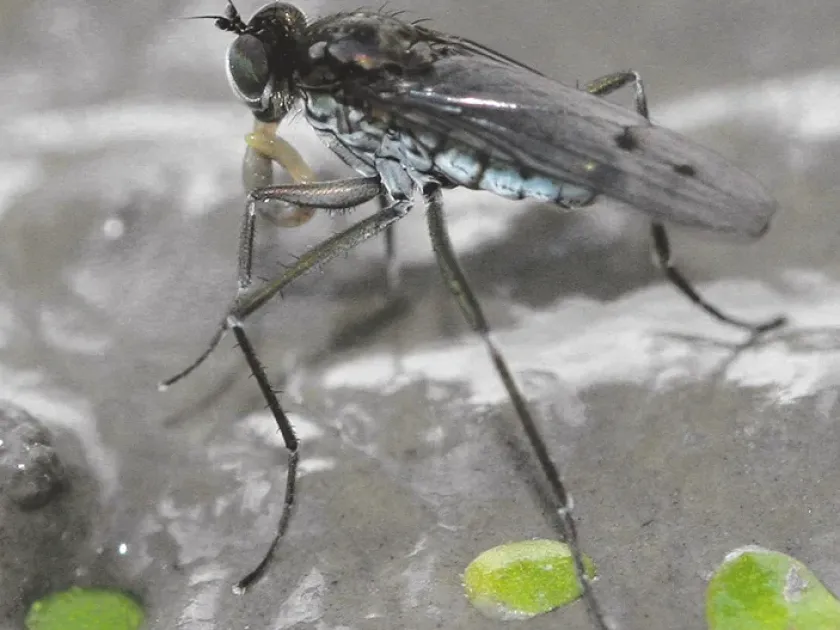
Adult flies are characterized by their metallic, often greenish or bluish, body color, which is a signature trait of the family Dolichopodidae.
The wings are generally transparent, sometimes with faint dark markings, and the legs are long, enabling them to move across water surfaces or muddy substrates.
The larvae are vermiform (worm-like), typically pale white or cream in color, and dwell within the soil or silt, making them difficult to detect without careful inspection.
Identification in the field requires a basic entomological understanding, as they can be easily confused with other small dipterans prevalent in agricultural settings.
What it damages
In most ecosystems, Hydrophorus flies act as predators, feeding on small invertebrates rather than directly consuming plant tissues as their primary food source.
However, when population densities spike, the larvae may feed on the tender roots of seedlings or young shoots, especially in waterlogged growing conditions.
This is a particular concern in greenhouse environments, where high humidity levels favor the breeding cycle of the pest and provide a consistent food source.
Hydroponic crops and plants in saturated media are at the highest risk, as the larvae thrive in these moist environments, leading to potential root damage.
Overall, while their pest status is classified as moderate, localized infestations can lead to significant economic losses in seedling beds.
When it appears
The peak activity of adult Hydrophorus flies occurs from late spring through the summer months when ambient temperature and soil moisture are ideal.
Their life cycle is intrinsically linked to moisture; prolonged droughts typically cause a sharp decline in population as the larvae cannot survive desiccation.
Multiple generations can occur within a single growing season, with eggs deposited directly into moist soil or onto aquatic vegetation.
As winter approaches, the flies enter a diapause stage, overwintering in the soil at depths of 10 to 15 centimeters to survive the cold.
Early-season outbreaks in greenhouses are often traced back to infested peat or contaminated soil brought into the controlled environment.
Signs of infestation
An early indicator of a Hydrophorus infestation is the stunted growth of seedlings, even when leaf health appears visually unaffected at first.
Upon closer examination of the root system, one may find minute lesions or superficial tissue damage that often serves as an entry point for secondary bacterial infections.
In the mornings, adult flies may be spotted clustering at the base of plants or near irrigation drip lines where moisture accumulates.
Gradual chlorosis or yellowing of the leaves often occurs as the damaged roots fail to supply necessary nutrients to the plant canopy.
- small pits or lesions on roots;
- wilting of seedlings during peak daylight hours;
- clusters of flies at the base of the plant stem.
Control measures
The most effective management strategy involves meticulous irrigation control to prevent stagnant water or excessively wet conditions around plant roots.
Regular cultivation and soil aeration are recommended, as they disrupt the larvae's habitat and subject them to desiccation, significantly reducing their numbers.
In greenhouses, yellow sticky traps are highly effective at monitoring and catching adult flies, which helps in breaking the reproductive cycle.
Biological control using entomopathogenic nematodes applied to the soil can target larvae without the need for harsh chemical interventions.
If chemical control is necessary, select insecticides with limited environmental impact, ensuring they are approved for use on the specific crop variety being treated.
Taxonomy
- Latin name
- Hydrophorus
- Order
- Diptera (flies)
- Family
- Dolichopodidae
- EPPO code
- HDRPSP
Discussion
No discussions yet — be the first.