
Great Oak Longhorn Beetle
Hoplocerambyx spinicornis
Description
How to identify
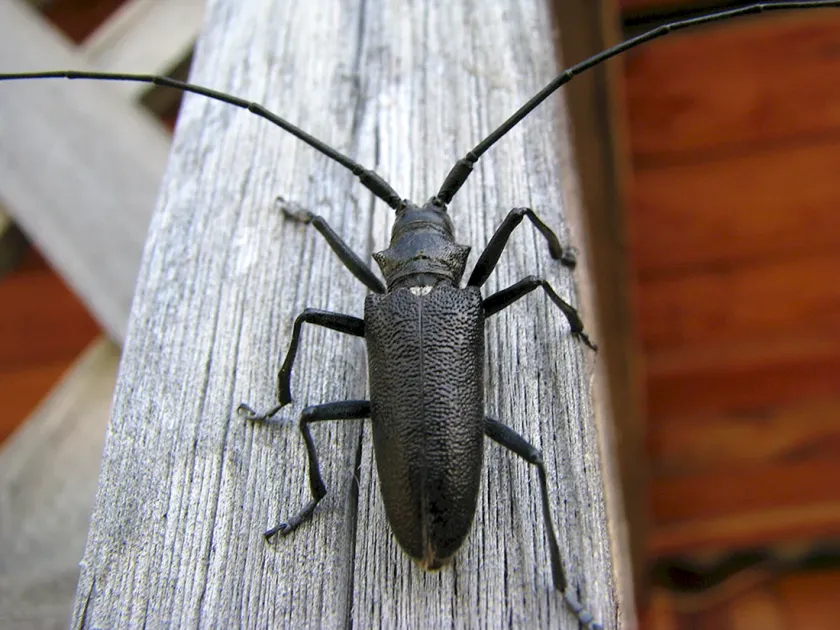
The Great Oak Longhorn Beetle (Hoplocerambyx spinicornis) is a large insect belonging to the family Cerambycidae, order Coleoptera.
Adults of this species are notable for their impressive size, which can reach up to 65 mm in length, making them significant wood-boring pests.
Their bodies are dark brown or black with a matte texture, while the pronotum has a distinctively rough, grainy appearance.
One of the most striking physical features is the long antennae, which in males can be significantly longer than the beetle's own body.
The larvae are cream-colored, reaching up to 90 mm, and are equipped with powerful mandibles capable of boring deep into hardwood.
What it damages
This species primarily attacks oak trees (Quercus species), although it is known to infest other deciduous trees under certain conditions.
The beetle typically selects stressed or fallen trees for colonization, but in cases of high population density, it can attack healthy, mature trees as well.
The damage is caused primarily by the larvae, which create extensive galleries in the sapwood and heartwood of the trunk.
This internal tunneling disrupts the tree's vascular system, leading to dieback, loss of structural integrity, and often the death of the tree.
Besides structural damage, the infestation often invites secondary pathogens, accelerating the decline of the forest or garden specimen.
When it appears
The adult beetles are active during the summer months, typically emerging between June and August for mating and dispersal.
Females search for suitable host trees to deposit their eggs, preferring the lower parts of the trunk where bark crevices are available.
The life cycle of this beetle usually lasts between one and two years, during which larvae undergo multiple developmental stages inside the tree.
Pupation occurs inside the wood, where the larvae construct specialized chambers before transforming into the adult stage.
After reaching maturity, the new generation of adults chews through the wood to emerge, leaving distinct exit holes in the bark.
Signs of infestation
The presence of fine wood dust, known as frass, accumulating at the base of a tree is a primary indicator of larval activity inside.
Visible entry and exit holes on the trunk surface suggest an active infestation and should be inspected carefully by arborists.
Crown thinning, yellowing foliage, and premature leaf drop are common symptoms that the tree's health is compromised by internal larval boring.
In severe cases, pieces of bark may begin to slough off, revealing the extensive galleries created by the large larvae beneath the surface.
Audible gnawing sounds can sometimes be detected near the trunk, providing confirmation of high-intensity larval feeding activity.
Control measures
The most reliable control measure involves the systematic removal and destruction of infested or weakened trees to prevent further spread.
Good forest hygiene is crucial, including the prompt removal of downed timber and debris that may provide breeding sites for the beetles.
Pheromone-baited traps are highly effective for monitoring local populations and capturing adult beetles before they lay eggs.
In high-value ornamental or park settings, targeted insecticide applications during the beetle emergence period can provide additional protection.
Long-term strategies should focus on maintaining tree vigor through proper watering and soil management to reduce susceptibility to attack.
Taxonomy
- Latin name
- Hoplocerambyx spinicornis
- Order
- Coleoptera (beetles)
- Family
- Cerambycidae
- EPPO code
- HPLCSC
Discussion
No discussions yet — be the first.