
Great oak longhorn beetle
Hoplocerambyx
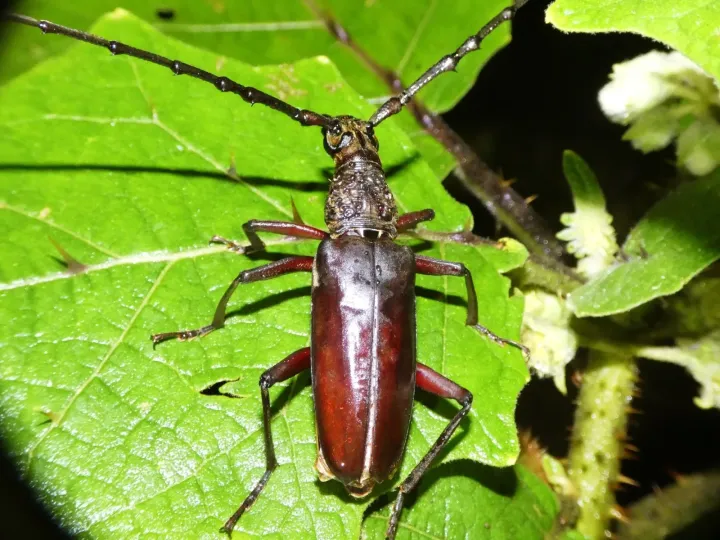
Description
How to identify
The great oak longhorn beetle (Hoplocerambyx cerdo) is a member of the Coleoptera order and the Cerambycidae family. It is one of the largest beetles in Europe, with adults growing up to 55–60 mm long.
The beetle has a dark brown or black appearance, with the posterior part of the elytra often displaying a reddish-brown hue. Males are particularly notable for their extremely long antennae, which extend well beyond their body length.
The larvae are cylindrical and creamy-white, reaching lengths of up to 100 mm. They possess a well-developed head with powerful mandibles capable of shredding tough hardwood.
The life cycle is long, typically ranging from three to five years, depending on the climatic conditions and the health status of the host tree.
These insects are primarily nocturnal, spending daylight hours hiding in deep cracks and crevices of the bark, which makes them difficult to spot in daylight.
What it damages
While the beetle shows a strong preference for oak species, it can occasionally infest other broad-leaved trees such as beech, hornbeam, elm, or sweet chestnut.
Although the insect often targets weakened or stressed trees, massive populations can successfully infest and eventually kill healthy, large mature oaks.
Larvae create extensive, deep galleries within the wood. Initially, they feed under the bark, but as they grow, they burrow deeper into the sapwood and heartwood, compromising the structural integrity of the trunk.
Heavy infestations lead to widespread tree decline, significant economic loss in timber quality, and an increased risk of trees falling during windstorms.
In forest ecosystems, the damage caused by this pest can trigger a domino effect of tree mortality, especially in old-growth stands that are already experiencing environmental stress.
When it appears
Adult emergence typically begins in early summer, around June, and continues through August, with peak activity occurring during warm July evenings.
Females lay eggs individually in bark crevices, usually on the lower part of the trunk where the bark is thick enough to provide protection for the young larvae.
After hatching, the neonate larvae immediately begin boring into the bark. As the season progresses, they penetrate deeper layers of the wood to overwinter.
Pupation takes place within a specially constructed chamber deep inside the tree's heartwood, a process that happens in the final year of the larva's development.
New adults emerge by boring circular or oval exit holes, allowing them to leave the tree and begin the mating cycle once again.
Signs of infestation
The most visible sign of an infestation is the presence of large, circular or oval exit holes, measuring up to 20 mm in diameter, on the surface of the bark.
Accumulations of frass—a sawdust-like mixture of wood particles and excrement—at the base of the trunk indicate that larvae are actively feeding inside.
Infested trees often exhibit signs of physiological decline, such as canopy thinning, premature yellowing of leaves, and dieback of individual large branches.
Dark sap flux or lesions on the trunk, caused by larval activity underneath the bark, may also be visible in the lower sections of the tree.
- Large exit holes in the bark.
- Frass deposits at the root collar.
- Premature yellowing and leaf loss.
- Visible bark damage and sap secretion.
Control measures
The most effective strategy for managing this pest is the timely implementation of sanitary logging, removing infested trees before the next generation of beetles emerges.
Promoting a balanced forest ecosystem that supports natural predators and parasitoids is essential for long-term population control.
Chemical control is generally restricted or discouraged in forest management due to the protected status of the species in many regions and environmental concerns.
For high-value trees in parks or historical sites, manual extraction of larvae or the use of specialized biopesticides may be considered on a case-by-case basis.
Prevention focuses on maintaining healthy, resilient tree stands and strictly removing fallen or dead wood that could act as a breeding reservoir for the beetle population.
Taxonomy
- Latin name
- Hoplocerambyx
- Order
- Coleoptera (beetles)
- Family
- Cerambycidae
- EPPO code
- HPLCSP
Discussion
No discussions yet — be the first.