
Jezo katydid
Homorocoryphus jezoenis
Description
How to identify
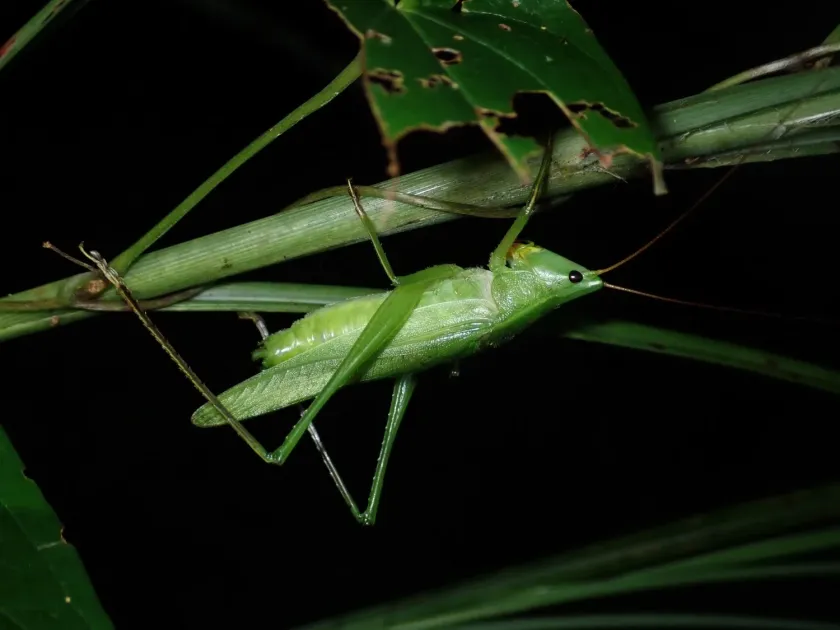
The Jezo katydid (Homorocoryphus jezoensis) belongs to the order Orthoptera and the Tettigoniidae family. These insects typically exhibit a slender body structure and are often green or brownish, allowing them to blend into the surrounding vegetation.
Adults possess long, thread-like antennae that are notably longer than their bodies. Their well-developed wings enable them to cover significant distances, allowing them to move efficiently across agricultural landscapes.
Like many katydids, they have tympanal organs on their front legs, which are sensory structures used to detect sounds and vibrations, facilitating communication between individuals in the dark.
Females are equipped with a saber-shaped ovipositor, which is used to deposit eggs into plant tissues or the soil, ensuring the protection of the next generation during unfavorable conditions.
The life cycle involves incomplete metamorphosis. Nymphs closely resemble smaller versions of the adults, undergoing several molting stages before reaching sexual maturity.
What it damages
This species is a generalist feeder, known to attack a variety of agricultural crops, including cereals, grasses, and some vegetable plants, depending on food availability in the habitat.
The primary damage occurs when both nymphs and adults consume foliage, which reduces the plant's photosynthetic capacity and hinders overall biomass accumulation.
During outbreaks, they can cause significant yield losses by feeding on the reproductive parts of crops, specifically attacking developing cereal heads and grains, which directly impacts the harvest quality.
Feeding activities can also weaken plant stems, leading to potential structural damage and increasing the plant's susceptibility to secondary pathogens such as fungi and bacteria that enter through feeding wounds.
Fields adjacent to uncultivated pastures or grasslands are particularly prone to infestation, as these areas often serve as primary breeding grounds for the population.
When it appears
The life cycle of the Jezo katydid is highly temperature-dependent. Overwintering occurs primarily in the egg stage, which remains dormant in the soil or within plant debris until environmental conditions become favorable.
Nymphs typically emerge in late spring or early summer. This stage coincides with the period when most crops are in their active growth phase, providing an abundant food source for the developing insects.
Adults usually appear in mid-to-late summer. This is when the insects are most active and voracious, leading to the highest potential for crop damage during the grain-filling or ripening stages.
Mating and egg-laying activities peak toward the end of the summer. After the reproductive cycle is complete, the adult population begins to decline as temperatures drop in autumn.
Understanding this phenological timeline is critical for farmers to implement timely monitoring and intervention strategies before the pest population reaches damaging levels.
Signs of infestation
Initial signs of infestation often include irregularly shaped holes or ragged edges on leaves, which are typical indicators of nocturnal feeding activity by these insects.
The distinct, rhythmic chirping sound produced by males during the evening hours serves as a reliable auditory indicator of their presence within the crop canopy.
In cereal crops, damage to the heads, such as partially eaten glumes or missing kernels, provides a clear visual signal that the katydids have shifted their feeding focus to the reproductive parts of the plant.
The presence of frass (insect excrement) on the leaves and stems is another useful sign that can help assess the density and distribution of the pest within the field.
Localized yellowing or lodging of stems can occur where feeding has been intensive, often weakening the structural integrity of the plant.
Control measures
Integrated pest management (IPM) for the Jezo katydid starts with field sanitation. Clearing weeds and tall grass from field margins and ditches removes essential breeding and shelter sites.
Deep autumn plowing is a highly effective mechanical control measure, as it disturbs the soil and destroys overwintering eggs, significantly reducing the pest pressure for the following season.
If population levels exceed economic injury thresholds, the use of targeted insecticides may be necessary. It is crucial to choose products that are effective against Orthoptera while minimizing impact on non-target species.
Biological control relies on preserving habitats for natural predators, such as birds and beneficial predatory insects, which can help keep the katydid population in check naturally.
- Regular monitoring using light traps to track adult activity.
- Prompt harvesting to minimize the time crops are exposed to pests.
- Crop rotation to disrupt the continuity of the pest's life cycle.
Taxonomy
- Latin name
- Homorocoryphus jezoenis
- Order
- Orthoptera (locusts)
- Family
- Conocephalidae
- EPPO code
- HOMRJE
Discussion
No discussions yet — be the first.