
Sable antelope
Hippotragus niger
Description
How to identify
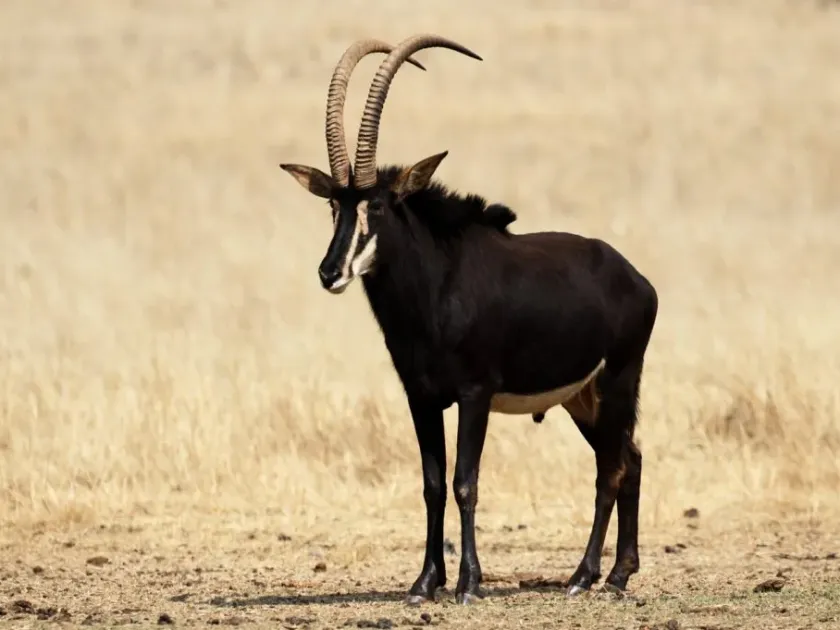
The sable antelope (Hippotragus niger) belongs to the order Artiodactyla and the family Bovidae. It is a large, sturdy animal characterized by long, backwards-curved horns that can grow up to one meter in length.
Adult males are striking with a dark brown to deep black coat, while females and juveniles have a more reddish-brown appearance. They possess distinct white facial markings, often referred to as a mask, which serve as a key visual identifier in the field.
Sable antelopes live in social groups led by a dominant male. They are naturally cautious but will venture far in search of high-quality grazing land, often congregating in areas with lush, nutrient-dense vegetation.
Their physiology is well-adapted to savanna and woodland environments, where they selectively graze on specific grasses. This selective feeding behavior can lead them to target crops that mimic their natural diet preferences.
In agricultural settings, their presence acts as a significant herbivory pressure, potentially causing extensive damage to crops through both intensive grazing and trampling by their heavy hooves.
What it damages
The primary agricultural targets for sable antelope include maize, sorghum, and various cereal crops. They consume both leafy mass and young shoots, which can severely compromise crop yield.
Grazing damage is particularly severe when antelopes target the growing points of young plants, often leading to total loss of individual specimens or stunted growth across the affected areas of the field.
Trampling damage is a secondary but equally significant problem. The weight of these animals compacts the soil and destroys the root structure of crops, reducing the overall vitality of the remaining plants.
Economic damage peaks during drought periods when natural pastures wither, forcing herds to migrate toward irrigated farmlands where the vegetation remains green and palatable.
Impacts include decreased harvesting efficiency, the need for costly replanting of damaged patches, and increased operational costs for farmers attempting to defend their lands.
When it appears
Antelope activity in agricultural areas is highest during the dry season. As wild forage availability declines, herds are driven to search for consistent food sources near human activity.
The timing of raids often aligns with the vegetative stage of crops, where plants are at their most succulent and nutrient-rich, making them highly attractive to visiting herds.
Migration patterns are typically influenced by the location of water sources and the growth cycles of agricultural commodities in the surrounding landscape.
As nocturnal and crepuscular feeders, these antelopes are most active in the early morning and late evening, which makes monitoring their presence and timing protective measures more challenging.
While pressure fluctuates depending on natural conditions, the risk remains a constant concern throughout the critical growth periods of cereal and grain crops.
Signs of infestation
One of the first signs of antelope presence is the appearance of distinct hoof prints, which are easily identifiable by their size and the depth of impact in soft soil.
The presence of droppings within the field is a clear indicator of herd activity and confirms that the animals have been feeding in the area over a sustained period.
Grazing signs often include uneven patches where vegetation appears stripped or "mowed" down, distinct from machine-harvested areas or typical mechanical damage.
Visible trails or paths leading from nearby wild habitats to the edge of the fields indicate established routes used by the herd to access food sources regularly.
Flattened vegetation and trampled patches of crop without clear signs of machinery use often point to resting sites where the herd has gathered during the night.
Control measures
Robust fencing is the most effective deterrent for managing sable antelope. Barriers must be of sufficient height and strength to prevent entry into sensitive agricultural zones.
Bio-acoustic deterrents, which play alarm calls or predator sounds, can be used to discourage the antelopes, although their effectiveness requires rotation to prevent animal habituation.
Repellents applied to the perimeter of fields can create an olfactory barrier that deters antelopes from entering, encouraging them to find alternative, less protected feeding grounds.
Planting buffer strips of less valuable but highly palatable fodder crops can help distract the herd and mitigate damage to the primary commodity crops.
Collaboration with local wildlife management agencies is recommended to monitor herd populations and implement non-lethal solutions that balance farming interests with wildlife conservation.
Taxonomy
- Latin name
- Hippotragus niger
- Family
- Bovidae
- EPPO code
- HPPTNI
Discussion
No discussions yet — be the first.