
Mottled umber
Hibernia tiliaria
Description
How to identify
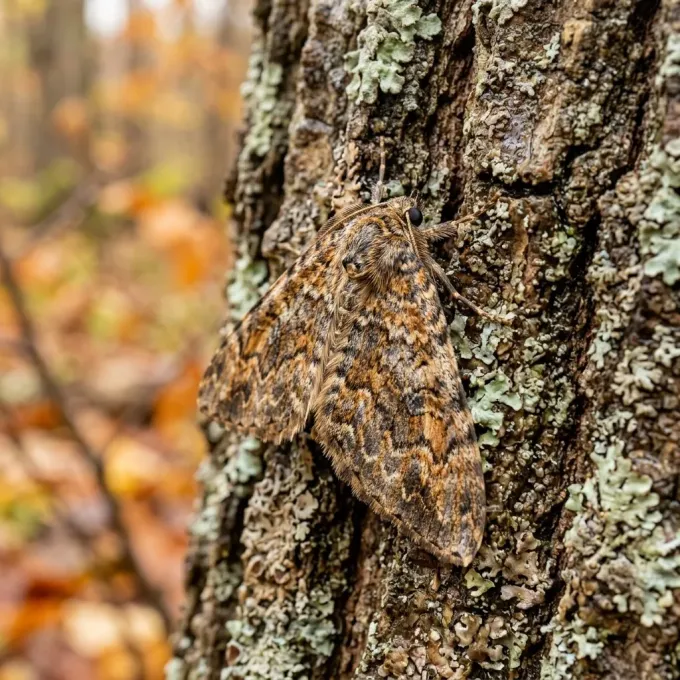
The mottled umber (lat. Hibernia tiliaria or Erannis defoliaria) is a moth of the family Geometridae. The species exhibits striking sexual dimorphism: males have broad, brown-patterned wings, while females are flightless, possessing only vestigial wings and a spider-like appearance.
The larvae, known as loopers or inchworms, have a characteristic movement pattern, pulling their hind segments towards their thoracic legs. They are generally yellowish-brown with a distinct dark stripe along their back, which acts as camouflage.
The insect undergoes complete metamorphosis: egg, larva, pupa, and imago. Unlike most moth species, adults emerge and mate in late autumn, often even after the first frosts, which helps them avoid peak activity of many predators.
Eggs serve as the overwintering stage. They are typically laid in small clusters or singly within bark crevices, around bud scales, or in branch forks, ensuring protection from winter conditions.
Pupation occurs in the soil beneath the host plant, inside a loose silken cocoon. This stage lasts throughout the summer months, allowing the species to survive warm and dry periods in a dormant state.
What it damages
This moth is a polyphagous pest, causing significant damage to both forest trees and fruit orchards. Preferred hosts include lime (linden), oak, birch, hornbeam, and various fruit species like apple, pear, and plum.
The caterpillar stage is the primary source of damage. Due to their voracious feeding, large populations can cause severe defoliation, stripping trees bare and severely hindering the photosynthetic process.
Heavy defoliation in spring depletes the tree's energy reserves, leading to poor fruit development, dropped yield, and an increased susceptibility to secondary pests, such as wood-boring beetles and fungal diseases.
In orchards, consistent defoliation over several consecutive seasons can lead to the death of branches or, in extreme cases, the entire tree, causing major economic losses for producers.
High population densities, often referred to as outbreaks, can encompass large forest areas, requiring coordinated monitoring and management efforts to prevent long-term ecological and timber damage.
When it appears
The flight period for adult moths begins in late autumn, typically from October to November. During this time, males search for the wingless females on tree trunks to mate.
Egg hatching takes place in early spring, usually in April or May, coinciding perfectly with the bud-burst of the host plants, which provides the larvae with an immediate and abundant food source.
Larvae feed actively throughout May and the first half of June. This growth phase is rapid, as the caterpillars consume significant amounts of plant matter to complete their development.
By mid-June, the mature caterpillars descend from the canopy to the ground. They burrow into the soil or leaf litter to construct their cocoons and undergo pupation.
The pupal stage lasts through the summer months, and the insects remain hidden in the soil until the cooler temperatures of autumn trigger the emergence of the adults.
Signs of infestation
The earliest sign of infestation is the appearance of small, irregular holes in young leaves. These holes expand rapidly as the larvae grow, often leaving only the major veins of the leaf.
Accumulations of frass (caterpillar droppings) under the canopy are a clear indicator of heavy infestation. These droppings can often be seen on the ground or stuck to lower foliage.
Caterpillars can often be observed hanging from branches on silken threads, a defensive behavior used to escape predators or redistribute themselves within the tree canopy.
During autumn or winter, bark inspections may reveal egg batches, which appear as tiny, dark, shiny clusters hidden in crevices near tree buds.
- Skeletonized leaves.
- Webbing between branches.
- Defoliated shoots.
- Increased activity of insectivorous birds near tree canopies.
Control measures
Management of the mottled umber involves an integrated pest management (IPM) approach to minimize damage while maintaining ecological balance in orchards and woodlands.
Applying sticky bands around tree trunks in late autumn is a highly effective mechanical control measure. These bands prevent the flightless females from climbing up to the canopy to lay their eggs.
Spring treatments with contact or stomach-poison insecticides should be timed to coincide with the period of peak egg hatching. This ensures the best efficacy before larvae cause significant damage.
Biological control, including the use of microbial insecticides like Bacillus thuringiensis, is an environmentally friendly option that effectively targets the larvae while preserving beneficial insect populations.
Encouraging natural predators, such as insectivorous birds and predatory wasps, through habitat management can naturally keep pest populations below the threshold of economic concern.
Taxonomy
- Latin name
- Hibernia tiliaria
- Order
- Lepidoptera (butterflies)
- Family
- Geometridae
- EPPO code
- HIBETI
Discussion
No discussions yet — be the first.