
Mottled Umber
Hibernia marginaria
Description
How to identify
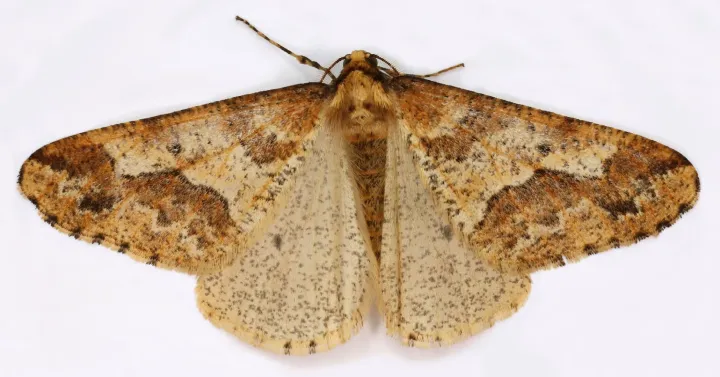
The Mottled Umber (Hibernia marginaria) is a moth belonging to the family Geometridae. The species displays significant sexual dimorphism: the males have fully developed wings with a brown, mottled appearance, while the females are flightless, possessing only vestigial wings, resembling small spiders.
The adult males typically emerge in late autumn and have a wingspan of approximately 30–35 mm. Their cryptic coloration allows them to blend seamlessly with the bark of trees during the day. Females remain on the trunks, waiting for males to find them for mating.
The larvae, known as loopers or inchworms, have a characteristic looping gait due to the reduction of their central prolegs. They vary in color from pale green to brownish, often with subtle patterns that mimic the twigs and buds of their host plants.
The lifecycle consists of four distinct stages: egg, larva, pupa, and adult. The eggs overwinter on the bark of host trees, providing a stable foundation for the next generation to begin feeding as soon as the vegetation starts to grow in the spring.
Due to their specific biological requirements, they are well-adapted to temperate climates, successfully timing their larval emergence with the budburst of various deciduous trees, which ensures an immediate and abundant food supply.
What it damages
The Mottled Umber is a polyphagous pest that feeds on a wide range of deciduous trees and shrubs. It is particularly damaging to fruit trees, including apples, pears, plums, and cherries, which are common targets in orchards and home gardens.
Beyond fruit trees, the larvae are frequently found on hardwoods such as oaks, beeches, birches, and elms. While often considered a minor pest in balanced ecosystems, mass outbreaks can lead to significant defoliation of these forest species.
The primary damage occurs in the early spring when the larvae consume the developing buds. This prevents the formation of flowers and leaves, directly threatening the potential yield and the overall vigor of the plant.
As the season progresses, the larvae feed on the foliage, skeletonizing leaves by consuming the soft tissues between the veins. Severe infestations can leave entire branches bare, significantly reducing the tree's photosynthetic capacity.
Weakened trees are far more susceptible to secondary stressors, such as fungal infections, drought, or attacks by bark-boring beetles, which can ultimately lead to the decline of branch health or the death of the entire tree if the infestation persists over several years.
When it appears
Adult moths are active during the autumn months, typically from October to November. This is the period when mating occurs and eggs are deposited securely into crevices in the bark or near the base of branches.
The eggs remain dormant throughout the winter, protected from cold temperatures and predators. They are highly resilient and act as the overwintering stage for the species.
In spring, usually around April, the larvae hatch. This timing is critical, as it aligns with the swelling and opening of tree buds, providing the larvae with the most nutritious and accessible food source possible.
The larval stage lasts for several weeks, during which they grow rapidly. They remain active until late spring or early summer, depending on the local climate and the host species they are feeding upon.
By early summer, the larvae descend to the soil to pupate. The pupal stage lasts throughout the summer and early autumn, hidden within the ground, where they remain protected until the cycle restarts with the emergence of adult moths.
Signs of infestation
One of the first signs of an infestation is the presence of hollowed-out or damaged buds in the spring. If buds fail to open or appear stunted, it is a strong indicator of early larval feeding.
Observing the larvae themselves is another clear sign. During the day, they may hide or remain still, but a quick inspection of the underside of leaves or near the buds often reveals the presence of these loopers.
Extensive defoliation is a sign of a high-density population. When trees appear thin or have large portions of missing leaf tissue, it is indicative of a significant feeding event that has likely been ongoing for weeks.
The presence of silken threads or leaves tied together with light webbing can also indicate the presence of Mottled Umber larvae, which use these structures as protection while they feed.
During late summer, the presence of pupae in the soil under the canopy can be observed by gently sifting through the topsoil, which can help gardeners assess the potential population size for the following season.
Control measures
Cultural control is a primary method, focusing on the mechanical disturbance of the soil under the tree canopy in late summer or autumn to expose pupae to predators and adverse weather conditions.
Sticky bands or grease bands applied to tree trunks in the autumn are highly effective. Since females are flightless and must climb the trunk to reach the branches for egg-laying, these barriers effectively stop them in their tracks.
Biological controls include the use of Bacillus thuringiensis (Bt) sprays. These are specific to lepidopteran larvae and are an environmentally friendly way to manage populations without harming beneficial insects.
Chemical intervention should be considered a last resort and should be timed to coincide with the hatching of the larvae, using targeted insecticides only when the population exceeds established economic damage thresholds.
- Maintain tree health through proper pruning and fertilization.
- Encourage insectivorous birds, which prey on larvae.
- Regularly monitor bark for egg clusters during winter.
- Remove weeds around the base of trees to eliminate hiding spots for pupae.
Taxonomy
- Latin name
- Hibernia marginaria
- Order
- Lepidoptera (butterflies)
- Family
- Geometridae
- EPPO code
- HIBEMA
Discussion
No discussions yet — be the first.