
Beet triozid
Heterotrioza chenopodii
Description
How to identify
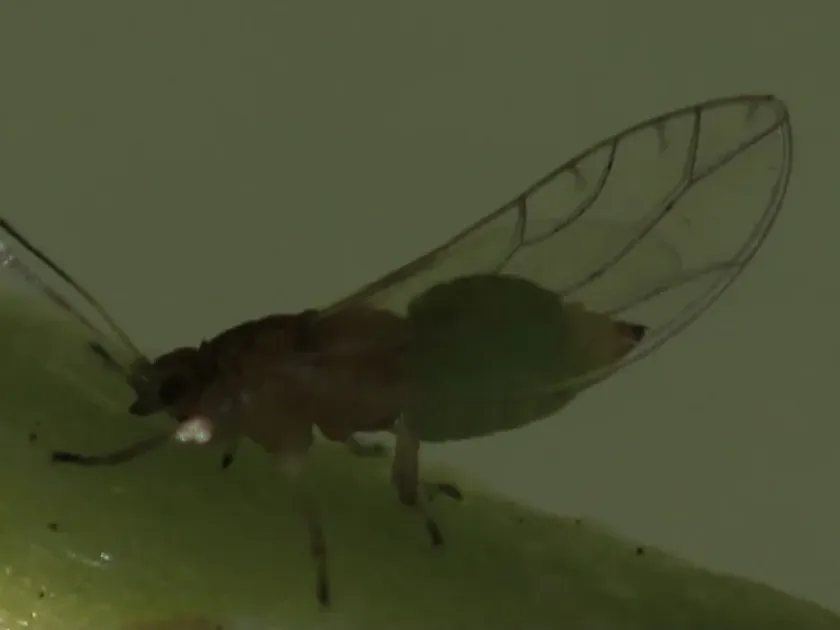
The beet triozid (Heterotrioza chenopodii) is a small insect belonging to the Triozidae family within the order Hemiptera, commonly found in temperate agricultural regions.
Adult insects are typically 2 to 3 mm in length, possessing a greenish to brownish hue that allows them to blend in seamlessly with host plant foliage.
They are characterized by strong hind legs adapted for jumping, which they use to quickly relocate when disturbed or when seeking new host plants.
The nymphs are often flattened and may be covered with waxy secretions, serving as a protective layer against environmental stress and desiccation.
The life cycle encompasses several nymphal instars before reaching the adult stage, with the developmental rate highly dependent on ambient temperature.
What it damages
The beet triozid primarily targets members of the Amaranthaceae family, most notably sugar beet, fodder beet, table beet, and spinach.
They are also frequently found on common weeds such as white goosefoot (Chenopodium album), which often act as alternative hosts throughout the season.
Both adults and nymphs feed by piercing plant tissues and extracting sap, which deprives the plant of essential nutrients and disrupts normal metabolic processes.
Feeding often leads to significant leaf deformation, stunted plant growth, and a reduction in the overall yield potential of the affected vegetable crops.
Severe infestations can lead to decreased photosynthetic efficiency, weakening the plant and making it more susceptible to secondary pathogens or environmental stress.
When it appears
Beet triozids overwinter as adults in protected environments, including crop residues, debris along field margins, or on perennial weed hosts.
In spring, as temperatures rise, the adults migrate to newly emerged beet seedlings, which represent a highly vulnerable stage for the crop.
The most significant damage typically occurs in late spring and early summer when the population density increases through subsequent generations.
Environmental conditions, particularly warm and dry springs, favor rapid population growth and increased activity of the pest across agricultural fields.
As the season progresses and crops mature, the migration patterns change, and adults eventually seek overwintering sites as temperatures decline in autumn.
Signs of infestation
The most visible symptom of a beet triozid infestation is the characteristic curling and crinkling of leaves, often accompanied by yellowing or chlorosis.
Affected leaves may exhibit stunted development, with the plants taking on a warped or stunted appearance that hampers uniform field growth.
- Leaf curling, crinkling, and distortion of the younger foliage.
- Visible chlorotic spotting or general yellowing of the leaf surface.
- Presence of nymphs on the undersides of leaves, often near the veins.
- Sticky honeydew residues left behind by feeding insects.
- General lack of vigor and slower developmental rates in affected crops.
Plants struggling under heavy infestation may eventually wilt if the feeding pressure is high enough to significantly disrupt water transport within the plant.
Scouting for early signs is critical, as leaf distortion is often irreversible once the feeding injury has occurred to the developing tissue.
Control measures
Management begins with rigorous weed control, specifically targeting goosefoot and related species to eliminate overwintering and early-season breeding grounds.
Crop rotation and maintaining spatial isolation between new beet fields and areas previously occupied by the host crops are essential preventative measures.
If population levels exceed economic thresholds, the application of registered insecticides is necessary to suppress the infestation and protect crop yields.
Implementing monitoring programs, such as using yellow sticky traps in early spring, helps growers track adult migration and time potential interventions.
Encouraging natural biological control agents, such as predatory beetles or parasitic wasps, can help keep local populations of the beet triozid in check.
Taxonomy
- Latin name
- Heterotrioza chenopodii
- Order
- Hemiptera (bugs, aphids, leafhoppers)
- Family
- Triozidae
- EPPO code
- TRIZCE
Discussion
No discussions yet — be the first.