
Steppe carpet moth
Hematurga amitaria
Description
How to identify
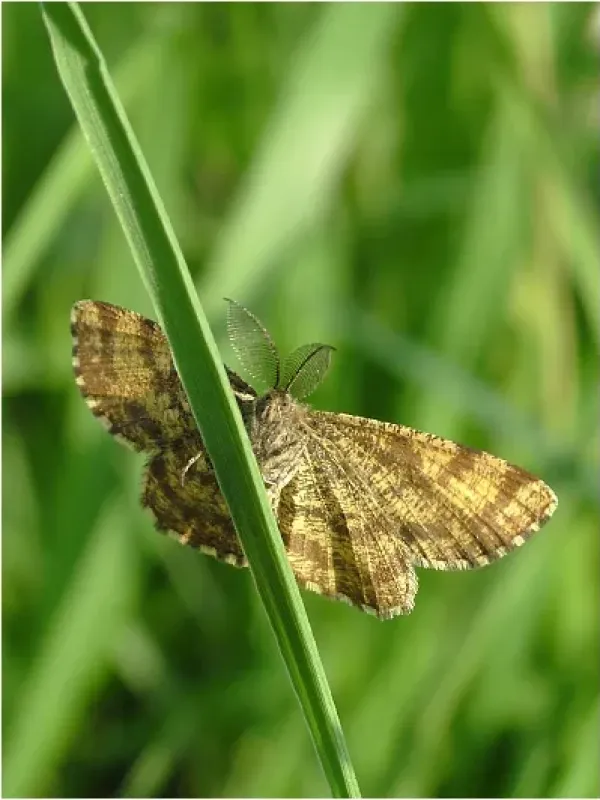
The Steppe carpet moth, scientifically known as Hematurga amitaria, belongs to the Geometridae family within the order Lepidoptera.
The adult moth features a wingspan of approximately 25–30 mm, with wings typically displaying brownish-yellow or ochre shades marked with dark cross-bands.
Larvae, commonly referred to as loopers, possess the distinct movement style of the Geometridae family, drawing their hind segments toward their thoracic legs.
The protective coloring of the caterpillars allows them to blend seamlessly with dry grasses and soil, making manual identification in the field quite challenging.
The insect undergoes a complete metamorphosis, consisting of egg, larva, pupa, and adult stages, each requiring specific environmental conditions for development.
What it damages
As a polyphagous insect, Hematurga amitaria primarily feeds on various steppe grasses, but it can shift to cultivated crops during outbreaks.
Cereals and legumes are particularly susceptible to damage, especially when the pest population density exceeds standard biological thresholds.
Larvae consume the foliage, often starting from the edges or creating holes in the leaf tissue, which directly affects the plant's photosynthetic efficiency.
Heavy infestations can lead to significant thinning of crop stands, which may result in yield reduction if damage occurs during critical growth stages.
Repeated defoliation by the caterpillars weakens the plants, making them more susceptible to drought stress and secondary pathogens.
When it appears
Adult moths typically emerge in late spring and early summer, taking advantage of the warm temperatures characteristic of the steppe climate.
The larval development period is synchronized with the active growth phase of the vegetation, providing the necessary nutrients for their rapid maturation.
Environmental factors, such as high temperatures and low humidity, can potentially trigger mass outbreaks if natural population regulators are absent.
The pupal stage is the primary mode of overwintering, occurring in the soil profile, which provides essential thermal insulation against harsh winters.
Agronomic field scouting is most critical from May through July, as this covers the peak of larval activity and potential crop damage.
Signs of infestation
The most visible indicator of infestation is the presence of jagged, irregular feeding patterns on the leaves of host plants.
Scouting involves checking the base of the plant or the underside of leaves, where the larvae often retreat to avoid high solar radiation during the day.
Accumulation of larval frass on the leaf surfaces or the ground beneath the plant serves as a clear indicator of recent feeding activity.
The presence of adult moths during field inspections is a strong warning that oviposition has occurred and larvae are likely developing nearby.
- Tattered leaf margins.
- Visible loopers on plant stems.
- Circular or irregular holes in the leaf blade.
Control measures
Cultural control practices, such as deep autumn plowing, are highly effective in disrupting the pupation process and reducing the pest population.
Effective weed management on field margins and within the crop is essential to eliminate alternative host plants and potential reservoirs.
Chemical control measures should be implemented when scouting indicates that larval density has reached the economic threshold for the specific crop.
Biological control using microbial insecticides, such as those derived from Bacillus thuringiensis, offers an effective and environmentally friendly solution.
Continuous monitoring using pheromone traps and visual inspection helps in timing applications accurately, ensuring maximum efficacy of the protection measures.
Taxonomy
- Latin name
- Hematurga amitaria
- Order
- Lepidoptera (butterflies)
- Family
- Geometridae
- EPPO code
- HEMUAM
Discussion
No discussions yet — be the first.