
Jamaican field cricket
Gryllus assimilis
Description
How to identify
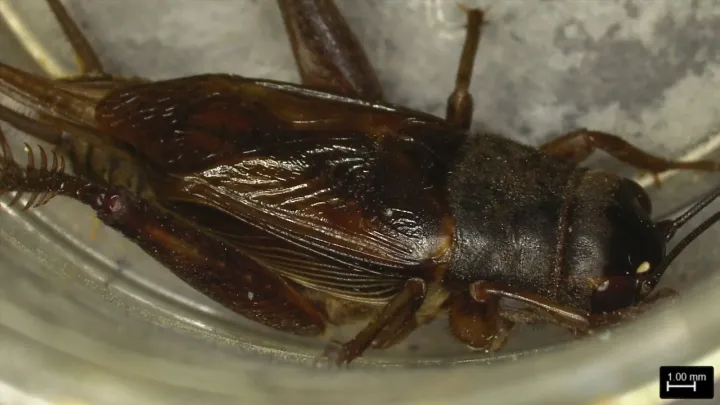
The Jamaican field cricket (Gryllus assimilis) is a large insect belonging to the order Orthoptera, family Gryllidae. Adults typically measure 2–3 cm in length and feature a dark coloration ranging from brown to black.
A key physical characteristic of this species is its robust chewing mouthparts, adapted for consuming a wide variety of plant and animal material. The head is equipped with long, thread-like antennae that serve as primary sensory organs for nocturnal orientation.
Adults possess well-developed wings, allowing them to travel significant distances to locate suitable breeding grounds or food sources. Their hind legs are enlarged and designed for powerful jumping, making manual removal difficult.
The life cycle consists of three stages: egg, nymph, and adult. Nymphs resemble miniature versions of adults but lack fully developed wings and reproductive capabilities.
This species thrives in warm climates, meaning it is most prevalent in tropical and subtropical regions where environmental conditions support multiple generations per year.
What it damages
This pest is a generalist feeder (polyphagous), making it highly destructive to a wide array of crops in gardens, farms, and greenhouses. The most severe damage typically occurs during the early growth stages.
The crickets frequently target vegetable crops such as tomatoes, cucumbers, peppers, and various brassica species. They often bite through the delicate stems of seedlings just at or slightly below the soil line.
In addition to vegetables, the Jamaican field cricket poses a threat to grain crops and various ornamental plants. During outbreaks, these insects can destroy entire seedbeds in just a few nights.
The damage is not limited to the surface; crickets frequently consume roots and seeds in the soil, preventing germination or killing seedlings before they ever emerge.
Beyond vegetative matter, crickets cause significant damage to fruits by boring deep cavities into them, which subsequently creates entry points for secondary fungal and bacterial pathogens.
When it appears
Activity levels are highly dependent on temperature and soil moisture. Crickets are most active during warm months when nighttime temperatures remain above 18–20 degrees Celsius.
In controlled environments such as greenhouses, the Jamaican field cricket can remain active year-round provided that stable and favorable conditions are maintained.
With the arrival of spring warmth, overwintering nymphs and adults emerge from their shelters to begin feeding, which coincides with the planting season for most crops.
The primary breeding period occurs throughout the summer when females deposit eggs into loose, moist soil. This timing usually corresponds to the peak population density and the most intense crop damage.
As temperatures begin to drop in autumn, these insects seek out overwintering sites, often congregating in buildings, garden debris, or deep soil fissures.
Signs of infestation
The primary indicator of a cricket infestation is characteristic damage to seedlings, where stems appear cleanly severed as if cut by a sharp blade.
The presence of small, uniform burrows in the soil (1–1.5 cm in diameter) is a clear sign that crickets have established a colony in the area.
The distinctive chirping sound of males during the evening and night is a definitive sign of an active, breeding population nearby.
A visual inspection of garden beds may reveal leaves with irregular, ragged edges or completely decimated seedbeds, often misidentified as the work of other ground-dwelling pests.
The accumulation of small, dark fecal pellets near the root zone of affected plants further confirms that the insects have been feeding extensively in that vicinity.
Control measures
Effective management of the Jamaican field cricket requires an integrated approach that combines cultural, biological, and chemical control methods.
- Deep tilling or plowing of the soil in autumn and spring to destroy egg-laying sites and overwintering burrows.
- Frequent cultivation and hoeing of inter-row spaces to disrupt burrow systems and discourage colonization.
- Removal of weeds and decaying plant material, which serve as essential cover and secondary food sources.
- Deployment of light traps at night to monitor population levels and reduce the number of reproductive adults.
- Application of approved insecticides as a last resort when infestation levels reach the economic threshold.
Taxonomy
- Latin name
- Gryllus assimilis
- Order
- Orthoptera (locusts)
- Family
- Gryllidae
- EPPO code
- ACHTAS
Discussion
No discussions yet — be the first.