
Tropical house cricket
Gryllodes sigillatus
Description
How to identify
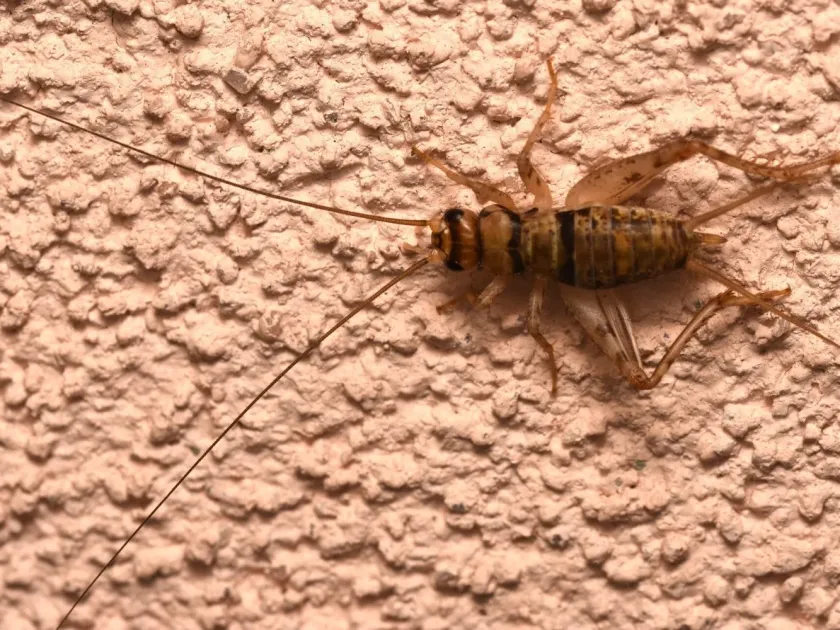
The tropical house cricket (Gryllodes sigillatus) belongs to the order Orthoptera and the family Gryllidae. It is a small insect characterized by a yellowish-brown color with dark cross-bands on the body.
Adult crickets typically reach 15–20 mm in length. Females possess a prominent ovipositor, which they use to insert eggs into moist substrate or soil crevices.
These insects are nocturnal and possess well-developed hind legs adapted for jumping, allowing them to move rapidly within enclosed structures such as greenhouses.
They are thermophilic organisms that thrive in consistently high temperatures, making them a significant pest in heated indoor cultivation facilities.
Their biology is closely linked to high humidity and the presence of organic debris, which provide optimal breeding sites and food sources for the colony.
What it damages
The tropical house cricket is a generalist feeder that damages a wide array of crops. In greenhouses, they frequently attack young vegetable seedlings, consuming cotyledons and stems.
Beyond seedlings, the pest causes damage to ornamental plant crops, leading to significant financial losses for commercial nurseries and farms.
Damage is inflicted by both nymphs and adults using their chewing mouthparts, which often create wounds that facilitate secondary infections in plants.
In storage environments, they can consume stored seeds, which severely reduces their germination rate and quality for future planting cycles.
When population densities are high, crickets can destroy mature plant parts, including blossoms and fruit, causing widespread destruction across the crop.
When it appears
In tropical climates or heated greenhouse environments, this species can reproduce year-round without a defined diapause phase.
The life cycle consists of egg, nymph, and adult stages. Depending on environmental conditions, one generation can develop in approximately 60 to 80 days.
Mass reproduction typically peaks during periods of high humidity and temperatures ranging from 25 to 30 degrees Celsius, accelerating the developmental process.
Females deposit eggs in clusters throughout the soil, leading to a constant overlapping of generations that necessitates continuous monitoring.
Since their population grows constantly, integrated pest management programs must be maintained throughout the entire production cycle to prevent outbreaks.
Signs of infestation
Initial signs of infestation include irregular holes in leaves or completely eaten leaf edges caused by the nocturnal feeding of the crickets.
Distinctive chirping sounds emitted by males at night are clear indicators that a population has successfully established itself within the facility.
Soil inspection often reveals fecal droppings and mechanical damage to the base of young plant stalks, where nymphs may congregate to hide.
Inspection with a flashlight during nighttime hours frequently reveals the presence of jumping insects, confirming the infestation level.
- Chewed or destroyed young seedlings.
- Persistent night-time chirping.
- Presence of frass on the substrate surface.
- Damage to stored seed stock.
Control measures
The most effective strategy involves strict sanitation, including the regular removal of organic waste and plant debris that serve as hiding spots.
Insecticidal baits formulated for greenhouse use can effectively reduce the population density when placed in known areas of activity.
Biological control options include the use of entomopathogenic nematodes or fungal-based biopesticides that target nymphs and eggs in the soil.
Light traps are useful for monitoring population trends and can help capture a portion of the adult population during the night.
Maintaining proper humidity and temperature control can create an environment less favorable for egg survival and nymph development.
Taxonomy
- Latin name
- Gryllodes sigillatus
- Order
- Orthoptera (locusts)
- Family
- Gryllidae
- EPPO code
- GRYDSI
Discussion
No discussions yet — be the first.