
Brown cicada
Graptopsaltria
Description
How to identify
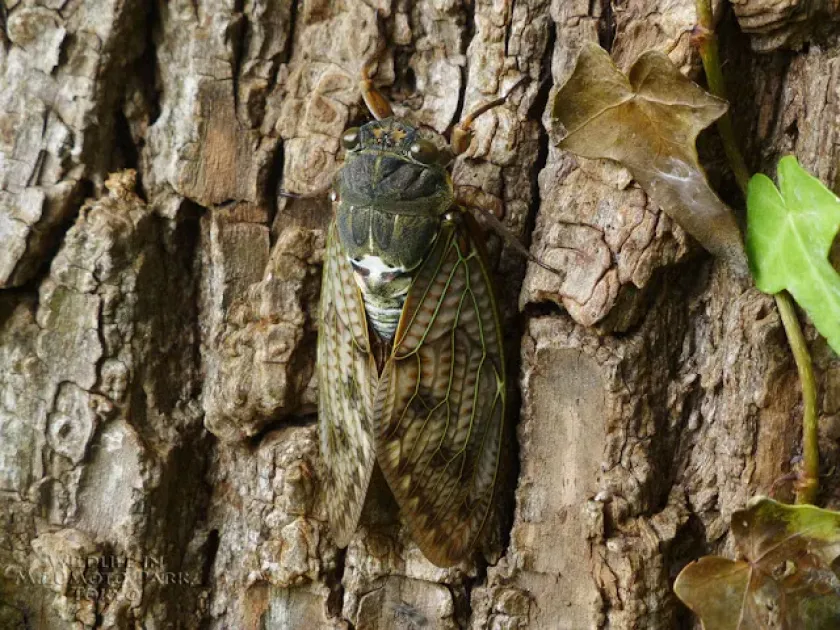
The brown cicada (Graptopsaltria nigrofuscata) is a large insect species within the Cicadidae family. Adult individuals possess brown or mottled coloration, providing excellent camouflage against tree bark.
These insects are notable for their significant wingspan, often reaching 70–80 millimeters. Males are equipped with specialized sound-producing organs (tymbals) used to attract mates during the summer season.
Nymphs spend several years living underground, where they subsist by feeding on the sap of tree roots. They are equipped with robust, shovel-like forelegs adapted for digging through dense soil.
Unlike adults, nymphs are wingless and have specialized mandibles for root feeding. When they reach maturity, they emerge from the soil, leaving empty exoskeletons (exuviae) attached to trunks.
As members of the Hemiptera order, their biology is characterized by complex cycles. High population densities can be detrimental, necessitating proactive monitoring by growers and orchard managers.
What it damages
Both adults and nymphs cause damage to vegetation. Adults utilize their needle-like mouthparts to pierce young branches and consume sap, which significantly weakens the plant and stunts growth.
The nymphs inhabiting the soil cause damage to the root systems of fruit and ornamental trees. Prolonged root feeding disrupts the plant's ability to absorb water and essential nutrients.
Fruit-bearing crops such as apples, pears, and peaches are highly susceptible to infestation. In periods of high population, they can also cause economic damage to forest and nursery trees.
Feeding sites often become entry points for secondary infections. Bark damage can lead to the development of fungal pathogens, resulting in branch dieback and general tree decline.
Young saplings are particularly vulnerable. Heavy root feeding by nymphs can lead to the death of the tree, as the plant lacks the vigor to overcome the physiological stress.
When it appears
The life cycle of the brown cicada is notably long, typically ranging from 3 to 5 years. The vast majority of this duration is spent in the nymphal stage buried beneath the soil surface.
Adult emergence typically occurs during the peak of summer, usually starting in June or July. Their presence is easily identified by the loud, rhythmic buzzing sounds produced by males.
The mating period lasts for several weeks. During this time, females lay eggs into the bark of tree branches, using a sharp ovipositor to create small pockets in the woody tissue.
Once the eggs hatch, the tiny nymphs drop to the ground and burrow into the soil. This initiates the long developmental cycle, remaining largely invisible for several seasons.
Understanding these seasonal patterns is critical for timing control measures. Strategic interventions during the emergence phase can significantly reduce the potential for future damage.
Signs of infestation
The most prominent indicator of cicada presence is the loud, continuous buzzing sound made by males throughout the day. It is a distinct acoustic sign of a resident population.
Discarded exoskeletons on tree trunks are a clear physical sign of recent emergence. These shells remain attached to the bark for a long time after the adult has flown away.
Small, puncture-like wounds on young branches indicate where adults have been feeding. In some cases, sap oozing from these spots suggests that the damage has breached the phloem.
Wilting, yellowing, or premature leaf drop are common symptoms of branch damage. When terminal shoots dry out, it often points to disrupted sap flow caused by feeding adults.
Soil disturbance or small exit holes at the base of trees may indicate where nymphs have emerged. Persistent tree weakness without evidence of typical pathogens warrants checking the roots.
Control measures
Management of the brown cicada requires an integrated approach. Healthy, well-maintained trees are generally more resilient to insect stress and recover faster from minor infestations.
Cultivation of the soil around the base of trees, particularly in autumn and spring, is an effective mechanical control. This practice disturbs the habitat and kills developing nymphs.
Application of systemic insecticides during the emergence period can reduce adult populations. Spraying should be targeted when insect activity is at its peak in the garden.
The use of light traps can help monitor and reduce adult numbers without relying solely on chemicals. These are effective in evening settings when cicadas are attracted to illumination.
- Sanitary pruning of damaged or dying branches.
- Maintaining optimal irrigation and fertilization to support tree vigor.
- Encouraging natural predators, such as birds, to visit the orchard.
Taxonomy
- Latin name
- Graptopsaltria
- Order
- Hemiptera (bugs, aphids, leafhoppers)
- Family
- Cicadidae
- EPPO code
- GRAOSP
Discussion
No discussions yet — be the first.