
Golden-spotted case-bearer moth
Goniodoma auroguttella
Description
How to identify
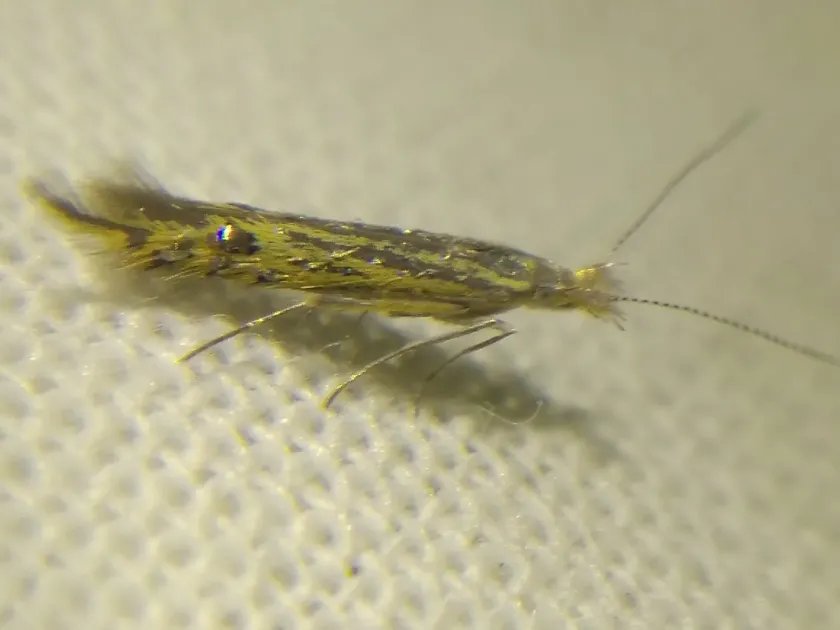
The golden-spotted case-bearer moth Goniodoma auroguttella belongs to the family Coleophoridae. This moth is distinguished by its unique larval stage where the caterpillar builds a protective case to live in.
The adult moth is small with narrow wings, often displaying a characteristic metallic gold or ochre sheen, which helps it camouflage within its environment.
The larvae are obligate leaf miners. They construct a portable case made of silk and plant debris, which they carry everywhere while feeding inside the leaf tissue.
As part of the Lepidoptera order, this species follows a complete metamorphosis cycle: egg, larva, pupa, and adult moth, with each stage adapted to specific host plants.
Due to the cryptic nature of the larvae, identifying this pest early is often challenging for farmers and agronomists during standard field inspections.
What it damages
This pest primarily infests plants of the Amaranthaceae family, with a strong preference for species in the Atriplex (orache) and Salsola (saltwort) genera.
The larvae feed on the internal parenchyma tissue of leaves, leaving behind characteristic transparent or pale blotch-like mines on the leaf surface.
As the larvae consume the mesophyll, the photosynthetic area of the plant is reduced, leading to leaf discoloration and eventual premature senescence of affected foliage.
In cases of high infestation density, the plant becomes weakened, which can reduce its competitive ability and overall biomass production in the field.
While often associated with weed populations, the moth's potential to migrate to related cultivated crops makes it a subject of agricultural interest.
Signs of infestation
The most reliable sign of infection is the presence of pale, irregularly shaped mines that mark the path of the larval feeding within the leaf.
One can also observe tiny, mobile cases attached to leaves or stems, which look like small bits of plant matter but possess the ability to move independently.
Leaves showing signs of damage often become necrotic in patches, starting from the areas where the larva has depleted the underlying plant tissue.
Tiny dark deposits of frass (larval waste) are often visible inside or near the exit holes of the mines, indicating active feeding by the caterpillar.
During the pupal stage, the cases are firmly attached to the undersides of leaves or stems, serving as a protective chamber for the insect until it emerges.
Control measures
Cultural control, particularly the effective removal of weeds belonging to the Amaranthaceae family, is the primary method to prevent population buildup.
Field sanitation practices, including the removal of infected plant material and post-harvest plowing, help reduce the overwintering pupae population.
Biological control agents, such as parasitoid wasps that target Coleophorid larvae, can be encouraged by maintaining natural field borders and avoiding broad-spectrum insecticides.
If chemical intervention is necessary for crop safety, systemic insecticides are generally more effective than contact-based products due to the larva's protective case.
Regular scouting throughout the growing season, focusing on the undersides of leaves, allows for early detection and targeted management before mass emergence.
Taxonomy
- Latin name
- Goniodoma auroguttella
- Order
- Lepidoptera (butterflies)
- Family
- Coleophoridae
- EPPO code
- GNDMAU
Discussion
No discussions yet — be the first.