
Coleophora coracipennella
Coleophora coracipennella
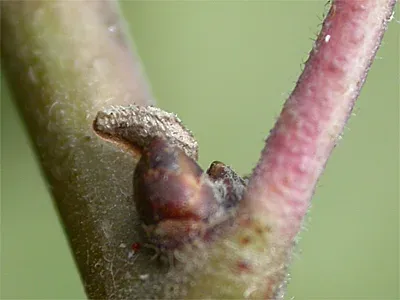
Description
How to identify
Coleophora coracipennella, commonly known as a type of casebearer moth, belongs to the family Coleophoridae within the order Lepidoptera. The adult moth is small, with a wingspan of approximately 10–12 mm, featuring narrow, pointed, dark-colored wings that exhibit a distinct metallic sheen.
The larva is the most recognizable stage due to its unique habit of building and living within a portable case. This protective cover is constructed from fragments of leaf tissue and silk, serving as a shield against predators and environmental stresses throughout the larval development.
The species undergoes a complete metamorphosis, including egg, larva, pupa, and adult stages. It typically overwinters as a young larva inside its robust case, securely attached to branches or tucked within crevices of the tree bark to survive winter conditions.
Adult moths are primarily nocturnal and crepuscular, making them difficult to spot during daylight hours. They often rest motionless on the undersides of leaves or along twigs, blending seamlessly with the plant's texture and color.
Identification is best achieved by observing the specific feeding patterns on foliage. The presence of small, moving cases on leaves, accompanied by characteristic shot-hole or mini-mine damage, is the most reliable indicator of a Coleophora coracipennella infestation.
What it damages
This pest primarily targets Rosaceae crops, causing significant damage to apple, pear, plum, cherry, hawthorn, and serviceberry trees. It is a persistent concern in both commercial fruit production and domestic gardens, impacting tree vigor and yield.
The larvae feed on leaf tissues by mining into the leaves and creating numerous small perforations. Because the larva periodically moves to new feeding sites while carrying its case, a single individual can cause substantial damage to the foliage over time.
Significant economic harm occurs in early spring when overwintered larvae emerge to feed on developing buds. This destruction of buds can lead to reduced flowering and fruit set, directly impacting the harvest potential of the orchard.
Persistent feeding by a large population of these larvae reduces the total photosynthetic area of the tree, leading to overall weakness. This reduced vigor can cause premature leaf drop, poor shoot development, and increased susceptibility to secondary infections.
Furthermore, the physical damage to the leaves provides entry points for various pathogens, including fungi that cause bark and leaf diseases. This makes the trees more vulnerable to environmental stresses such as drought or severe cold in subsequent growing seasons.
When it appears
Activity begins in early spring, synchronized with the swelling of buds. Overwintered larvae leave their dormant state and resume feeding, targeting the fresh green tissues of the emerging foliage and floral buds.
Pupation typically occurs in late spring or early summer, following a period of intense feeding. The larva anchors its case firmly to a leaf or twig, where it remains protected during the transformation process, which lasts roughly two to three weeks.
The flight period of adult moths generally peaks in June and July. During this time, the moths mate and lay eggs on the undersides of leaves, establishing the next generation that will eventually enter diapause for the winter.
Newly hatched larvae appear during the summer months and begin feeding on leaves. As they grow, they construct their own cases, which they continue to enlarge as they prepare for the upcoming autumn and winter cycles.
Understanding the life cycle timing is critical for effective management. Monitoring the emergence and flight patterns allows growers to apply protective measures during the most vulnerable life stages of the pest.
Signs of infestation
- Characteristic shot-hole patterns on leaves, resembling small punctures.
- Small, mobile, cone-shaped cases attached to the undersides of leaves or on branches.
- Damaged or hollowed-out buds observed in early spring.
- Premature yellowing and shedding of leaves in mid-summer.
- Minor leaf surface mining that results in discolored spots as the tissue dies.
Control measures
Cultural control is the first line of defense. Proper orchard sanitation, including the removal and destruction of fallen leaves and infected plant debris, helps to significantly reduce the overwintering population of the larvae.
Cleaning tree trunks and larger branches to remove loose bark, followed by white-washing, disrupts the overwintering sites of the larvae. Managing wild host plants in the orchard vicinity also reduces the risk of re-infestation.
When infestation levels exceed economic thresholds, the application of systemic or contact-stomach insecticides is recommended. The timing of these applications should coincide with the spring bud-burst to target larvae when they are most active.
Biological control agents, including various species of parasitic wasps and predatory insects, can play a significant role in keeping populations at manageable levels without the need for intensive chemical interventions.
Using pheromone traps is an effective way to monitor adult flight activity. This data allows for precise timing of treatment applications, maximizing the efficacy of control measures and minimizing the number of chemical sprays required during the season.
Taxonomy
- Latin name
- Coleophora coracipennella
- Order
- Lepidoptera (butterflies)
- Family
- Coleophoridae
- EPPO code
- COLENI
Discussion
No discussions yet — be the first.