
Casebearer
Coleophora
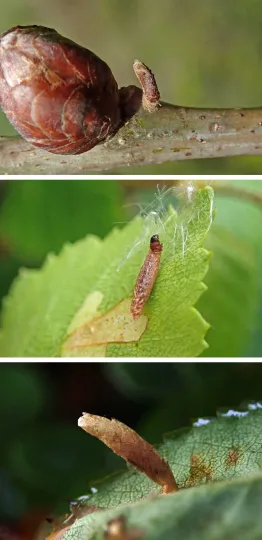
Description
How to identify
Casebearers belong to the family Coleophoridae within the order Lepidoptera. These are tiny moths, typically having a wingspan ranging from 8 to 15 mm, characterized by very narrow, fringed wings.
The insect derives its name from the larvae, which construct a portable case made of leaf tissue or excrement bound with silk. The larva remains inside this protective case throughout its development.
Adult moths are largely nocturnal and generally inconspicuous, making them difficult to detect in the field. They usually display grey, brown, or yellowish patterns that provide camouflage against tree bark.
The larvae are the primary damaging stage. They exhibit a cylindrical body shape and are often yellowish or brownish, well-adapted for feeding while protected by their cases.
The life cycle involves complete metamorphosis: egg, larva, pupa, and adult. Most species overwinter as larvae inside their cases, securely attached to branches or tree trunks.
What it damages
The primary damage is caused by the larvae, which feed on the tissues of leaves, buds, and flowers. They frequently target fruit trees such as apples, pears, cherries, and plums, as well as various forest species.
Larvae consume the internal tissues of the leaf while leaving the epidermis intact, resulting in light-colored blotches or "mines." Eventually, these patches dry up and fall out, leaving characteristic holes in the leaves.
During spring, larvae can inflict severe damage by feeding on expanding buds. This inhibits plant growth, reduces crop yields, and weakens the tree, making it susceptible to secondary infections.
When flower buds are attacked, the larvae hollow out the inside, causing the buds to wither, turn brown, and drop before they can bloom, which significantly impacts fruit production.
In nurseries, high populations of casebearers can severely stunt the development of young seedlings, sometimes leading to plant mortality under heavy pressure.
When it appears
Activity begins in early spring, synchronized with the onset of bud break. Overwintered larvae emerge from their dormant state to begin feeding on young foliage and emerging floral structures.
By early summer (June or July), the larvae finish feeding and pupate within their cases, which are usually attached to the underside of leaves or bark surfaces.
The adult flight period typically occurs in mid-summer. Females deposit eggs on the undersides of leaves, starting the next generation.
In autumn, newly hatched larvae feed on leaf tissue until the weather cools, at which point they construct winter cases and migrate to branches to enter diapause.
Most species are univoltine (one generation per year), although local environmental conditions can influence the exact timing of their developmental stages.
Signs of infestation
The most prominent sign of an infestation is the presence of light, circular or irregular "windows" or holes on the leaves caused by the larvae's feeding habits.
Small, mobile cases visible on leaf surfaces or bark are a definitive diagnostic indicator of a casebearer presence.
Premature bud drop or the failure of blossoms to open in early spring is a frequent symptom of high larval activity in the previous season and current infestation.
Careful inspection of twigs during late autumn or early spring reveals the overwintering cases attached to the bark or near bud scales.
- Light-colored patches on leaves
- Perforated leaf holes
- Deformed or hollowed buds
- Premature blossom drop
Control measures
Cultural control methods involve regular pruning and the removal of infested branches to eliminate overwintering sites, which significantly reduces the local population.
Manual collection and destruction of cases in small orchards during early spring can be effective when the infestation levels are low.
Biological treatments, such as applying Bacillus thuringiensis, can be effective if timed correctly during the early stages of larval emergence.
Chemical control using systemic insecticides is most effective when applied in early spring, targeting the larvae while they are actively feeding before full flowering.
Implementing sticky bands on tree trunks can help monitor and limit the movement of certain species, providing an additional layer of protection for the orchard.
Taxonomy
- Latin name
- Coleophora
- Order
- Lepidoptera (butterflies)
- Family
- Coleophoridae
- EPPO code
- COLESP
Discussion
No discussions yet — be the first.