
Glaucopsyche alexis
Glaucopsyche alexis
Description
How to identify
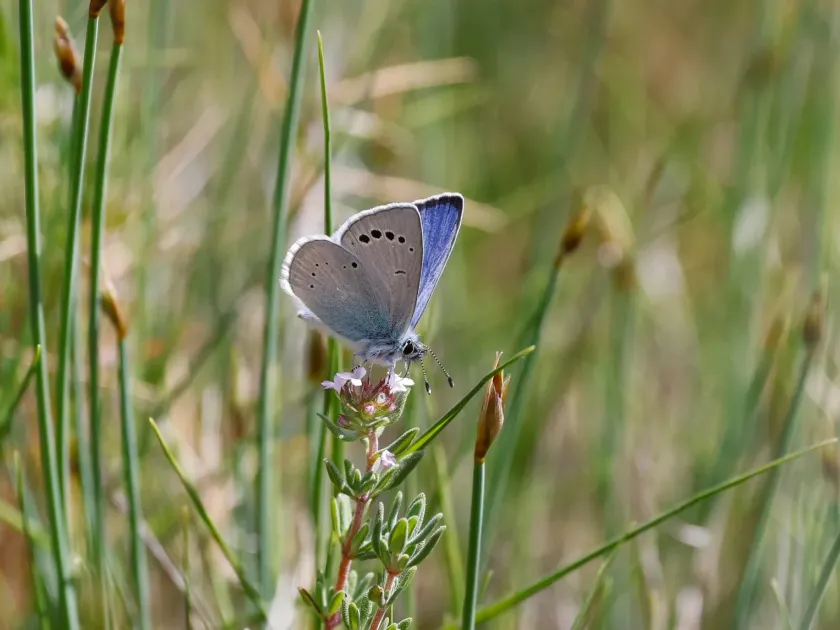
Glaucopsyche alexis, commonly known as the Green-underside blue, is a butterfly belonging to the Lycaenidae family, order Lepidoptera. It is a small butterfly with a wingspan of approximately 30 mm.
The upper side of the males' wings is bright blue with a dark border. Females typically display dark brown or grayish wings with blue dusting near the wing bases.
The underside of the wings is characterized by a pale ash-gray color with a series of small, arc-shaped black spots and a subtle blue sheen in the basal area.
The body is covered with dense hair, and the head features large eyes and club-tipped antennae. When resting, the butterfly keeps its wings tightly closed vertically.
The larvae (caterpillars) are woodlouse-shaped and green, featuring fine hairs that provide excellent camouflage against the host plant's foliage.
What it damages
The larvae primarily feed on various species of the Fabaceae family. In agricultural settings, the pest targets both wild and cultivated legumes.
Damage is most commonly reported in crops such as vetch, sweet peas, bird's-foot trefoil, sainfoin, and certain types of alfalfa. The caterpillars feed on both generative and vegetative organs.
The larvae damage buds and flowers, directly impacting the yield of leguminous crops. They also consume leaves and young shoots, stunting plant development.
At high population levels, the caterpillars damage the developing pods, rendering them unsuitable for harvest or seed production.
Beyond direct feeding damage, the wounds created by the larvae serve as entry points for secondary fungal and bacterial infections that further weaken the plant.
When it appears
The species completes one generation per year. Adult flight occurs during the spring and summer, typically ranging from late April to June, depending on the region.
Females deposit eggs singly or in small groups on the leaves, buds, or flower clusters of host plants, preferring the most succulent parts.
Embryonic development lasts approximately two weeks. Upon hatching, the caterpillar begins intensive feeding and progresses through several larval stages during the summer.
Pupation takes place in the root zone, among plant debris, or within the soil substrate. The insect overwinters as a pupa until the following spring.
The emergence of the next generation of butterflies in spring is highly dependent on temperature fluctuations and the accumulated heat units in the soil.
Signs of infestation
Visual signs of infestation include characteristic "windows" or small holes in the leaf blades caused by younger caterpillars feeding.
Inspecting flower clusters may reveal fallen or damaged buds, which have been hollowed out or eaten from the exterior by the larvae.
The presence of frass (caterpillar droppings) in the form of small dark granules on the leaves or beneath the buds is a reliable indicator of the pest's presence.
Due to their excellent camouflage, the caterpillars are often difficult to spot, requiring a careful examination of the undersides of leaves and stems.
Stunted plant growth and deformed flower spikes are additional indicators that the pest may be damaging the crop during its flowering and pod-forming stages.
Control measures
Effective control of Glaucopsyche alexis begins with deep autumn plowing, which helps destroy the pupal overwintering sites.
Implementing spatial isolation between legume fields and wild legume patches is a crucial cultural practice to reduce migration from wild habitats.
Biological insecticides based on entomopathogenic bacteria (e.g., Bacillus thuringiensis) are highly effective against early-stage larvae while being safe for beneficial insects.
Chemical intervention with broad-spectrum insecticides should be reserved for cases where the economic damage threshold is met during the budding and flowering phases.
- Mowing weeds in the Fabaceae family along field margins.
- Encouraging natural predators such as parasitic wasps and predatory bugs.
- Rotating crops to disrupt the pest's life cycle.
Taxonomy
- Latin name
- Glaucopsyche alexis
- Order
- Lepidoptera (butterflies)
- Family
- Lycaenidae
- EPPO code
- GLPSAL
Discussion
No discussions yet — be the first.