
Large Emerald
Geometra papilionaria
Description
How to identify
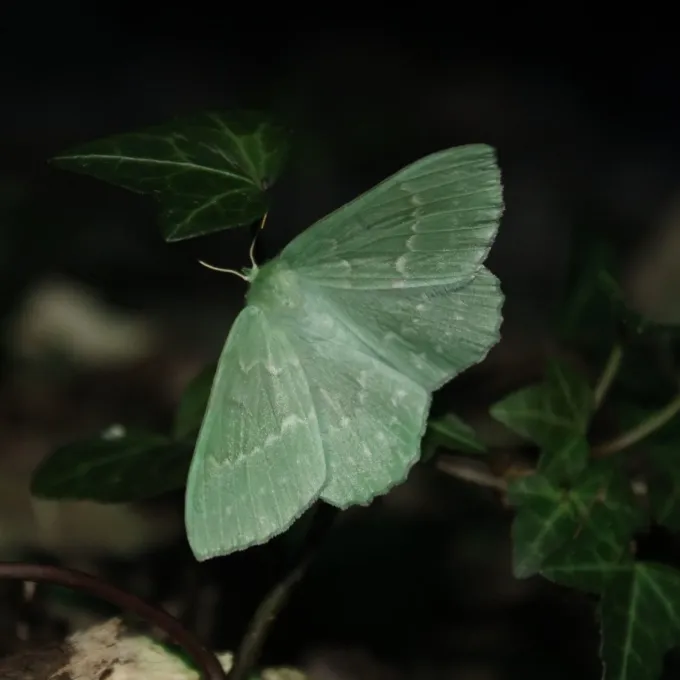
The Large Emerald (Geometra papilionaria) is a prominent moth belonging to the family Geometridae, order Lepidoptera. Adult moths feature a wingspan of 40–60 mm and are distinguished by their bright, vibrant green coloration, which may fade slightly over time.
The larvae, or caterpillars, of this species are masters of mimicry, evolving to resemble the twigs of their host plants in both shape and color. Their green bodies possess small fleshy protrusions, making them nearly impossible to detect while resting on branches.
The pupae are brown and are typically housed within folded leaves that the caterpillar secures using silken threads before transformation.
The species overwinters as a young or mid-stage larva, hiding in the crevices of tree bark or among leaf litter beneath the host plant.
Commonly found throughout the forests of Eurasia, this moth also frequently inhabits orchards and suburban gardens, occasionally causing localized damage.
What it damages
The larvae primarily feed on the foliage of various deciduous trees and shrubs, most notably birch, alder, hazel, and oak.
In garden and orchard settings, the Large Emerald can become a pest for fruit-bearing trees including apple, pear, plum, and cherry species.
Caterpillars consume leaf blades systematically, often starting from the edges, which reduces the photosynthetic capacity of the affected plants.
During outbreaks, severe defoliation can occur, leaving behind only the tough, primary veins of the leaves, which stresses the host tree significantly.
Young saplings in nurseries are particularly vulnerable, as leaf loss can severely stunt their growth and compromise their ability to withstand winter frosts.
When it appears
The flight period for adult Large Emerald moths typically occurs in the summer, generally from June through August, depending on the local climate.
This species is univoltine, meaning it completes only one generation per year, which helps keep population densities relatively stable in most environments.
The most damaging period for vegetation is in the spring, when overwintered larvae emerge to feed voraciously on developing buds and young leaves.
Pupation occurs in mid-summer, followed by the emergence of adults, who mate and lay eggs on the leaves to prepare for the next generation.
By late autumn, the new generation of larvae is born, feeding briefly before settling into their overwintering sites for the cold season.
Signs of infestation
The primary sign of infestation is irregular, crescent-shaped notches eaten out of the edges of leaf blades, leaving a jagged appearance.
The presence of leaves spun together with silk at the tips of branches suggests the larva is using these as a shelter or a protective site for pupation.
Due to their highly effective camouflage, caterpillars are rarely seen by the naked eye unless they move, making early detection a significant challenge.
Frass (larval droppings) appearing on foliage below the canopy serves as a reliable indicator that caterpillars are feeding above.
- Crescent-shaped notches on leaf edges
- Leaves bundled together with silk
- Caterpillars resembling woody twigs
- Pupae tucked inside folded leaves
Control measures
Effective orchard management begins with the manual removal of loose bark on tree trunks, which eliminates potential overwintering spots for larvae.
Clearing leaf litter from around the base of trees is an essential cultural practice to reduce the population that survives the winter.
Hand-picking caterpillars during the morning or evening hours is a highly effective control measure for smaller gardens and individual trees.
Biological control, using formulations of Bacillus thuringiensis, is recommended as it effectively targets the larvae while sparing beneficial insects and predators.
In cases of severe infestation, chemical insecticides may be applied during the early growth stage, though integrated pest management practices should always be prioritized.
Taxonomy
- Latin name
- Geometra papilionaria
- Order
- Lepidoptera (butterflies)
- Family
- Geometridae
- EPPO code
- HIPCPA
Discussion
No discussions yet — be the first.