
Flatid planthopper
Geisha distinctissima
Description
How to identify
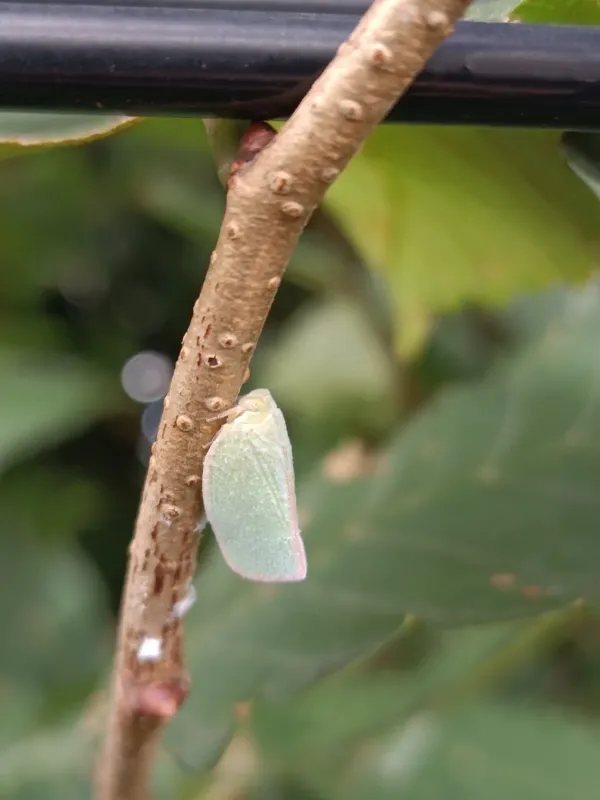
The Flatid planthopper is a member of the Flatidae family within the Hemiptera order. Adult insects exhibit a distinctive wedge-shaped body with wings held vertically over their backs, giving them a strong resemblance to a leaf.
The coloration of adults ranges from brownish-grey to ash-grey tones. Measuring approximately 7–9 mm in length, the most striking feature of the adult is its broad, triangular-shaped wings, which are notably wider than its body.
Nymphs (juveniles) look significantly different from adults. They are covered in dense, white, fluffy wax filaments produced by specialized abdominal glands, which serve as a defense mechanism against predators.
This waxy coating makes the nymphs resemble small clumps of cotton wool or lint, which are typically found clustered on the undersides of leaves or along succulent stems.
These insects are elusive and highly mobile; when disturbed, they exhibit a characteristic jump, making them difficult to capture or observe closely without disturbing the foliage.
What it damages
This pest is a polyphagous insect that attacks a wide variety of agricultural crops. Vineyards, fruit trees such as apples and peaches, and various ornamental shrubs are particularly susceptible to heavy infestations.
The planthopper feeds by piercing and sucking sap from young shoots, leaf petioles, and fruit stalks. This constant loss of nutrients severely weakens the plant and slows down its overall growth and development.
Significant damage occurs to fruit and flower clusters, leading to reduced yields and inferior product quality. Heavily infested plants often lose turgor pressure and may drop their leaves prematurely.
During feeding, the insects secrete honeydew—a sugary substance that attracts sooty mold. This fungus grows over the surface of the leaves, forming a black layer that blocks sunlight and inhibits photosynthesis.
Beyond direct feeding damage, the Flatid planthopper is a known vector for various phytoplasmas and plant viruses, which can cause long-term pathological issues in host plants.
When it appears
The life cycle of the Flatid planthopper typically consists of a single generation per year. The pest overwinters primarily in the egg stage, with females laying eggs into the bark crevices of young twigs.
In spring, as temperatures rise, the eggs hatch into nymphs. This period usually coincides with the active vegetative growth phase of most garden crops, providing the larvae with an immediate food source.
The active feeding stage of the nymphs lasts for several weeks. During this time, they are most susceptible to contact insecticides, provided the treatment is applied before they develop too much protective wax.
The transition to the adult stage occurs in late summer. Adults become very active and fly readily between plants, allowing them to spread quickly throughout orchards or garden landscapes.
By autumn, the females deposit their eggs for the next overwintering cycle. Understanding these phenological timing markers is essential for farmers and gardeners to schedule effective pest control interventions.
Signs of infestation
The first sign of an infestation is the appearance of white, cotton-like masses on leaves and stems. These clusters are the hallmark of nymph activity as they congregate and feed.
Visible sticky residues, known as honeydew, on the upper surface of leaves directly below insect clusters serve as a secondary indicator that a population is actively feeding above.
A further progression of the infestation is the development of sooty mold—a black, powdery fungus that thrives on the sugary honeydew, making the plant look dirty and significantly reducing its aesthetic value.
Distortion of young, tender shoots and leaf curling are common symptoms caused by the toxic saliva injected by the insect while feeding, which disrupts normal plant tissue development.
- White waxy tufts on the underside of leaves.
- Sticky honeydew patches on foliage.
- Black sooty mold growth on leaves and stems.
- Puncture marks on stems and leaf stalks.
- Adult planthoppers jumping when branches are shaken.
Control measures
Controlling the Flatid planthopper requires an integrated approach that combines cultural and chemical practices. Pruning and destroying heavily infested branches during the dormant season can help reduce the overwintering egg population.
The use of systemic and contact insecticides is most effective when targeted at the early nymph stages. It is crucial to apply these products before the nymphs grow their thick, protective waxy layer.
Biological control agents, such as specialized parasitic wasps (e.g., Dryinus species), play a significant role in keeping planthopper populations in check and should be encouraged where possible.
Regular monitoring using yellow sticky traps is a recommended practice to detect the arrival of adults and determine the best timing for protective measures to prevent large-scale outbreaks.
In professional agriculture, rotating insecticides with different modes of action is vital to prevent the development of resistance. Additionally, maintaining good canopy airflow through proper pruning helps create an environment less favorable for the pest.
Taxonomy
- Latin name
- Geisha distinctissima
- Order
- Hemiptera (bugs, aphids, leafhoppers)
- Family
- Flatidae
- EPPO code
- GEISDI
Discussion
No discussions yet — be the first.