
White planthopper
Geisha
Description
How to identify
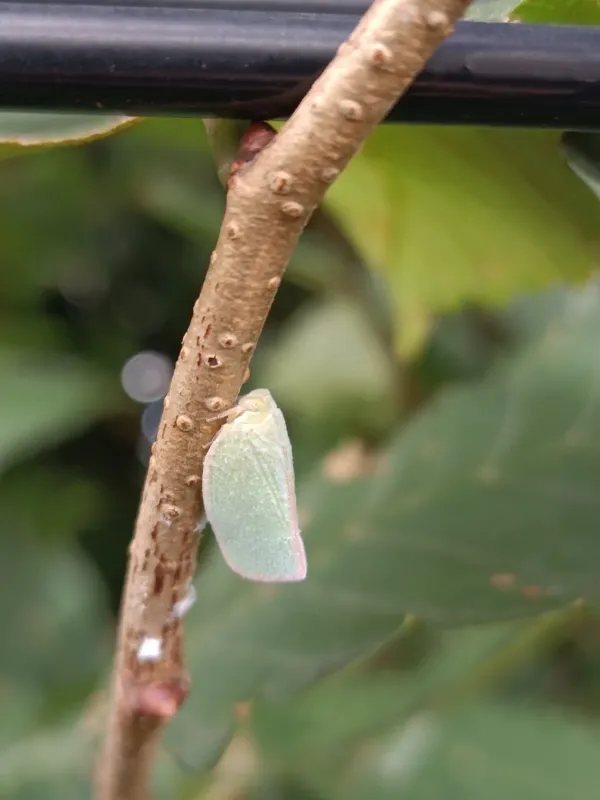
The white planthopper, scientifically known as Metcalfa pruinosa, belongs to the family Flatidae and the order Hemiptera. Adult insects are roughly 7–8 mm long, characterized by their grayish-white, waxy appearance.
The nymphs are distinct from the adults; they are covered in a dense, fluffy white waxy secretion that resembles cotton or spider webs. This coating protects them from predators and prevents desiccation.
Adult planthoppers are highly active; they can jump and fly quickly when disturbed. They are typically found on the undersides of leaves, making them difficult to spot during initial inspections.
The life cycle consists of the egg stage, five nymphal instars, and the adult stage. The species typically has one generation per year, although high fecundity levels allow for rapid population growth.
Overwintering occurs at the egg stage, with eggs laid under the bark of woody stems and branches. This survival strategy makes the species highly adaptable to various climatic zones.
What it damages
As a polyphagous pest, the white planthopper attacks a wide variety of plants, including grapes, citrus, apples, and numerous ornamental shrubs. Its broad host range makes it a significant agricultural threat.
Planthoppers feed by sucking sap from plant tissues. This nutrient loss results in stunted growth, leaf curling, and premature leaf drop, which collectively weaken the plant's overall health and vigor.
During feeding, they excrete honeydew—a sugary substance that accumulates on leaves and fruits. This promotes the growth of sooty mold, which blocks photosynthesis and significantly reduces the crop's market value.
Severe infestations can lead to a drastic reduction in yield and can make plants more susceptible to secondary infections, including viral diseases transmitted by the insects themselves.
In ornamental gardens and nurseries, the aesthetic damage caused by sooty mold and foliage distortion can result in substantial economic losses for growers and landscapers.
When it appears
Nymphs typically emerge from overwintering eggs in late spring, around May, when temperatures become consistently warm. Early detection at this stage is crucial for control.
The nymphal development phase lasts through early summer. By mid-summer, specifically July and August, adult planthoppers become the dominant stage, reaching their peak activity levels.
In late summer and early autumn, female planthoppers begin laying eggs to ensure the next generation survives the winter. During this time, they become less mobile as they focus on oviposition.
Climatic conditions play a major role in population dynamics; mild, humid springs are particularly conducive to higher survival rates for emerging nymphs.
Regular monitoring of plants from early spring through autumn is essential for identifying the presence of this pest before populations reach damaging levels.
Signs of infestation
The most visible sign of infestation is the presence of white, cotton-like masses on stems and leaves. These are colonies of nymphs protected by their waxy secretions.
Sticky honeydew on the leaves, often accompanied by the development of black sooty mold, is a clear indicator that a planthopper colony is active nearby.
Leaves may appear distorted, chlorotic, or wilted without any obvious signs of fungal or bacterial pathogens, pointing toward damage from sap-sucking pests.
Disturbing a branch often reveals the presence of adult planthoppers as they jump or fly away, providing a quick way to confirm an infestation in a garden setting.
An increased presence of ants on plants is another common sign, as ants are frequently attracted to the honeydew produced by the planthoppers.
Control measures
Effective control of Metcalfa pruinosa requires an integrated approach that combines cultural, mechanical, and chemical strategies to manage population density.
Sanitation practices, such as pruning and destroying heavily infested branches during the dormant season, can significantly reduce the number of overwintering eggs.
Chemical control is most effective when targeted at the nymphal stages before they develop a thick waxy coating. Systemic insecticides are generally the preferred method for managing established populations.
- Application of neonicotinoid or pyrethroid insecticides.
- Use of yellow sticky traps for monitoring and adult population reduction.
- Biological control through the encouragement of native predators and parasitoids.
Maintaining plant health through balanced fertilization and proper irrigation helps minimize the stress that makes plants more attractive to sap-sucking pests.
Taxonomy
- Latin name
- Geisha
- Order
- Hemiptera (bugs, aphids, leafhoppers)
- Family
- Flatidae
- EPPO code
- GEISSP
Discussion
No discussions yet — be the first.