
Japanese seed bug
Gastrodes japonicus
Description
How to identify
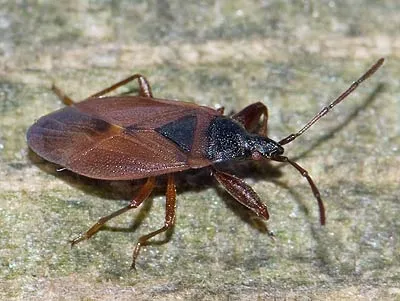
The Japanese seed bug (Gastrodes japonicus) belongs to the order Hemiptera and the family Rhyparochromidae. It is a specialized pest adapted to feeding on coniferous trees.
Adult bugs are characterized by their flattened body shape, which allows them to hide effectively between cone scales and within bark fissures during the daytime.
The coloration of the insect typically mimics the texture and shade of conifer bark and dry needle litter, providing excellent camouflage against predators.
The developmental stages include the egg, five nymphal instars, and the adult stage, with each stage requiring specific microclimatic conditions.
These insects are highly specialized, often showing a distinct preference for specific species of pine or related coniferous genera within their habitat range.
What it damages
Gastrodes japonicus primarily feeds on the developing seeds of coniferous trees, piercing the cones to extract essential nutrients from the seed kernels.
This feeding activity often leads to seed abortion, premature cone drop, and a significant reduction in the viability of the harvested seed crop.
Besides seed damage, nymphs and adults may also feed on the sap of young needles, which can cause localized yellowing and premature needle fall.
In forest nurseries and orchards, this pest can cause economic losses by reducing the quality and quantity of seeds intended for reforestation programs.
Severe infestations weaken the trees, making them more susceptible to secondary pests and various environmental stressors throughout the growing season.
When it appears
The activity of the Japanese seed bug begins in early spring, as temperatures rise and the insects emerge from their overwintering sites.
Adults become active as they seek suitable trees for mating and laying eggs, coinciding with the early development of young cones on the host plants.
The summer months represent the peak feeding period for both nymphs and adults, as the developing cones provide a rich and easily accessible food source.
By late autumn, as the climate turns colder, the insects seek shelter in leaf litter or under the bark to enter diapause and survive the winter.
Regional climatic factors play a critical role in the insect's life cycle, potentially shifting the timing of emergence and peak activity periods.
Signs of infestation
The most visible sign of an infestation is the premature drop of green or brown cones under the canopy of the affected tree during the summer.
Close inspection of the fallen cones often reveals minute puncture marks on the scales, indicating where the bug's rostrum has pierced the tissue.
- Yellowing of needle tips on growing branches.
- Small fecal spots left on the foliage surface.
- Hollow or damaged seeds found when opening cones.
- Presence of the bugs themselves hidden in cone crevices.
- Noticeable thinning of the tree canopy in highly infested areas.
Control measures
The primary control strategy involves the systematic removal and destruction of fallen cones and debris to reduce the overwintering population.
In cases of high pest pressure, applying approved systemic insecticides during the early stages of nymphal development can effectively curb the infestation.
Integrated pest management (IPM) practices, such as maintaining healthy tree vigor through proper irrigation and soil management, help increase tree resilience.
It is crucial to monitor the population levels using pheromone traps or visual inspections to ensure the correct timing for any chemical intervention.
Rotating insecticide types is recommended to prevent the development of pesticide resistance in the bug population over long-term management cycles.
Taxonomy
- Latin name
- Gastrodes japonicus
- Order
- Hemiptera (bugs, aphids, leafhoppers)
- Family
- Lygaeidae
- EPPO code
- GASTJA
Discussion
No discussions yet — be the first.