
Spruce cone bug
Gastrodes abietum
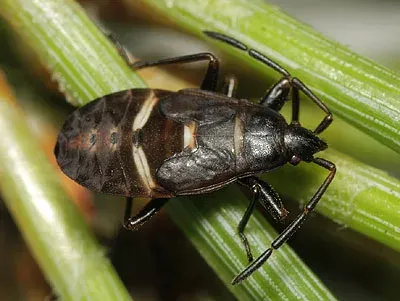
Description
How to identify
The spruce cone bug (Gastrodes abietum) is a small insect belonging to the family Rhyparochromidae within the order Hemiptera.
Adult insects are characterized by a flattened, elongated body typically measuring 6 to 8 mm in length, with a dark brown or reddish-brown coloration.
They possess specialized mouthparts designed for piercing plant tissues, which they use to extract nutrients from their host plants.
The physical structure of this species allows it to navigate easily within the tight spaces of spruce cones and under the protective bark of trees.
The life stages consist of eggs, multiple nymphal instars, and adults, with the nymphs appearing as miniature versions of the mature insects.
What it damages
The spruce cone bug is primarily a pest of spruce trees (Picea spp.), specifically targeting the reproductive structures of the host.
By piercing the scales of developing cones, the bugs feed on the developing seeds and the sap within the cone scales.
This feeding activity often leads to the deformation of cones, premature drying, and a significant reduction in seed viability and yield.
In addition to cones, nymphs and adults may occasionally feed on needles, although this causes less impact compared to cone damage.
Repeated or severe infestations can severely hamper natural regeneration processes in spruce forests and plantations.
When it appears
Adults overwinter in sheltered locations, such as forest litter, bark crevices, or protected areas near the base of the tree.
Emergence occurs in the spring, triggered by rising temperatures, at which point the bugs migrate to the canopy to begin feeding and reproduction.
The primary period of nymphal development and active feeding occurs during the summer months, aligning with the cone maturation cycle.
The population reaches its peak activity during warm, dry summers, which favor the development and survival of the offspring.
As temperatures drop in the autumn, the insects relocate to their overwintering sites to survive the cold season.
Signs of infestation
Symptoms of an infestation include the premature browning and drying of cones while they are still attached to the branches.
Upon closer inspection, one may observe small puncture marks on the cone scales, which are characteristic of the feeding mechanism.
Deformed, stunted, or improperly developed cones are common visual cues that suggest the presence of the spruce cone bug.
The presence of fine, dark excrement pellets inside the cone scales is a strong indicator of an active or recent bug colony.
In cases of heavy infestation, a noticeable decrease in the quantity of viable seeds produced by the stand is observed.
Control measures
Integrated pest management strategies are essential to mitigate the impact of this pest in both natural forests and commercial plantations.
Sanitation practices, such as removing fallen infested cones and pruning heavily damaged branches, can significantly reduce local populations.
Chemical control using systemic insecticides is generally reserved for high-value seed orchards where maximizing seed yield is critical.
- Regular monitoring of spruce cones during the early growth stages.
- Preservation of natural bird habitats to encourage biological control.
- Application of environmentally responsible insecticides when necessary.
Maintaining tree health through proper thinning and site management reduces the attractiveness of the stands to the bugs.
Taxonomy
- Latin name
- Gastrodes abietum
- Order
- Hemiptera (bugs, aphids, leafhoppers)
- Family
- Lygaeidae
- EPPO code
- GASTAB
Discussion
No discussions yet — be the first.