
Gasteracantha
Gasteracantha
Description
How to identify
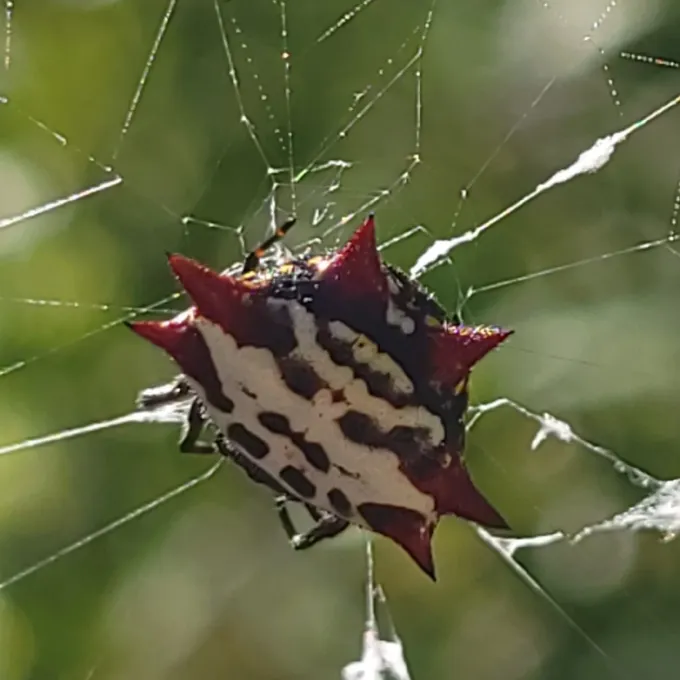
Gasteracantha is a genus of spiders belonging to the Araneidae family, commonly known as spiny orb-weavers due to the distinct appearance of their abdomen.
The defining characteristic of these spiders is the hardened abdomen, which is equipped with six prominent, sharp-looking spines, giving it a unique geometric shape.
Females are significantly larger than males and are the ones typically observed sitting in the center of their large, circular webs.
Their coloration is often bold, featuring white, yellow, and black patterns which serve as a warning to potential predators in the wild.
These spiders are primarily nocturnal and reside in tropical and subtropical regions, playing an active role as predators in garden ecosystems.
What it damages
Gasteracantha is not a plant pest; it does not consume plant tissues, sap, or foliage, meaning it poses no direct threat to agricultural productivity.
The only impact these spiders have on plants is physical, as their large webs can accumulate dust or potentially shade small leaves if they are particularly dense.
In most cases, the presence of these spiders is highly beneficial because they feed on a variety of small flying insects, many of which are crop pests.
They act as natural biological control agents, helping to keep populations of harmful insects in check without the need for synthetic chemicals.
There is no record of Gasteracantha causing any form of physiological damage to crops or ornamental plants in any commercial setting.
When it appears
The life cycle and activity of Gasteracantha are heavily influenced by temperature and humidity, with peak activity occurring during warmer months.
In tropical climates, these spiders can remain active throughout the year, provided that food sources and appropriate habitat structures are available.
Reproductive phases and the construction of new, large webs are most frequent during periods of abundant insect activity.
Seasonal changes often dictate the lifespan of individual spiders, with many populations peaking during the rainy season or the onset of warmer weather.
Young spiderlings often disperse during favorable weather conditions, using silk threads to travel on the wind, a process known as ballooning.
Signs of infestation
The most visible sign of Gasteracantha presence is the characteristic orb-shaped web stretched between tree branches, bushes, or garden structures.
Finding the adult female spider resting in the center of the web confirms the identity of the organism within the garden.
Egg sacs attached to leaves or twigs in the vicinity of the web are clear indicators of a long-term presence of the spider population.
Remnants of various insects caught in the web indicate that the area is being used as a hunting ground by the predator.
The total lack of necrotic spots, insect bite marks, or wilting on the host plant is a key indicator that the spider is not a threat to the plant's health.
Control measures
No chemical control or pesticide application is necessary or recommended, as these spiders do not cause damage to plants and are valuable predators.
If the web is located in an inconvenient spot, such as near a path or a doorway, it can be easily removed by hand or with a broom without harming the environment.
Sustainable agriculture practices emphasize the protection of such arachnids as they are part of a balanced ecosystem and act as natural pest suppressors.
Management is largely unnecessary; however, regular pruning of overgrown garden areas can naturally limit the space available for web construction.
Promoting biodiversity in the garden helps maintain a healthy population of beneficial predators, which ultimately aids in the protection of the crops.
Taxonomy
- Latin name
- Gasteracantha
- Family
- Araneidae
- EPPO code
- GASCSP
Discussion
No discussions yet — be the first.