
Bean lace bug
Gargaphia subpilosa
Description
How to identify
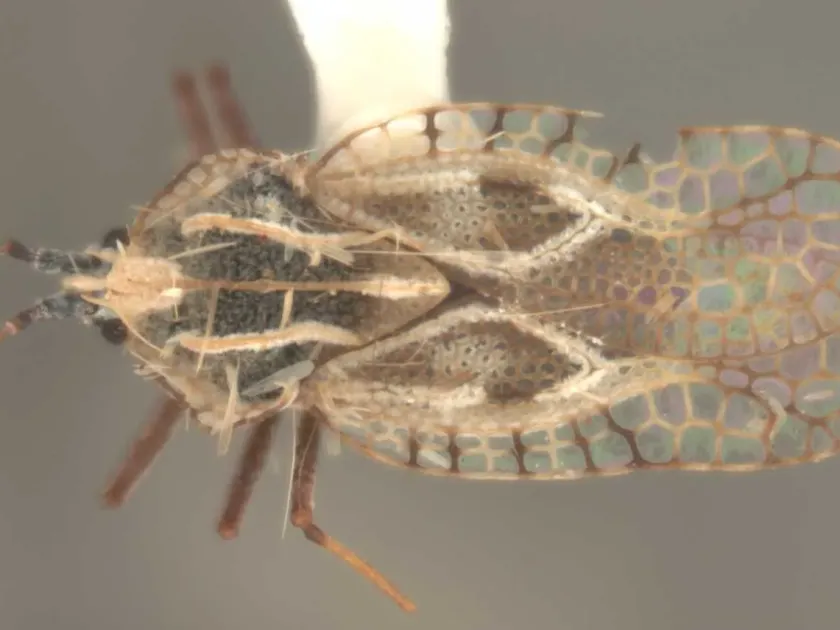
The Bean lace bug (Gargaphia subpilosa) is a member of the Tingidae family, characterized by its distinctive reticulated, lace-like appearance of the pronotum and hemelytra.
Adults are small, generally measuring around 3–4 mm in length. Their flattened body shape and brownish, lace-like wings allow them to blend in with the leaf surface.
Nymphs are significantly different from adults, often appearing darker and protected by an array of spines or hairs, which serves as a defense against natural enemies.
They exhibit incomplete metamorphosis. Females typically deposit their eggs in organized batches on the underside of leaves, often covering them with a protective secretion.
These insects are social in their juvenile stages, feeding in clusters, which makes the damaged leaf tissue appear uniform in its pattern of discoloration.
What it damages
This pest primarily attacks leguminous crops, with significant economic impact on soybeans, common beans, and various forage legumes.
Both adults and nymphs feed by piercing the plant tissues and extracting cell sap, which disrupts the plant's photosynthetic capacity and weakens its general vigor.
The feeding activity creates characteristic stippling or chlorotic spots on the upper leaf surface, which eventually merge to cover larger areas of the foliage.
Heavy infestations result in severe leaf yellowing, necrosis, and premature defoliation, which directly leads to reduced pod set and smaller seed size.
Furthermore, the physical damage created by the mouthparts provides entry points for various phytopathogens, potentially leading to secondary infections in the crop.
When it appears
The Bean lace bug becomes active in the spring when temperatures rise, at which point overwintering adults colonize young legume crops.
Multiple generations occur throughout the growing season. In warmer climates, the population can increase exponentially within a few weeks due to short generation times.
Peak infestation levels usually coincide with the reproductive stages of the host plants, specifically when the crop is flowering or filling pods.
As the season progresses toward autumn, environmental cues trigger adults to seek sheltered overwintering sites, such as leaf litter or plant debris.
Dry and hot weather conditions often favor population explosions, as host plants under water stress are more susceptible to feeding damage.
Signs of infestation
Early identification is possible by observing the upper leaf surface for tiny, pale chlorotic spots that appear as white or yellow stippling.
Inspecting the underside of the leaf is the most reliable way to confirm the presence of the pest, where colonies, eggs, and dark excrement droplets are visible.
As the infestation progresses, leaves lose their natural green color, develop a dry, papery texture, and may eventually drop from the plant prematurely.
- Stippled chlorotic spots on leaves.
- Presence of colonies and dark frass on the underside of leaves.
- Premature yellowing and drying of lower leaves.
- Reduced vigor and delayed development of the crop.
- Shed exuviae (cast-off skins) of nymphs on leaf surfaces.
Regular scouting is essential, especially in the lower canopy, where these pests prefer to congregate and feed undisturbed.
Control measures
Integrated Pest Management (IPM) strategies for the Bean lace bug focus on crop rotation to break the life cycle and reduce overwintering populations.
Effective sanitation, including the removal of weeds and crop residues after harvest, is crucial in limiting the survival of the pest during the off-season.
Biological control agents, such as predatory bugs, lacewings, and parasitic wasps, play a vital role in maintaining pest populations below economic thresholds.
Chemical control should be considered only when scouting confirms that population densities are reaching levels that threaten yield potential.
Selective insecticides should be preferred to preserve natural predator populations, ensuring a more sustainable long-term approach to controlling the pest.
Taxonomy
- Latin name
- Gargaphia subpilosa
- Order
- Hemiptera (bugs, aphids, leafhoppers)
- Family
- Tingidae
- EPPO code
- GARGSU
Discussion
No discussions yet — be the first.