
Eggplant lace bug
Gargaphia solani
Description
How to identify
The eggplant lace bug Gargaphia solani belongs to the Tingidae family, commonly known as lace bugs. The name derives from the ornate, reticulated, lace-like appearance of their wings and pronotum.
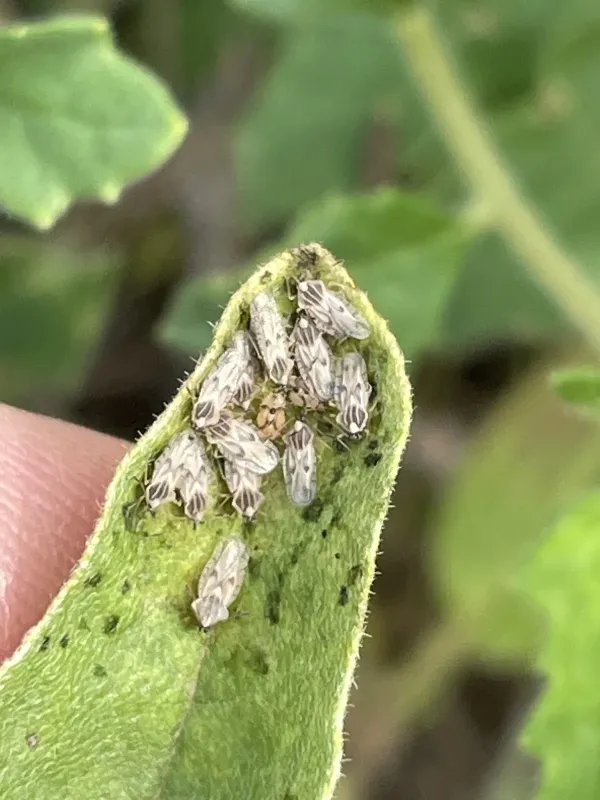
Adult bugs are small, typically measuring between 3 and 4 mm in length. Their bodies are flattened and exhibit a coloration that ranges from brownish to gray, providing excellent camouflage against the foliage.
The nymphs go through several developmental stages (instars) before reaching maturity. They often congregate in groups on the underside of leaves, where they remain throughout their development.
A distinctive feature of these insects is the complex mesh-like structure on their wings. This lattice pattern is a reliable diagnostic characteristic used to identify the species in the field.
Their life cycle is highly specialized, occurring almost exclusively on solanaceous hosts. They spend their entire life cycle on these plants, moving through the egg, nymph, and adult stages in a relatively short period.
What it damages
The primary hosts for this pest include plants within the Solanaceae family, such as eggplants, potatoes, tomatoes, and certain weeds like the horsenettle (Solanum carolinense).
The lace bug causes damage by feeding on plant sap. Both nymphs and adults use their piercing-sucking mouthparts to penetrate the leaf tissue, leading to the extraction of essential plant fluids.
Heavy infestations can significantly affect the commercial yield of crops. Plants may exhibit stunted growth, reduced vigor, and premature leaf drop, which ultimately weakens the overall harvest potential.
In addition to sap loss, the feeding process can cause structural damage to the leaf epidermis, which might lead to secondary infections or the spread of other plant pathogens within the field.
If the population is not monitored, the cumulative damage caused by multiple generations can lead to widespread chlorosis and necrosis across the leaf canopy, severely impacting plant health.
When it appears
Activity of the eggplant lace bug is highly dependent on temperature. These insects become active as soon as the weather warms up, typically when temperatures consistently exceed 15-20 degrees Celsius.
Early in the season, adults emerge from overwintering sites and colonize young solanaceous crops. This period is critical for the establishment of the first generation of the pest.
During the peak of summer, high temperatures and dry conditions accelerate the development cycle, allowing for rapid population growth and multiple generations within a single season.
Adults overwinter in protected sites, including plant debris, leaf litter, or the upper layer of soil, allowing them to survive winter temperatures until the next growing season begins.
As autumn approaches and temperatures drop, the bugs enter a state of diapause, seeking refuge in debris or protected areas to endure the cold months ahead.
Signs of infestation
The first indicator of an infestation is the appearance of small, whitish, or chlorotic spots on the upper surface of the leaves, corresponding to the feeding sites on the underside.
Inspecting the underside of the leaf reveals adults, nymphs, and characteristic dark, sticky spots of excrement. The affected foliage often takes on a marbled or bleached appearance.
Severe infestations cause the leaves to wilt, curl, and eventually dry out prematurely. This leads to a decline in photosynthetic efficiency and significant stress for the plant.
- Small white or yellowish stippling on the upper leaf surface.
- Dark excrement spots on the underside of leaves.
- Visible colonies of nymphs on leaf undersides.
- Leaf curling and yellowing.
- Premature defoliation of the crop.
Regular scouting, particularly targeting the underside of leaves, is essential to identify the presence of these pests before they reach levels that necessitate intensive intervention.
Control measures
Cultural management is the first line of defense, involving the removal of host weeds from the field perimeter to eliminate potential reservoirs for the pest.
Sanitation practices after harvest are crucial, including the thorough removal and destruction of crop residues where adults tend to congregate for overwintering.
Biological control agents, such as predatory insects or entomopathogenic fungi, can be encouraged to help regulate lace bug populations naturally within the ecosystem.
Chemical control should be employed if infestation thresholds are reached. Systemic insecticides are generally the most effective, provided they are applied to cover the underside of the foliage.
It is important to practice pesticide rotation to prevent the development of resistance and to strictly follow the pre-harvest intervals to ensure the safety and quality of the final crop.
Taxonomy
- Latin name
- Gargaphia solani
- Order
- Hemiptera (bugs, aphids, leafhoppers)
- Family
- Tingidae
- EPPO code
- GARGSO
Discussion
No discussions yet — be the first.